Steel Hub

For project managers, corrosion protection is not a finishing detail to be confirmed just before steel erection. It is a design, procurement, fabrication, and quality-control decision that shapes the service life of a steel construction project long after the site team has moved on.
A structural frame may look complete and sound at handover, yet early corrosion can begin in places that are difficult to see: a poorly prepared flange edge, an unsealed hollow section, a bolted connection that retains water, or a damaged coating left unrepaired after transport. The resulting cost is rarely limited to repainting. Access restrictions, operational shutdowns, safety concerns, and disputes over responsibility can turn a small specification gap into a major lifecycle issue.
The practical question is not simply, “Which coating is best?” It is: Which protection system is appropriate for this structure, this environment, this fabrication route, and this owner’s maintenance capacity? A reliable assessment connects all four.
Start with exposure, not with a preferred coating
Steel does not corrode at the same rate everywhere. A warehouse frame in a dry inland location faces a very different risk profile from a coastal logistics terminal, a wastewater plant, a chemical processing platform, or a bridge exposed to de-icing salts. Before comparing paint systems, galvanizing, or duplex protection, define the actual service environment in detail.
Useful questions for the project team include:
- Will the steel be indoors, outdoors, buried, immersed, or exposed to frequent wetting and drying?
- Is the site near the sea, heavy industry, rail traffic, chemical emissions, or salt-treated roads?
- Will condensation form inside roof spaces, enclosed members, or unheated buildings?
- Are there local conditions that trap moisture, such as splash zones, poor drainage, leaking joints, or sheltered areas with limited airflow?
- Is the steel subject to abrasion, impact, elevated temperatures, ultraviolet exposure, or chemical contact?
- What design working life is expected, and how feasible will future maintenance be?
Standards such as ISO 12944 provide a useful framework for classifying atmospheric and immersion environments. They should guide the discussion, but they should not replace site-specific judgement. For example, two facilities may both be classified as highly corrosive, while one has easy access for routine maintenance and the other has steelwork installed above active process equipment. The latter may justify a more durable and more forgiving protection strategy even if the nominal exposure category is the same.
Project managers should also separate general atmospheric exposure from localized “hot spots.” The underside of a canopy, the base of a column, the interior of a box section, and the edge of a roof drainage line can each behave differently. A specification that treats the entire steel package as one uniform condition often overlooks where failures begin.
Choose the protection route around lifecycle risk
Most steel construction projects evaluate three broad routes: protective paint or coating systems, hot-dip galvanizing, and duplex systems that combine galvanizing with paint or powder coating. Each can perform well when correctly matched to the environment and fabrication details. None is automatically the right answer in every situation.
A lower initial cost can be attractive during tender review, particularly when several packages compete for budget. But the lowest-cost system is not necessarily the lowest-risk choice. If access equipment, traffic closures, production interruptions, or confined-space work will make recoating difficult later, the project should place greater weight on durability and maintainability. The most economical decision is often the one that avoids a premature intervention, not the one with the thinnest initial specification.
For coating systems, assess more than the generic description of “epoxy paint” or “zinc-rich primer.” A complete system should state the substrate preparation grade, primer, intermediate coat where required, topcoat, dry film thickness for each layer, total nominal thickness, stripe-coat requirements, curing conditions, and repair method. In aggressive external exposure, ultraviolet resistance of the finish coat can matter as much as the barrier properties of the underlying layers.
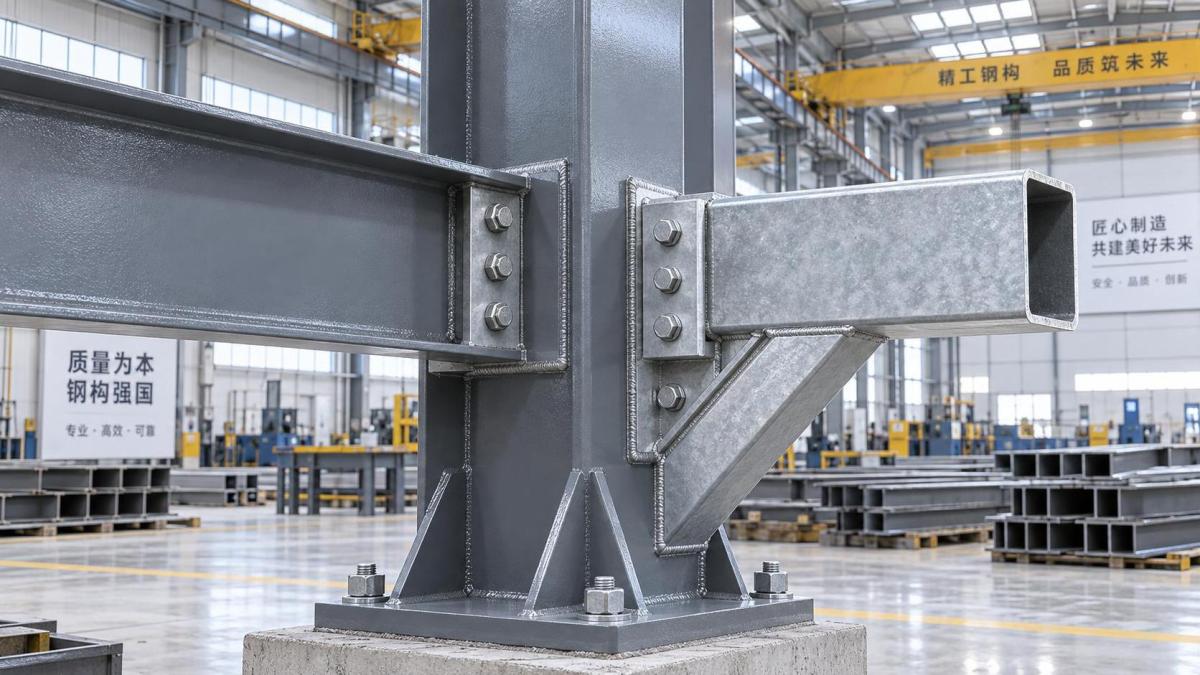
For galvanizing, check whether the steelwork can be safely and effectively dipped. Hollow sections require correctly positioned vent and drain openings. Deep pockets, overlapped plates, narrow gaps, and enclosed cavities can create safety hazards or prevent full coating coverage. These are not minor shop-drawing issues; they influence both corrosion performance and fabrication acceptance.
Surface preparation is the point where many good specifications fail
Even a well-selected protective coating cannot compensate for inadequate substrate preparation. Mill scale, rust, salts, oil, welding residue, sharp edges, and surface defects all reduce adhesion or create early weak points. The project specification should state preparation requirements in measurable terms rather than relying on vague instructions such as “clean steel thoroughly.”
For blast-cleaned structural steel, the required cleanliness grade should be identified according to the governing standard, alongside surface profile expectations where relevant. Surface profile affects how a coating anchors to the steel; too little profile can reduce adhesion, while excessive roughness may make it difficult to achieve the intended film thickness over peaks. If steel is stored near marine air or contaminated during fabrication, soluble salt testing may also be appropriate before coating begins.
Edges deserve special attention. Coatings naturally pull away from sharp corners, leaving reduced thickness exactly where damage and corrosion are likely to start. Specify edge rounding, weld-spatter removal, and stripe coating on edges, welds, bolt areas, and complex geometries. A stripe coat is not decorative extra work. It is a targeted control measure for locations where spray application alone may not build an adequate film.
Do not overlook fabricated details that make corrosion protection harder than it needs to be. Crevices between lapped plates, intermittent welds that allow moisture entry, upward-facing channels, and unsealed tubular sections can all create corrosion traps. A short design review between the structural engineer, fabricator, corrosion specialist, and coating contractor can eliminate many of these problems before steel reaches the shop floor.
Translate the specification into inspection hold points
“Apply in accordance with the manufacturer’s instructions” is not a complete quality plan. For a project manager, the more useful document is an inspection and test plan that identifies what must be checked, who records it, and when work must stop until acceptance is confirmed.
A sensible sequence usually includes incoming steel condition, fabrication completion, weld and edge preparation, pre-cleaning, abrasive blasting or mechanical preparation, environmental checks before application, wet and dry film thickness measurements, curing verification, visual examination, and final defect repair. For critical systems, adhesion testing, holiday detection, or other additional checks may be specified based on the coating type and service condition.
Environmental control is particularly important for shop and site painting. Steel temperature should be evaluated in relation to dew point, not merely ambient air temperature. A surface can appear dry yet be close enough to condensation conditions to compromise adhesion. Humidity, ventilation, dust, overspray, and curing time between coats also require active control. If the programme forces coating work into unsuitable weather, a faster schedule can quietly create a longer-term defect.
Inspection records should be traceable by steel member, area, batch, or coating lot as appropriate. This matters later if damage is found after delivery or erection. Clear records help distinguish between a fabrication issue, an application issue, transit damage, or site damage caused by another trade.
Questions to ask during a factory or site inspection
- Has the approved coating system been matched to the correct exposure zone and steel item?
- Are welds complete, spatter removed, edges treated, and inaccessible corrosion traps addressed?
- Was the specified surface preparation actually achieved immediately before coating?
- Were temperature, humidity, and dew-point conditions recorded at the time of application?
- Do dry film thickness readings cover edges, welds, difficult geometries, and not just broad flat areas?
- Are damaged areas, runs, pinholes, thin spots, and contamination repaired using an approved procedure?
- Have bolts, field welds, cut edges, and handling marks been included in the final touch-up plan?
Coordinate corrosion protection with procurement and erection
Corrosion protection is often fragmented across purchase orders: structural sections come from one supplier, fabrication from another, galvanizing or coating from a specialist, and erection from a site contractor. Without clear responsibility boundaries, essential tasks can be missed. A common example is a galvanized member that is cut or welded on site after delivery, leaving exposed steel without a defined repair method.
Procurement documents should therefore identify the required product standard, coating system, acceptance criteria, documentation, and responsibility for repairs. For steel products such as plate, hollow sections, beams, channels, pipe, and long products, the chosen protection route should be compatible with both the supplied material form and the downstream fabrication process. Storage and transport conditions should also be considered. Fresh galvanized steel, for instance, can develop wet-storage staining if tightly stacked in damp conditions without drainage and airflow.
At erection stage, avoid assuming that minor coating damage is harmless. Small scratches may be tolerable in some zinc-coated applications because of zinc’s sacrificial behaviour, but the extent, location, and exposure conditions still matter. Deep gouges, damage at joints, and bare areas on high-performance paint systems should be assessed and repaired promptly. Site crews need a practical repair kit, approved materials, compatible colour references where relevant, and a defined inspection sign-off.
Assess maintainability before approving the final system
Durability is not only a laboratory or specification issue. It is also about whether the owner can inspect and maintain the steelwork in real operating conditions. Ask where future access will come from. Can personnel safely reach the underside of elevated platforms? Will a bridge require lane closures? Is the steel inside a process area where cleaning and recoating would interrupt production? Are there areas concealed behind cladding, insulation, or equipment?
These questions frequently change the decision. Accessible steel in a moderately corrosive environment may be well served by a conventional paint system with planned maintenance. Steel that will be difficult, hazardous, or expensive to reach may warrant galvanizing or a duplex solution, even when the initial investment is higher.
A maintenance plan should identify inspection intervals, likely damage zones, cleaning requirements, repair materials, and triggers for intervention. It does not need to predict every future defect. Its purpose is to ensure that corrosion protection remains an operating discipline rather than a forgotten line item in the construction budget.
A practical approval test for project managers
Before releasing a corrosion protection package for a steel construction project, test the proposal against five simple conditions: it matches the real exposure; it can be fabricated without creating drainage, venting, distortion, or access problems; its surface preparation and application requirements are measurable; its quality can be inspected and documented; and its future maintenance assumptions are realistic.
If any of those conditions is unclear, the system is not yet ready for approval. Revisit the drawings, exposure map, coating data, galvanizing details, and inspection plan while changes are still inexpensive. Corrosion protection performs best when it is built into the project’s decisions early—not when it is treated as a repair problem waiting to happen.
Please give us a message
Tianjin Kaichuang Metal Material Co., Ltd
Add: No. 41, District 6, First Street, Huanghuadian Town, Wuqing District, Tianjin
Tel: + 86 137 9101 9833
E-mail: boss@kaichsteel.com