Steel Hub

Before placing an order for a structural steel product, a buyer should be able to answer one basic question: will the material delivered to site match the engineer's design assumptions, fabrication process, and service environment?
Price and lead time matter, but they are only safe decision factors after that question is resolved. A section that is nominally the right size but has the wrong grade, uncontrolled tolerances, incomplete documentation, or poor traceability can create costs far beyond the purchase order. Rework, rejected fabrication, delayed inspection, and substitution disputes often begin with an unclear material requirement rather than an obvious quality failure.
For structural use, the most effective approach is to review the steel product in the same order that risk appears in a project: first its intended function, then its specified properties, then the evidence that proves compliance, and finally the supplier's ability to deliver consistently.
Start with the structural function, not the product name
"Structural steel" is not a complete purchasing specification. Plate, beams, channels, angles, hollow sections, pipe, and reinforcing or long products may all be used in load-bearing assemblies, but their selection criteria differ. The same nominal steel grade can be suitable for one component and unsuitable for another because the loading condition, joint design, fabrication method, and exposure are different.
A buyer should therefore clarify how the item will be used before requesting quotations. Is it a primary load-bearing member, a secondary support, a bracing element, a connection plate, a welded frame, a marine structure, or part of equipment subject to vibration and fatigue? Will it be cut, bent, drilled, welded, hot-dip galvanized, painted, or machined? Is it indoors, externally exposed, buried, wet, chemically affected, or located in a low-temperature environment?
These questions determine which requirements belong in the purchase specification. For example, a basic strength value may be enough for a lightly loaded indoor support, while a welded structural assembly may also require controlled chemical composition, impact performance, through-thickness properties, or tighter dimensional limits. A steel product should be bought against the governing design and fabrication requirements, not against a familiar trade description alone.
Where drawings and bills of materials use abbreviated designations, procurement should obtain the full referenced standard and revision. The designation on its own may not state the required delivery condition, inspection class, supplementary requirement, or test frequency. A quotation that appears compliant can still exclude these details unless they are written into the enquiry and purchase order.
Check grade, condition, and mechanical properties as one package
Buyers often focus first on yield strength or tensile strength because these are easy to compare on a mill certificate. For structural work, that is necessary but incomplete. Mechanical performance is linked to the product form, thickness range, delivery condition, chemical composition, and applicable standard.
A grade may have different specified properties at different thicknesses. A plate grade ordered at a heavier thickness may not carry the same minimum yield strength as the thinner material assumed during preliminary costing. Likewise, a hollow section, rolled beam, and plate made to different standards should not be treated as interchangeable simply because their nominal strength values look similar.
The procurement review should establish the following before order release:
- The exact material standard, grade, and required edition or project specification reference.
- The product form and dimensional range covered by that standard.
- The required delivery condition, such as rolled, normalized, normalized rolled, thermomechanically rolled, quenched and tempered, or another defined condition where relevant.
- Minimum mechanical properties applicable to the ordered thickness or section size.
- Any required impact toughness, including test temperature and orientation where specified.
- Chemical composition limits or carbon-equivalent controls needed for welding.
- Any project-specific requirements for lamellar tearing resistance, ultrasonic testing, hardness, fatigue-related performance, or other supplementary tests.
Weldability deserves particular attention. Fabricators may be capable of welding many grades, but welding procedure qualification, preheat requirements, consumable selection, and heat input limits can change with chemistry, thickness, restraint, and ambient conditions. Ordering a lower-cost material without checking these implications can shift cost into fabrication and quality control. If the engineering package requires a weldable structural grade with defined chemistry controls, accepting a strength-equivalent substitute may create an avoidable approval issue.
Impact toughness is another area where assumptions create risk. A grade suffix or toughness designation may be critical for outdoor structures, cold-service equipment, dynamic loading, or safety-sensitive components. It should be specified as a documented requirement, rather than inferred from a supplier's statement that the material is suitable for structural use.
Dimensional tolerance can change fabrication cost before it affects strength
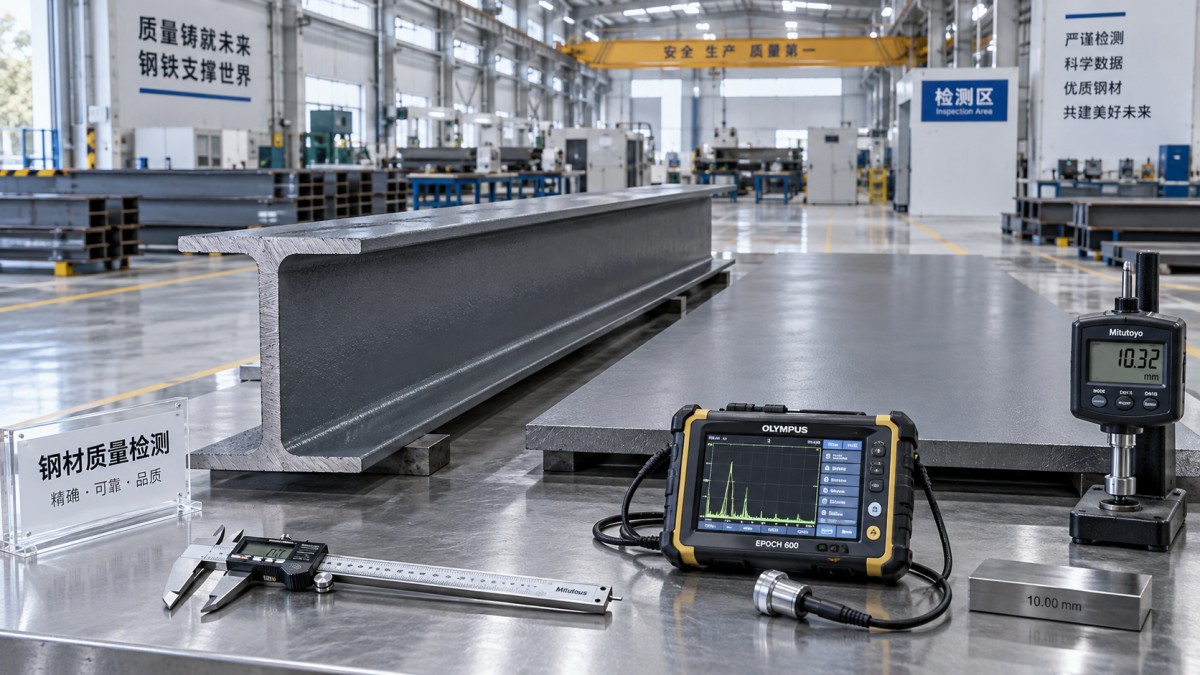
Structural procurement is sometimes handled as though nominal dimensions are enough: a 10 mm plate is a 10 mm plate, and a 200 mm beam is a 200 mm beam. In practice, tolerance affects cutting, fit-up, alignment, coating consumption, weight reconciliation, and the ability to assemble components without field modification.
For plate and flat product, review thickness tolerance, width and length tolerance, flatness, edge condition, camber, and surface quality. These factors matter especially when material is used in automated cutting, precision fabrication, box sections, stiffened panels, or machined connections. A plate that meets a broad commercial tolerance may still generate extra leveling, trimming, or fitting work.
For sections and hollow structural products, buyers should examine outside dimensions, wall thickness, mass per metre, straightness, twist, corner geometry, and permitted local deformation. The specified standard may allow a range that is acceptable for ordinary construction but difficult for a project with tight connection details or repeated modular assemblies.
There is also a commercial issue: steel is frequently priced by theoretical or actual weight, depending on the product and contract. If the purchasing basis, allowable tolerance, and invoicing method are not aligned, a low unit price can become less attractive after weight variation is applied. Procurement should make sure that the quotation clearly states whether pricing is based on actual scale weight, theoretical weight, nominal weight, or another agreed method.
Certification is useful only when it preserves traceability
A material test certificate is not merely paperwork for final inspection. It is the link between the physical steel product and the properties claimed for it. For structural work, documentation should be requested early enough that the supplier can quote accurately and arrange production accordingly.
The required certificate type should be stated in the purchase order, along with any additional inspection, witnessing, or third-party verification requirements. The certificate should identify the relevant heat or cast, product dimensions, grade, chemical analysis, mechanical test results, applicable standard, and delivery condition. Where a project requires a particular inspection framework, the document format and issuing authority should be agreed before production starts.
Traceability must continue after the steel leaves the mill. This is where otherwise compliant material can become difficult to accept. Pieces may be cut, blasted, primed, stock-transferred, or combined with material from several heats. If original markings disappear and no controlled identification system is used, the fabricator may be unable to demonstrate which certificate belongs to which component.
For high-consequence structural items, buyers should ask how identification will be maintained through handling and processing. Practical controls may include heat-number marking, bundle tags, plate stenciling, controlled stock records, cut-piece transfer marks, and packing lists that correspond to the certificates. The appropriate level of control depends on the project, but the purchase order should not assume that traceability will happen automatically.
Do not treat corrosion protection as a separate afterthought
Corrosion resistance is often discussed only after the base steel has been selected. That sequence can be expensive. The chosen steel, surface condition, fabrication design, and protective system need to work together.
For a dry internal structure, standard carbon structural steel with an appropriate shop primer may be sufficient. External structures, humid process areas, coastal sites, chemical exposure, buried installations, and splash-zone applications require a more deliberate decision. The question is not simply whether to choose coated, galvanized, weathering, stainless, or painted steel; it is whether the expected environment and maintenance plan support that choice.
Buyers should establish which party is responsible for surface preparation and at what stage it occurs. Surface condition at delivery can affect blasting requirements, coating adhesion, and schedule. Scale, rust level, oil contamination, weld spatter, sharp edges, crevices, and drainage details can all influence coating performance, even when the base material complies with the ordered grade.
Galvanizing also needs early coordination. Certain section geometries and closed fabricated assemblies require venting and drainage provisions. Steel chemistry can influence coating appearance and behavior, while distortion risk may matter for thin or asymmetrical fabrications. These are engineering and fabrication questions, but procurement should identify them before buying material that is assumed to be ready for galvanizing.
Evaluate the supplier's capability against the order, not its catalogue
A supplier may offer a wide portfolio of plate, sections, tube, and long products, yet still be a poor fit for a particular structural order. The relevant question is whether that supplier can provide the exact specification, quantity, documentation, processing, packaging, and delivery sequence required by the project.
For stocked material, ask whether the offered steel is from identified mill inventory and whether the full certificate package is available for the actual lots to be supplied. For mill production, confirm the realistic production route, minimum rolling quantity, rolling window, test requirements, and shipment plan. A supplier's general lead-time statement can conceal a long wait for a non-standard thickness, unusual toughness class, controlled delivery condition, or special testing requirement.
Substitution control should be explicit. Commercial teams may offer an alternative grade, origin, standard, section size, or coating route when availability changes. Some alternatives are technically acceptable, but approval should sit with the responsible engineering authority. Procurement can prevent late disputes by requiring written approval before any substitution, including changes that appear minor.
Compare total exposure, not only the quoted rate
The lowest quoted price may be the right choice when the specification is standard, the application is forgiving, and the supplier can provide documented stock quickly. It becomes less persuasive when uncertainty is transferred to fabrication, inspection, or site installation.
A more useful comparison combines purchase price with the likely cost of deviations: extra testing, material sorting, rejected certificates, rework caused by dimensional variation, additional welding controls, delayed coating, unplanned freight, and lost construction time. These costs are rarely visible in a steel price comparison, but they are often predictable from the gaps in a quotation.
For critical structural items, a disciplined enquiry document is usually the best cost-control tool. It should state the approved specification, acceptance documents, tolerance expectations, surface or coating responsibilities, traceability requirements, substitution rules, packing needs, and delivery sequence. That gives suppliers a fair basis for quotation and gives procurement a defensible basis for comparison.
The final check before release should be simple: can the project team identify exactly what will be delivered, prove that it meets the design requirement, fabricate it without avoidable complication, and install it within the planned sequence? When any of those answers is uncertain, the order is not yet ready to be judged on price alone.
Please give us a message
Tianjin Kaichuang Metal Material Co., Ltd
Add: No. 41, District 6, First Street, Huanghuadian Town, Wuqing District, Tianjin
Tel: + 86 137 9101 9833
E-mail: boss@kaichsteel.com