Steel Hub

A bolted steel frame costs less than a welded frame in a tall building when the savings from faster erection, lower field-labor exposure, simpler inspection, and reduced schedule risk exceed the added cost of bolts, connection plates, and fabrication detailing. This condition is common where site welding is slow, highly regulated, weather-sensitive, or dependent on scarce certified labor.
The comparison is frequently misunderstood because “bolted” and “welded” are not mutually exclusive structural systems. In most high-rise steel projects, major members and connection components are welded in the fabrication shop, while beams, columns, braces, and splice assemblies are bolted on site. The commercial question is therefore rarely whether to eliminate welding entirely. It is whether field-bolted connections deliver a lower total installed cost than field-welded alternatives for the same structural performance, fire rating, architectural requirements, and construction programme.
For a commercial evaluation, the steel weight or unit price of bolts is not enough. The decisive number is the installed cost of the frame, including fabrication, transport, crane time, labor productivity, inspection, temporary works, programme effects, and the financial consequence of delay.
Where the cost difference is actually created
A field-welded connection may appear economical at the drawing stage because it can use fewer plates, fewer bolts, and sometimes a more compact joint geometry. Yet its apparent material saving can be consumed by site preparation and execution requirements. Welders need access, stable working platforms, suitable weather protection where required, power supply, consumables, preheat control for applicable procedures, and inspection access. Each of these requirements becomes more consequential as elevation increases.
Bolted erection shifts a larger share of work into controlled fabrication conditions. Plates, stiffeners, welded subassemblies, and hole patterns can be completed before shipment. At the site, the crew aligns members, installs bolts, makes the required tightening checks, and releases the connection according to the erection sequence. This can shorten the critical path where repeated floor geometry allows crews to establish a predictable rhythm.
The relevant commercial comparison is not:
Cost of bolts versus cost of weld metal.
It is:
Additional connection hardware and shop detailing versus the cost and risk of performing more structural work at height.
A bolted scheme becomes particularly attractive when the building programme assigns high value to achieving floor-by-floor progress. Earlier structural completion can release follow-on activities such as decking, concrete placement, façade installation, mechanical coordination, and interior works. The resulting benefit is project-specific, but it can exceed the nominal difference in connection material cost.
Conditions that favor bolted connections
Bolted frames are more likely to have a cost advantage when the project has a high repetition rate. Office towers, hotels, residential buildings, and mixed-use structures with regular grids often use repeated beam-to-column details and recurring column splices. Repetition allows connection design, jigging, fabrication, logistics, and erection procedures to be refined over many similar assemblies. The value does not come simply from using bolts; it comes from reducing variation.
Site conditions matter just as much. A constrained urban site may have limited laydown space, restricted work hours, complex safety controls, or high labor costs. Field welding can be difficult to organize under such conditions, particularly when multiple trades compete for access. Bolted connections can reduce the duration of high-elevation hot work and can be installed in shorter, more discrete erection operations.
Weather exposure is another important variable. Welding quality is sensitive to conditions such as wind, rain, surface moisture, and temperature, depending on the approved welding procedure and applicable specifications. Maintaining compliant conditions can require enclosures, drying, heating, and additional supervision. Bolted work also faces weather and handling limits, but it generally has fewer process controls related to the joint itself. In locations with prolonged adverse weather, this difference can materially affect schedule reliability.
Projects with limited access to qualified field welders and welding inspectors can also favor bolting. A structural weld performed in the shop can be produced under more consistent conditions, with dedicated equipment and repeatable quality-control routines. That does not remove the need for inspection, but it can reduce the quantity of critical site welds requiring coordination. When qualified field resources are scarce or expensive, that shift has direct commercial value.
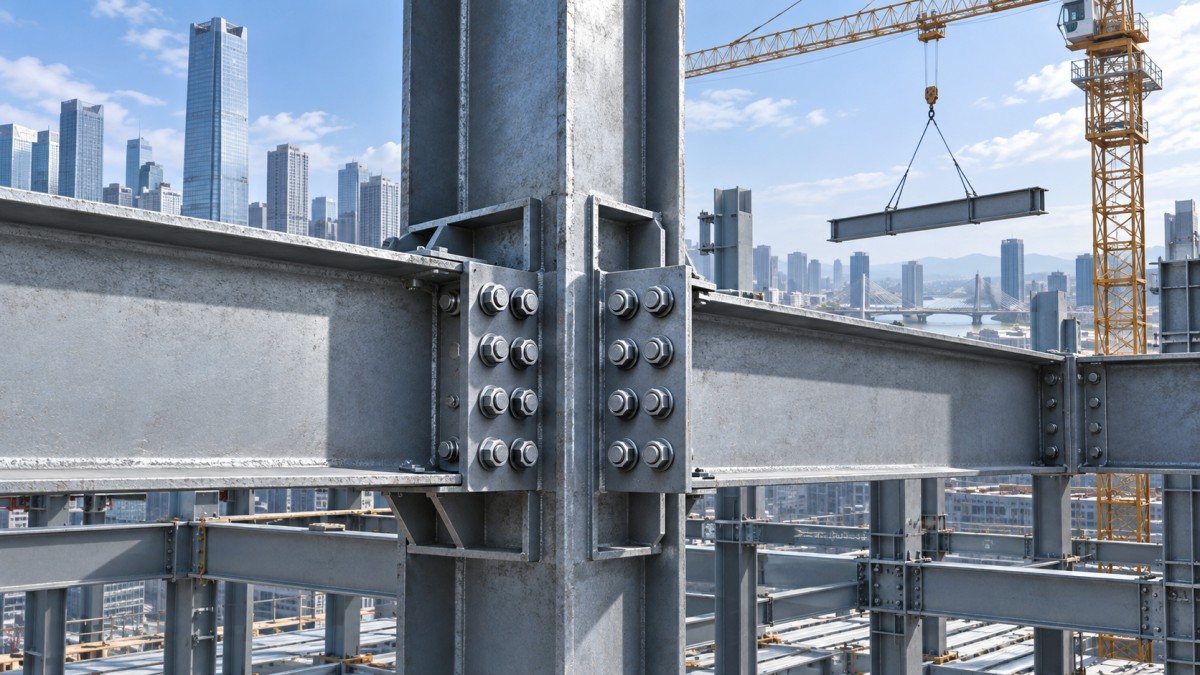
Transport and erection logistics may also support a bolted approach. Tall buildings often require member splices because full-length columns or deep transfer elements cannot be transported economically or safely. A bolted field splice is usually faster to assemble than a welded splice at elevation. It can allow the erection team to set the next segment sooner, provided tolerances, bolt-hole geometry, and access for installation have been properly designed.
When welded frames can still be cheaper
Bolted construction is not automatically the low-cost option. A welded solution can be commercially stronger when connection geometry is highly specialized, the number of unique joints is large, or substantial connection plates and bolt groups would add fabrication complexity and steel weight. Transfer structures, heavily loaded moment connections, architecturally exposed steel, and irregular tower forms may require extensive analysis and detailing regardless of the connection method. In some cases, a shop-welded assembly reduces the number of field operations enough to justify more demanding fabrication and transport arrangements.
A nearby fabricator with strong automated welding capacity can also alter the result. If the facility can produce complex welded assemblies efficiently, and the site has favorable conditions for controlled field welding, the incremental cost of a welded connection may be lower than expected. This is especially relevant where crane availability is not a constraint, labor productivity is stable, and the project schedule does not depend on rapid repetitive floor cycles.
Connection type matters. Simple shear connections are often well suited to bolting, but moment-resisting frames require more careful evaluation. A bolted moment connection can be fully capable of meeting design requirements, yet it may need flange plates, end plates, continuity plates, stiffeners, and a substantial number of high-strength bolts. The resulting fabrication and inspection burden can be significant. A comparison that treats every bolted joint as a simple beam shear connection will understate cost.
There are also situations where architectural appearance or clearance requirements favor welding. Exposed structural steel may require smooth, visually controlled joints. Large bolted assemblies may project beyond the desired profile or interfere with finishes, cladding interfaces, or service routes. Concealing connections can introduce secondary steel or finishing work that narrows the savings from rapid erection.
The hidden costs behind the connection choice
Connection cost is often distorted because different cost categories sit in different contracts. The steel fabricator may quote shop fabrication and supply. The erection contractor may price installation separately. Welding inspection, non-destructive examination, access scaffolds, fire watches, touch-up painting, and schedule-related preliminaries may fall elsewhere. A low fabrication quote for a welded alternative can therefore look favorable while transferring cost and risk into site packages.
A reliable comparison should consolidate at least the following items:
- Shop labor for cutting, drilling, fitting, welding, trial assembly where required, and coating repair;
- Connection steel, bolts, nuts, washers, weld consumables, and the added member weight caused by connection design;
- Transport restrictions, shipping configuration, site unloading, and temporary storage;
- Crane occupancy, erection crew output, access equipment, and work at elevation;
- Field welding time, welding procedures, consumables, environmental controls, and inspection requirements;
- Bolting installation, tightening verification, inspection records, and remediation of fit-up problems;
- Temporary stability measures, erection sequence constraints, and the duration for which these measures remain in place;
- Schedule contingency and the cost impact if structural completion moves later.
The last item is regularly underestimated. A connection method that saves a modest amount in direct labor but introduces uncertain inspection hold points or weather delays can be more expensive at project level. Conversely, a bolted system with higher connection material cost may protect the schedule if it reduces dependencies on field welding at height.
Fabrication capacity can reverse the answer
Whether a bolted steel structure is more cost effective than welded for tall buildings depends heavily on the fabricator’s production model. Bolted connections require accurate drilling or punching, controlled hole location, clear part identification, and disciplined packing so that bolts and connection components arrive in the correct erection sequence. Poorly managed fabrication can turn nominally fast bolted erection into site delays caused by missing plates, mismatched holes, or unresolved revisions.
Welded frames impose a different capacity test. The fabricator must control weld procedure qualification, fit-up, distortion, sequence, and inspection. Heavy welded assemblies may require more handling, turning, and storage space. If production bottlenecks develop at the welding bays, the supposed advantage of reducing field work may be offset by delayed releases from the shop.
Commercial assessment should therefore compare actual supply-chain capability rather than generic assumptions. The relevant questions include whether the fabricator has the equipment to process the selected details, whether the design team can issue stable connection information early enough, and whether the erector has proven procedures for the intended bolt installation and inspection regime. A connection method is economical only when the organizations delivering it can execute it consistently.
Design maturity is a cost variable, not an administrative issue
Bolted systems benefit from early dimensional certainty. Hole patterns, splice elevations, member orientations, bolt access, and tolerances must be coordinated before fabrication. Late changes can be expensive because a revised bolted connection may require replacement plates, redrilled members, or site modifications that remove the original productivity advantage.
Field welding can sometimes absorb limited dimensional variation more readily, but that flexibility should not be mistaken for free contingency. Unplanned site welding adds labor, inspection, coating repair, and possible programme disruption. The economically sound approach is not to choose welding merely because details are unresolved; it is to identify which connections genuinely need adjustment capacity and to freeze repetitive bolted details as early as possible.
Interface design is especially important in tall buildings. Connections at belt trusses, outriggers, transfer levels, façade support zones, and mechanical plant floors can differ sharply from typical floor connections. These locations should be costed separately rather than allowing a few complex joints to distort the evaluation of the entire structural frame.
Quality control should be priced as part of installation
Neither method avoids quality requirements. Bolted connections require correct bolt grade, installation method, tightening procedure where applicable, access for installation, and inspection documentation. Welded connections require approved procedures, qualified personnel, joint preparation, preheat or interpass controls where specified, visual examination, and any additional non-destructive testing required by the contract documents.
The key difference is where quality is created and verified. Shop welding allows more controlled workflow, while field bolting generally offers more observable assembly progress. However, bolting is not a remedy for poor tolerance management. Misalignment, oversized remedial holes, inaccessible bolts, or unapproved site modifications can create structural and contractual problems. Savings should never be assumed by reducing inspection scope; they arise from selecting a connection method whose quality controls fit the project’s execution environment.
A practical basis for the commercial decision
The most useful evaluation compares two buildable connection strategies for the same structural scheme, not a theoretical “all-bolted” frame against an “all-welded” frame. For each strategy, separate typical floor connections from exceptional locations, quantify shop and site hours, map the erection sequence, and test the schedule against realistic access and inspection constraints.
Bolted field connections tend to cost less where floor plates repeat, erection speed has economic value, site welding is constrained, and accurate shop fabrication is available. Welded alternatives can remain preferable where connections are unique or heavily loaded, shop welding is highly efficient, transport favors larger preassembled units, or architectural and geometric requirements make extensive bolting inefficient.
The sound conclusion is conditional rather than absolute: bolts are often the lower-total-cost choice in tall-building steelwork when they move labor from the tower to the shop and reduce the uncertainty of erection. They are not cheaper merely because they are faster to install. The cost advantage exists only when connection design, fabrication accuracy, logistics, inspection planning, and programme value are evaluated as one integrated construction decision.
Please give us a message
Tianjin Kaichuang Metal Material Co., Ltd
Add: No. 41, District 6, First Street, Huanghuadian Town, Wuqing District, Tianjin
Tel: + 86 137 9101 9833
E-mail: boss@kaichsteel.com