Steel Hub

Outdoor steel structures rarely fail because a specification omitted the word “corrosion.” They fail because the chosen grade, coating system, fabrication details, and exposure conditions were treated as separate decisions. For technical evaluators, steel material grade matters because it sets the baseline behavior of the substrate when moisture reaches an edge, a scratch, a crevice, a weld zone, or an area where coating protection has aged.
A higher-grade steel does not automatically mean better outdoor corrosion resistance. Carbon steel with a robust galvanizing or paint system can perform well in many exposed structures. Stainless steel can corrode quickly when the grade is poorly matched to chloride exposure or when fabrication contamination is left on the surface. Weathering steel may develop a protective patina in suitable atmospheric conditions, yet remain a poor choice where salt deposits or persistent wetness prevent that patina from stabilizing.
The practical question is therefore not simply, “Which steel is more corrosion-resistant?” It is: what corrosion mechanisms are credible at this location, and how does the specified steel material grade respond once the intended surface protection is stressed or locally compromised?
Grade affects corrosion through composition, but exposure controls the outcome
Steel grades differ in chemical composition, microstructure, cleanliness, mechanical properties, and permitted manufacturing tolerances. Their corrosion behavior is influenced most directly by alloying elements and by the stability of any oxide film or corrosion product they form. Yet outdoor durability is still governed by the combined system: atmosphere, geometry, drainage, joining method, coating condition, inspection access, and maintenance practice.
For ordinary structural carbon steels, minor variations among common grades are usually less important to atmospheric corrosion than coating quality and water management. A structural member with trapped water at a bolted lap, for example, may corrode severely even when its base grade is fully suitable for the load case. Conversely, a well-drained, properly coated carbon-steel frame in a low-contaminant inland environment can have a long service life without requiring a corrosion-resistant alloy.
Alloy additions become more decisive when the structure depends partly or fully on the substrate itself for corrosion resistance. Chromium is fundamental in stainless steel because it supports a passive chromium-rich oxide film. Nickel can improve resistance in certain environments and support the austenitic structure of many stainless grades. Molybdenum is particularly relevant where chlorides are present, because it improves resistance to localized attack such as pitting and crevice corrosion. Copper, chromium, nickel, and phosphorus may be used in weathering steels to help form a denser protective rust layer under appropriate wet-dry exposure cycles.
These broad principles should not be reduced to a ranking chart. A grade selected for general atmospheric exposure may be unsuitable near marine spray, road de-icing salts, process emissions, cooling-tower drift, or wash-down operations. The same building can contain multiple corrosion zones: a roof truss exposed to rainwater runoff, a shaded lower column exposed to splashback, and a sheltered connection accumulating airborne chlorides may all require different assessment.
Carbon steel, weathering steel, and stainless steel solve different problems
Technical evaluations often go wrong when these materials are compared as if they are interchangeable choices on a single corrosion-resistance scale. They use different protection strategies.
Coated carbon steel remains the standard answer for a large share of outdoor structural work because it offers familiar fabrication routes, broad availability, and a clear inspection and repair logic. The grade must still meet structural and welding requirements, but atmospheric corrosion performance generally depends on the selected zinc coating, paint system, or combined protection scheme. Where repainting is difficult, expensive, or unsafe, the evaluation should consider lifecycle access costs rather than comparing only the initial price of a more corrosion-resistant steel material.
Weathering steel is often misunderstood as “rust-proof steel.” It is intentionally allowed to form a corrosion product layer, but the layer only becomes protective when exposure supports the right drying behavior. Crevices, horizontal shelves, ground-contact zones, leaking joints, continually shaded surfaces, and locations receiving chloride deposits can prevent stable patina development. Corrosion can continue beneath loose scale, and runoff from early-stage weathering may stain adjacent concrete, masonry, or cladding. The architectural appearance and runoff path need review alongside structural durability.
Stainless steel reduces reliance on organic coatings, but its passive surface is not invulnerable. In clean, regularly rain-washed atmospheric conditions, many common stainless grades perform well. In coastal, industrial, or salt-contaminated locations, chloride deposits may remain on protected or sheltered surfaces long after rain has washed exposed faces. This creates conditions for pitting and crevice corrosion. A stainless assembly with narrow laps, unsealed threaded joints, gasketed interfaces, or uncleaned fabrication residue can therefore deteriorate in locations where the visible open surface appears unaffected.
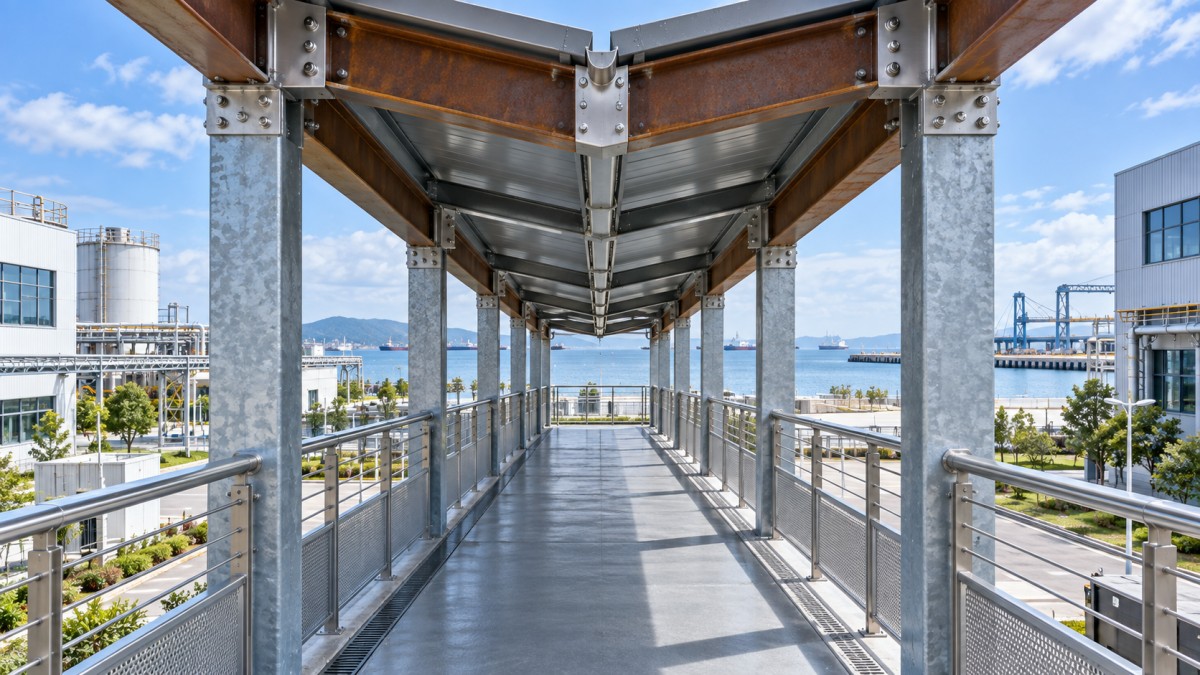
Chlorides and retained moisture change the grade decision
Chlorides are often the dividing line between a routine outdoor selection and a more demanding material review. They may come from marine aerosol, direct sea spray, de-icing salts, industrial process streams, water treatment chemicals, or contaminated dust. The distance from the sea alone is an incomplete proxy. Local wind direction, sheltering, elevation, traffic patterns, and cleaning by rainfall can materially change chloride deposition on a structure.
For galvanized carbon steel, chloride-rich wet deposits can accelerate zinc consumption. The thickness of the zinc layer, the expected exposure severity, and the ability of water to drain will influence whether galvanizing alone is sufficient. A duplex system, where paint is applied over galvanized steel, may be justified when longer protection is needed or when later maintenance would be disruptive. It is important to specify surface preparation and repair procedures for cut edges, drilled holes, field welds, and damaged coating areas; these locations are often where the protection system becomes discontinuous.
For stainless steel, the grade decision should address localized corrosion rather than only uniform rusting. A common austenitic stainless grade may be appropriate for mild exterior exposure, but conditions with frequent salt deposits, stagnant water, or crevice geometry may call for a grade with stronger pitting and crevice resistance, often through higher chromium, nickel, and molybdenum content. The exact choice should be based on the applicable material standard, exposure assessment, fabrication route, and any project-specific durability requirements.
Surface finish is part of that decision. Rougher finishes can retain deposits and moisture more readily than smoother, properly finished surfaces. Grinding marks, embedded carbon-steel particles, heat tint beside welds, and unremoved welding residues can locally undermine corrosion performance. A nominal stainless grade cannot compensate for fabrication practices that damage or contaminate the passive surface.
Details can negate the benefit of a better grade
Corrosion evaluation should move from the general environment to the actual member and connection geometry. Outdoor structures usually corrode first at locations with a different micro-environment from the surrounding open atmosphere.
- Bolted laps and overlapping plates can retain moisture, salts, and debris.
- Unsealed hollow sections can collect condensation or water through damaged caps and weld defects.
- Base plates and column feet may be exposed to splash, soil moisture, standing water, or de-icing chemicals.
- Horizontal ledges, stiffeners, and bracket tops can hold deposits even where the main member drains well.
- Field welds and repaired coating areas may have lower protection quality than shop-applied surfaces.
- Contacts between dissimilar metals can create galvanic corrosion conditions when an electrolyte is present.
Changing from one carbon-steel grade to another will not correct a water trap. Upgrading stainless steel while retaining an aggressive crevice can also be an inefficient response. Geometry improvements often have a larger effect: provide drainage paths, avoid upward-facing ledges, seal or vent hollow sections appropriately, isolate incompatible metals where necessary, and make inspection surfaces accessible.
Welded connections require special attention because they combine several corrosion variables. Heat can alter the local metallurgical condition, welding can remove or damage coatings, and the completed joint may create a crevice or rough deposit-retaining surface. Stainless fabrication may require cleaning and passivation practices appropriate to the grade and service environment. Carbon-steel work should define how weld areas are prepared and recoated after fabrication or site erection. Leaving this to a general site instruction can create substantial variation in the final protection level.
Use standards as a decision framework, not a substitute for exposure assessment
Material standards establish composition, mechanical properties, dimensions, and delivery requirements for a given steel grade. Corrosion protection standards and coating specifications establish other parts of the durability system. Neither category, by itself, proves that a selected combination will achieve the intended service life in a particular location.
A sound specification separates several questions that are often merged into one line item:
- What mechanical and welding properties must the structural steel grade provide?
- What environmental exposures are expected at each relevant zone of the structure?
- Is protection supplied mainly by the base alloy, zinc coating, paint system, or a combination?
- Which fabrication operations can disturb the protection?
- What acceptance criteria apply to material certificates, coating thickness, surface preparation, weld treatment, and repair work?
- How will the structure be inspected and maintained after installation?
This separation prevents a common procurement problem: a purchase order may identify a compliant steel grade but leave coating class, preparation quality, repair scope, and inspection records too vague. The result can be technically compliant material with an incomplete durability outcome.
For weathering steel, the specification should also identify whether uncoated exposure is intended, which surfaces may be exposed to persistent wetness, and how runoff staining will be managed. For stainless steel, the grade designation alone should be accompanied by requirements for finish, welding consumables where relevant, post-weld treatment, contamination control, and avoidance of unfavorable crevice details. For coated carbon steel, the coating system must cover fabricated steel as delivered, including the treatment of edges, fasteners, welds, and field modifications.
Evaluate lifecycle risk before paying for a higher alloy
The initial material premium of a more corrosion-resistant grade is visible in a budget; the cost of access, shutdown, coating repair, staining remediation, or premature component replacement often appears later. That does not make stainless or weathering steel the automatic lifecycle choice. A higher alloy can increase fabrication requirements, complicate welding control, lengthen procurement, or create unnecessary cost in a low-corrosion environment.
The decision becomes clearer when evaluators compare credible failure modes. If the principal risk is broad atmospheric corrosion on accessible members, a conventional structural steel grade with a maintainable coating system may be the most rational solution. If the risk is chloride-driven attack in concealed or difficult-to-maintain joints, better alloy resistance and redesigned details may be warranted. If the structure is intended to remain unpainted for architectural or maintenance reasons, weathering behavior must be compatible with the actual wetting and contamination pattern, not just the regional climate description.
Corrosion allowance may be considered in some applications, but it should not be used casually as a substitute for protection. Added thickness does little to address localized pitting, crevice attack, coating disbondment around a connection, or corrosion where section loss affects a highly stressed area. It can also obscure the inspection threshold at which repair becomes necessary.
A practical review sequence for outdoor steel
Start with the exposure map rather than a material catalogue. Identify surfaces subject to direct rain, sheltered deposits, splashback, chlorides, industrial contaminants, condensation, and trapped water. Then review how each candidate steel material and protection system behaves in those zones, including cut edges and connections.
Next, test the design against imperfect execution. Ask what happens if coating damage occurs during erection, a drain hole blocks, a gasketed joint stays wet, or cleaning access is limited. This is where grade selection becomes meaningful: the base steel’s corrosion behavior determines how much tolerance the structure has when its primary protection is no longer ideal.
The final specification should make that logic traceable. It should state the structural grade, corrosion-protection system, relevant surface and fabrication requirements, connection detailing expectations, and inspection hold points. A corrosion-resistant outdoor structure is rarely the result of one premium material choice. It is the result of matching the grade to the environment and ensuring that fabrication and detailing do not defeat the protection the grade was selected to provide.
Please give us a message
Tianjin Kaichuang Metal Material Co., Ltd
Add: No. 41, District 6, First Street, Huanghuadian Town, Wuqing District, Tianjin
Tel: + 86 137 9101 9833
E-mail: boss@kaichsteel.com