Steel Hub

How to Choose Welded Pipe for Pressure-Bearing Applications
Selecting welded pipe for a pressure-bearing system is not a matter of matching nominal diameter and wall thickness to a purchase order. The pipe must withstand internal pressure, temperature changes, corrosion, installation stresses, and the realities of fabrication and inspection over its intended service life. A technically acceptable pipe on paper can still become a weak point if its seam quality, material traceability, dimensional tolerance, or joining method does not match the actual duty.
For technical evaluators, the practical question is rarely “Is welded pipe suitable?” Welded pipe is widely used in water systems, process lines, energy infrastructure, structural-pressure combinations, and industrial utility networks. The more useful question is: which welded pipe specification, manufacturing route, and inspection level are appropriate for this pressure boundary?
That decision should begin with the system rather than the pipe catalogue. The conveyed medium, design pressure, design temperature, corrosion mechanism, pressure-cycle profile, installation environment, governing code, and inspection accessibility all influence the selection. Cost matters, but it should be evaluated across procurement, fabrication, testing, maintenance, and possible downtime—not only by price per tonne or per metre.
Start with the actual pressure duty
A line described simply as “low pressure” can still be demanding if it experiences frequent starts and stops, pump surges, thermal expansion, or occasional vacuum conditions. Likewise, a moderate design pressure may require a more conservative pipe selection when the medium is corrosive, toxic, flammable, abrasive, or difficult to isolate for repair.
Before comparing welded pipe options, define the operating envelope in a form that engineering, procurement, and quality teams can use consistently:
- Design pressure and normal operating pressure, including surge or transient pressure where relevant.
- Minimum and maximum design temperature, not only the expected average temperature.
- Fluid composition, solids content, moisture, chlorides, hydrogen sulfide, oxygen, and cleaning chemicals where applicable.
- Whether pressure is steady, cyclic, pulsating, or subject to rapid temperature changes.
- External loads from supports, soil, wind, vibration, thermal movement, or equipment connections.
- Required design life, corrosion allowance, inspection access, and repair strategy.
The pressure rating of a pipe cannot be treated as an isolated product property. Allowable pressure is normally established under the applicable piping or pipeline design code, using variables such as outside diameter, nominal wall thickness, material strength at temperature, weld factors where applicable, corrosion allowance, and design margins. The responsible design authority should confirm the calculation and code basis. A mill designation alone does not establish that a pipe is fit for a particular pressure system.
Choose the manufacturing route with the seam in mind
“Welded pipe” covers several manufacturing routes. Their suitability depends on diameter, wall thickness, material grade, service conditions, and the project’s required examination level. The main distinction is not simply whether a pipe has a weld; it is how that weld is produced, controlled, tested, and documented.
Electric resistance welded (ERW) pipe is commonly used for many industrial and line-pipe applications. It is formed from strip or coil, with the longitudinal seam created through resistance heating and pressure. Modern ERW production can provide consistent seam quality when coil chemistry, edge preparation, welding parameters, heat treatment where specified, and nondestructive examination are properly controlled. It is often a practical option for high-volume sizes, but technical review should confirm that the selected grade and specification permit the intended pressure service.
Submerged arc welded pipe, including longitudinal SAW and helical or spiral SAW products, is often used in larger diameters. These products can be well suited to transmission, water, piling-related, and large process piping applications, depending on the governing specification. For pressure duty, evaluators should pay close attention to weld procedure qualification, seam geometry, radiographic or ultrasonic examination requirements, hydrostatic testing, and the relationship between pipe diameter, wall thickness, and ovality tolerance.
A spiral seam is not automatically unsuitable for pressure service, and a longitudinal seam is not automatically superior in every project. The relevant issue is whether the product standard, design code, service conditions, and project quality plan collectively address the risks. A large-diameter raw-water line and a high-consequence hydrocarbon process line may both carry pressure, yet their pipe selection logic can be quite different.
Material grade is a service decision, not a strength comparison
Higher specified strength can reduce required wall thickness in some designs, but it does not automatically produce a better pressure-bearing pipe. Strength must be balanced against weldability, toughness, forming behavior, low-temperature performance, corrosion resistance, fabrication procedures, and availability in the required dimensions.
Carbon steel remains common because it offers a workable combination of strength, cost, and fabricability. Yet corrosion can dominate the decision. A carbon steel welded pipe may be entirely appropriate for treated water or compressed air with suitable corrosion allowance and coating, while a chloride-bearing fluid, wet sour environment, or elevated-temperature process stream may require a different alloy strategy, lining, internal coating, or more detailed materials engineering review.
Do not evaluate chemistry only by a grade name. Review the governing standard’s mechanical-property requirements, heat analysis and product analysis rules, delivery condition, impact-test requirements when relevant, and any limits connected to welding or sour service. If field welding will be extensive, carbon equivalent and weld procedure compatibility may be as consequential as minimum yield strength. A pipe that is readily available but difficult to weld consistently at site can increase project risk.
Use standards correctly—and avoid specification shortcuts
Standards identify product requirements; piping and pipeline codes establish how a system is designed, fabricated, examined, and tested. These two functions overlap but are not interchangeable. Commonly referenced specifications may include API 5L for certain line-pipe applications, ASTM A53 for particular black and hot-dipped galvanized steel pipe uses, and EN 10217 series standards for welded steel tubes intended for pressure purposes. The correct selection depends on market, application, purchaser requirements, and code jurisdiction.
A frequent procurement mistake is to specify only a nominal size, schedule, and generic material label. That leaves unresolved questions about manufacturing method, inspection category, end preparation, test requirements, dimensional tolerances, coating condition, documentation, and whether substitute materials are permitted. Another mistake is assuming that any pipe described as “pressure pipe” can be used under every pressure code. It cannot.
A sound purchase specification should state the required product standard and edition, material grade, permitted manufacturing process, dimensions, length range, end type, required testing, certification documents, marking, coating or surface condition, and any project-specific supplementary requirements. Where code compliance is required, the applicable code should be referenced by the design team rather than inferred by the supplier.
Inspect the evidence behind the weld
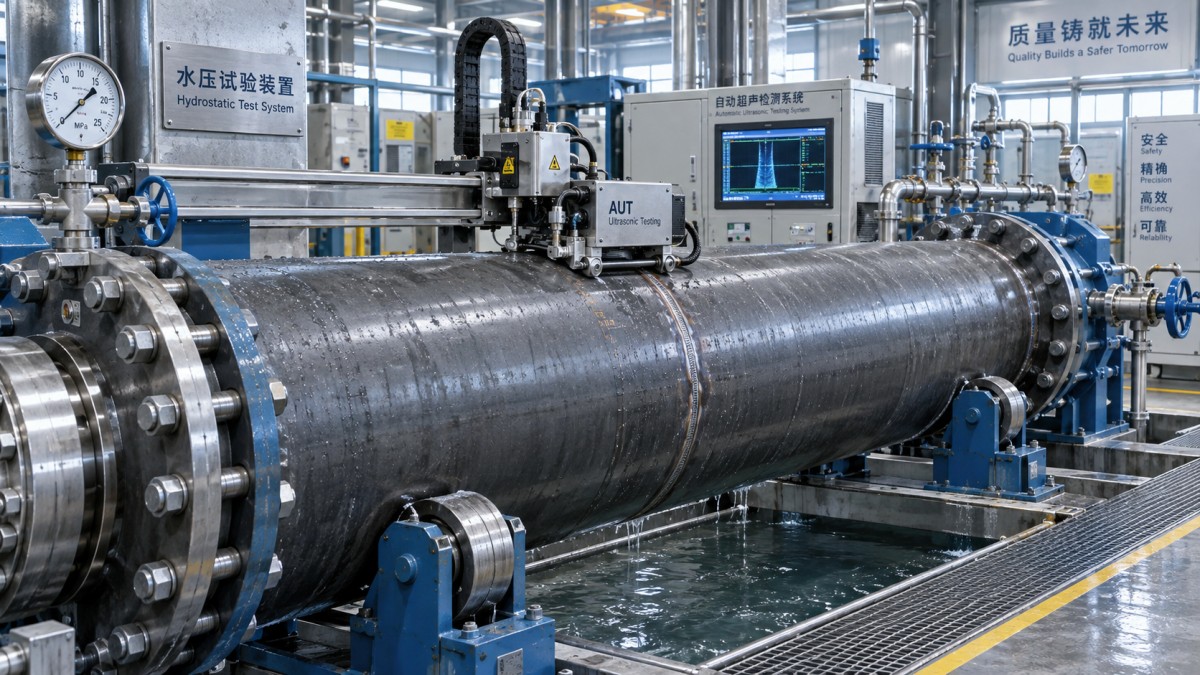
For a pressure-retaining welded pipe, the seam deserves a deliberate review. The required level of nondestructive testing is governed by the applicable standard and project specification. Depending on the product and service, this may involve ultrasonic testing, radiographic testing, electromagnetic examination, visual inspection, or other methods defined by the relevant requirements. It is not enough to request “100% inspection” without stating the method, acceptance criteria, coverage, and documentation expected.
Hydrostatic testing is another important control, but it should not be misunderstood. A hydro test demonstrates performance at the specified test condition; it does not replace proper material selection, seam examination, dimensional verification, or system design. For critical applications, review whether test pressure, hold time, test medium, and record format meet the governing standard and project requirements.
Traceability is particularly valuable when multiple heats, sizes, or delivery batches are involved. Heat numbers, pipe markings, certificates, and receiving inspection should remain linked through cutting, fabrication, and installation where the project quality plan requires it. Once traceability is lost, confirming that a repaired or installed spool uses the intended material becomes much harder.
Account for corrosion, fatigue, and external conditions early
Internal corrosion is often considered during pipe selection, while external corrosion is deferred until later. That separation can be costly. Underground lines may need a coating system compatible with soil conditions, installation damage risk, and cathodic protection strategy. Above-ground lines may face atmospheric corrosion, insulation-related moisture, salt exposure, or chemical washdown. A bare welded pipe may meet mechanical requirements and still be incomplete as a durable piping solution.
Pressure cycling should also be treated with caution. Pump discharge lines, compressor systems, reciprocating equipment, and lines near vibrating machinery can experience fatigue loading that is not evident from a single design-pressure value. In such cases, support layout, restraint design, branch connections, weld details, and dynamic analysis may matter as much as the selected pipe wall. Increasing thickness alone is not a universal answer.
For low-temperature service, toughness requirements deserve explicit attention. For elevated temperature, confirm material properties at design temperature and consider oxidation, creep-related concerns where applicable, and the long-term behavior of coatings or linings. These are not details to leave to a final purchase-order review.
Evaluate supply capability without reducing the decision to availability
Steel is an upstream material foundation for infrastructure and manufacturing. Iron ore and scrap are converted through ironmaking, steelmaking, and rolling into plate, section products, pipe and tube, wire rod, and other forms used across construction, energy, shipbuilding, equipment manufacturing, rail transit, automotive production, and household appliances. Because pipe production depends on coil or plate availability, rolling schedules, testing capacity, coating operations, and logistics, delivery risk can affect downstream fabrication well before installation begins.
For that reason, a technically robust welded pipe specification should be commercially executable. Check whether the required diameter-wall combination is routinely produced by the proposed manufacturing route, whether the requested length and end preparation are realistic, and whether inspection requirements can be documented within the project timeline. If a specification permits alternatives, define the approval process before production—not after material has arrived.
Receiving inspection should verify quantity, dimensions, visible surface condition, end damage, marking, certificates, and coating condition where relevant. This is especially important when pipe will be cut into spools, buried, insulated, or otherwise made difficult to inspect later. A small discrepancy at receipt can become an expensive field issue after fabrication has started.
Make the final selection as a documented engineering decision
The best welded pipe choice is usually the one that aligns the design code, product specification, material behavior, seam quality controls, corrosion strategy, fabrication method, and supply plan. It is rarely the pipe with the highest strength grade, the heaviest wall, or the lowest unit cost.
Before release, technical evaluators should be able to answer a few direct questions: What pressure and temperature basis was used? Which standard and code govern the application? Why is this manufacturing route acceptable? What testing and documentation will prove compliance? How are corrosion, field welding, fittings, supports, and operating transients being handled? If those answers are clear, the welded pipe selection is far more likely to perform as intended throughout the life of the system.
Please give us a message
Tianjin Kaichuang Metal Material Co., Ltd
Add: No. 41, District 6, First Street, Huanghuadian Town, Wuqing District, Tianjin
Tel: + 86 137 9101 9833
E-mail: boss@kaichsteel.com