Steel Hub

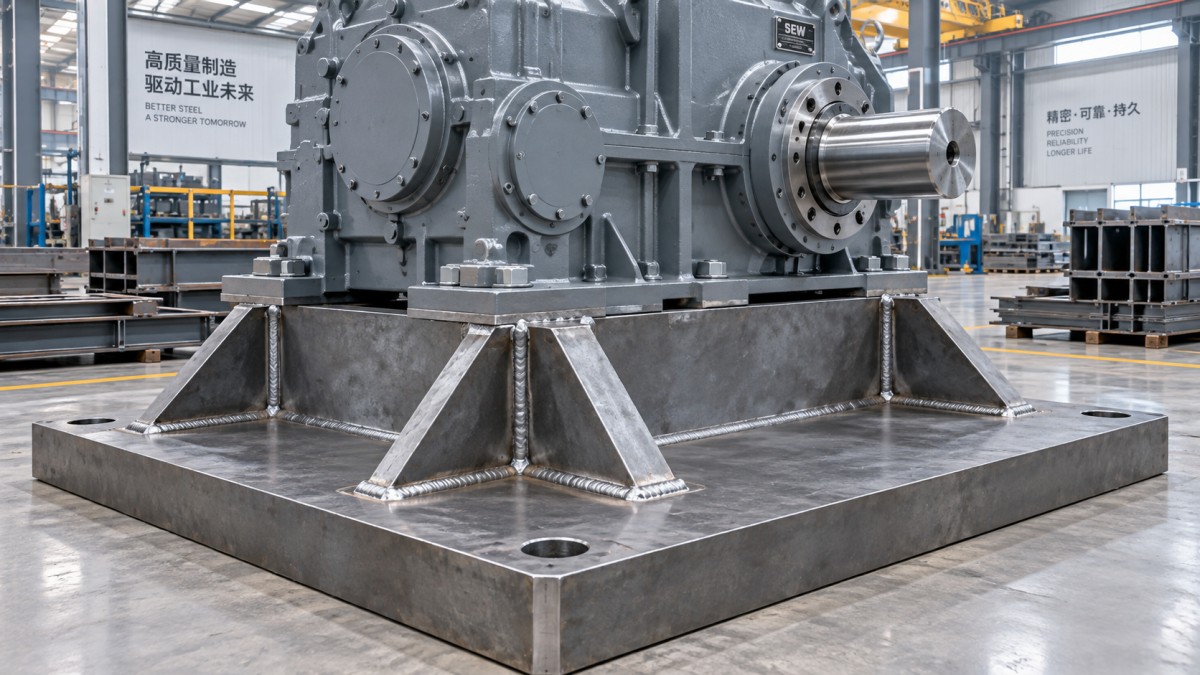
For heavily loaded equipment base plates, a normalized structural plate with a yield-strength class around 355 MPa is often the strongest starting point when the design also requires dependable fabrication. In common plate specifications, this is frequently represented by grades such as S355, with the exact subgrade selected for the required toughness temperature. Higher-strength plate classes can be appropriate where calculated stresses, plate thickness, or weight limits justify them, but a higher yield value alone does not make a base plate better. The selected grade must remain weldable, sufficiently tough through the ordered thickness, flat enough for mounting, and compatible with the fatigue and environmental demands of the assembly.
For a large machine frame, gearbox skid, press foundation plate, crane support, or similar fabricated structure, the grade decision should begin with the governing failure mode. A plate that has adequate static yield strength can still perform poorly if a localized load causes permanent dish deformation, if a welded attachment introduces a crack-prone restraint condition, or if repeated vibration creates fatigue damage at a hole, stiffener end, or abrupt thickness transition. The best grade is therefore the one that satisfies the actual design condition with a practical fabrication margin, rather than the highest nominal-strength plate available.
Why a 355 MPa-class structural plate is often the baseline
A 355 MPa-class plate provides a useful balance of strength, ductility, and weldability for many high-load base plates. Compared with a lower-strength structural grade, it offers more resistance to gross yielding and bending under concentrated equipment reactions. That additional capacity can reduce the plate thickness in some designs, although thickness should never be reduced without rechecking local bearing, deflection, bolt-load distribution, weld demand, and fatigue detail geometry.
Its practical advantage is not only the nominal yield strength. Structural grades in this range are widely used in welded fabrications, so material availability, cutting behavior, forming limits, and welding procedures are generally well understood. This makes the grade suitable for base plates carrying welded ribs, equipment supports, lifting lugs, pipe brackets, hydraulic units, or drive assemblies.
Selection becomes more demanding when the base plate is very thick. Yield strength stated in a material designation is often tied to a defined thickness range. As thickness increases, the specified minimum yield strength can be lower than the value associated with thin plate. Using the headline grade number without checking the applicable thickness band is a common design error. The ordered plate thickness, not the nominal grade name alone, must be used in structural calculations.
Static load capacity is only the first screen
Base plates rarely see a perfectly uniform load. Equipment feet transfer force through limited contact areas; anchor bolts introduce highly localized stresses; welded stiffeners redirect load paths; grout condition affects bearing distribution. A plate may appear adequate when the total equipment weight is divided by the plate area, yet still yield locally beneath a mounting foot or around an anchor-bolt pattern.
Plate strength must be assessed with the support arrangement. A plate continuously supported by properly cured grout behaves differently from one spanning gaps, sitting on shims, or bearing only at isolated machine feet. A heavy pump or motor can also impose overturning moments and cyclic horizontal loads that are more severe than its vertical dead load. Where a base plate bridges open structural members, it functions as a bending element rather than merely a bearing plate.
For this reason, a 355 MPa-class grade is often suitable for severe general-duty applications, but it is not an automatic answer for every high-load installation. A higher-strength structural plate may be justified where a verified calculation shows that static yielding governs and the joining details are designed accordingly. Conversely, selecting a stronger grade will not correct excessive deflection caused by insufficient thickness, an unsupported span, or a poor stiffener layout. Stiffness is governed primarily by geometry; increasing yield strength does little to reduce elastic deflection.
Conditions that change the grade decision
Toughness subgrade matters when the plate is constrained or cold
Toughness is sometimes overlooked because a base plate is perceived as a static component. Yet thick base plates commonly contain welds, bolt holes, sharp corners, machined pockets, and restrained intersections with stiffeners. These features can create a triaxial stress state where brittle fracture resistance matters more than a simple tensile test suggests.
The required toughness level should reflect the lowest steel temperature in service, plate thickness, loading rate, and stress concentration severity. Cold outdoor installations, refrigerated process areas, lifting equipment, mobile machinery, and impact-prone assemblies deserve a more deliberate subgrade choice than indoor, steady-load installations. A subgrade identified by a lower test temperature is not merely a paperwork upgrade; it is relevant when the structure must retain fracture resistance under colder service conditions.
There is also a distinction between impact toughness and fatigue performance. Good Charpy performance does not eliminate fatigue cracking. Fatigue resistance is heavily controlled by welded detail category, weld toe profile, attachment termination, residual stress, surface condition, and the number and range of load cycles. A fatigue-sensitive base plate benefits more from smooth load transfer and carefully detailed welded connections than from selecting a stronger plate while retaining abrupt geometry.
Weldability can set the upper limit on usable strength
High-load base plates often receive multiple stiffeners and mounting features. This makes weldability a primary selection criterion rather than a secondary fabrication concern. As plate strength and thickness rise, welding may require tighter control of heat input, consumable selection, preheat, interpass temperature, and hydrogen content. A grade that is structurally attractive on paper can introduce fabrication risk if the workshop procedure is not qualified for the combination of thickness, joint restraint, and ambient conditions.
Material chemistry should be reviewed through the mill certificate, particularly the carbon equivalent and the values relevant to the selected welding procedure. Carbon equivalent does not predict every welding outcome, but it is a useful indicator of hardening and hydrogen-cracking sensitivity. Thick plate, high restraint, damp consumables, rapid cooling, and heavy multi-pass welds can compound the risk.
Where loads act through stiffeners welded perpendicular to the plate surface, through-thickness behavior may also need attention. Lamellar tearing is associated with shrinkage strain acting through the plate thickness, especially in heavily restrained T- and corner-joint configurations. Increasing the plate's in-plane strength does not solve this issue. Joint design, weld sequencing, buttering where appropriate, and plate with specified through-thickness ductility can be more relevant than moving to a higher yield class.
Thickness, flatness, and surface condition affect the installed result
A base plate is frequently machined after fabrication, but not every installation allows broad machining of the bearing face. Thickness tolerance and flatness therefore influence alignment, grout contact, shim packing, and the ability to achieve predictable bolt preload. Rolled plate can have residual curvature or local waviness, and thermal cutting or heavy welding can add distortion. Ordering a nominal thickness without defining the functional surface requirement can lead to rework after fabrication.
For equipment mounting faces, identify which surfaces require machining, which areas must remain flat after welding, and whether the plate will be grout-supported or installed on precision shims. A thick plate can still distort significantly when ribs are welded asymmetrically. Balanced weld placement, controlled sequence, adequate fit-up, and post-weld machining where required are more reliable than assuming a heavier plate will stay flat.
Surface condition also affects corrosion protection and contact behavior. Scale, cut-edge roughness, weld spatter, and abrupt transitions near mounting faces can interfere with coating systems or create local stress raisers. If corrosion allowance is used, it must be treated separately from structural thickness. Corrosion loss at plate edges, around drainage paths, or beneath poorly sealed equipment feet may be more significant than uniform loss across the plate face.
When higher-strength plate is justified
A higher-strength structural plate deserves consideration when design calculations demonstrate that yield-limited capacity controls and a thicker 355 MPa-class plate is impractical because of weight, available space, or handling limits. Typical examples include compact mobile equipment structures, heavily loaded transport frames, or plates that must span between discrete supports with limited allowable mass.
That change should trigger a fresh review rather than a simple grade substitution. Reduced thickness changes bending stiffness sharply, may reduce thread engagement for tapped holes, alters bolt-edge distances and local bearing behavior, and can increase distortion during welding. Weld consumables and procedure parameters may also need revision. If a fatigue detail governs, a higher-strength grade often produces less benefit than expected because fatigue design is commonly controlled by the geometry and quality of the connection.
A stronger plate is also not necessarily the best option for a thick, highly restrained welded base. In that situation, a weldable 355 MPa-class plate with appropriate toughness, a sound joint layout, and sufficient thickness may provide a more robust fabricated result than a thinner, stronger alternative.
Information that should appear on the material request
A useful plate specification identifies the design need clearly enough to prevent an unsuitable substitution. The minimum content normally includes the recognized material standard, strength grade, required toughness subgrade, nominal thickness, dimensions, and required inspection documentation. Where the application demands it, the request should also state ultrasonic testing, through-thickness ductility, tighter thickness tolerance, flatness expectations, surface requirements, or restrictions on repair welding.
- State the actual ordered thickness and ensure the design strength corresponds to that thickness range.
- Link impact-toughness requirements to the lowest anticipated steel temperature rather than selecting a subgrade by habit.
- For welded fabrications, align the plate chemistry limits with the approved welding procedure and the expected restraint level.
- Define machining allowance where a finished mounting face, bore, or precision seating surface is required.
- Keep traceability from plate marking to fabricated component identification, especially when different subgrades or thicknesses are present in one assembly.
A practical selection position
For many high-load heavy-equipment base plates, a properly specified 355 MPa-class structural plate is the preferred general choice because it offers substantial yield capacity without abandoning practical welded fabrication. The final designation should include a toughness subgrade suited to the service temperature and fracture-demand level. Move to a higher-strength plate only when verified stress and weight constraints support that choice, and only after checking the effect on stiffness, fatigue, hole and bolt details, welding, and fabrication distortion.
Where the load path is uncertain, improve the design definition before changing the material grade. Confirm equipment reactions, anchor-bolt forces, grout or shim support, span conditions, dynamic loading, weld arrangement, and environmental exposure. Those details determine whether the plate needs more thickness, a tougher subgrade, a revised stiffener layout, controlled welding requirements, or genuinely higher yield strength.
Please give us a message
Tianjin Kaichuang Metal Material Co., Ltd
Add: No. 41, District 6, First Street, Huanghuadian Town, Wuqing District, Tianjin
Tel: + 86 137 9101 9833
E-mail: boss@kaichsteel.com