Steel Hub

On a high-rise steel project, a connection is more than a detail on a drawing. It determines how long a crew stays at the workface, when the crane can release a member, and how quickly the next trade gets access. That is why project managers ask: is bolted steel structure more cost effective than welded for tall buildings?
Often, yes—especially when comparing field bolting with field welding for repetitive, accessible connections. Bolting can reduce site labor and make erection cycles more predictable. But those savings are not automatic. Connection design, fabrication accuracy, inspection requirements, crane utilization, and site constraints can change the result.
The useful comparison is therefore not the price of bolts versus weld metal. It is total installed cost for connections that meet the same structural requirements. For many towers, the economical answer is a combination: welded assemblies produced in the fabrication shop and bolted connections completed on site.
Start by separating shop fabrication from field erection
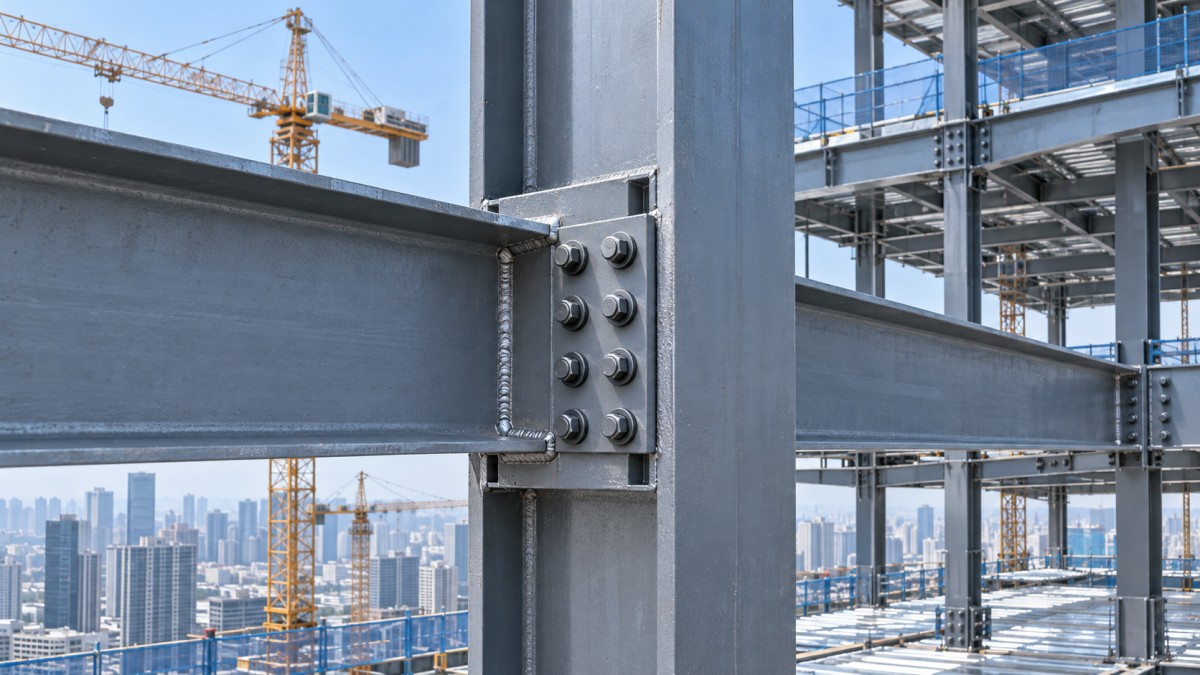
“Bolted versus welded” can be a misleading distinction. A beam may arrive with a welded end plate, then be bolted to a column. A column splice may combine bearing, bolts, and welds. The purchasing decision is often about where the work happens, rather than choosing one joining method throughout the building.
Shop welding offers controlled access, stable workstations, lifting equipment, and more manageable environmental conditions. Fabricators can position assemblies to improve welding productivity and organize inspection around production. Field welding takes place within the constraints of the erection sequence, often with difficult access and additional weather protection.
Field bolting transfers some of that effort upstream. Connection plates must be fabricated, holes accurately located, and bolt assemblies supplied in the correct sizes and grades. The site receives a more assembly-ready package, but the workshop has done more preparation.
For procurement, ask bidders to identify shop work and field work separately. Otherwise, a low fabrication price may conceal expensive site operations, while a higher supply price may actually buy a faster erection cycle.
Where bolting usually earns its cost advantage
Less time completing connections at height
When members fit as intended, erection crews can position the steel, install the required initial bolts, and proceed through the engineered erection sequence. Final tightening and inspection may follow in a coordinated operation, subject to the connection requirements and erection plan.
Field welding introduces preparation, fit-up, welding, and inspection activities. Depending on the joint and procedure, crews may also need preheating, interpass temperature control, back-gouging, or work platforms that support sustained access. These tasks are not inherently inefficient, but they can consume expensive hours above ground.
The advantage is strongest where a tower repeats similar details floor after floor. Standard connection families help crews establish a rhythm, reduce tool changes, and simplify material distribution. A bolted detail that requires awkward access or too many installation steps may deliver much less benefit.
A more predictable erection cycle
Crane time can outweigh the apparent difference in connection material cost. Once a member has been secured and the structure is stable under the approved erection plan, the crane can move to its next lift. Connections that reach that condition quickly can improve utilization.
However, it would be wrong to assume that every welded connection keeps a member on the hook until welding is finished. Welded erection schemes can use temporary bolts, seats, or other engineered supports. Compare the actual sequence, including temporary works, rather than relying on the connection label.
Predictability also matters. Field welding may require protection from wind and precipitation, while cold conditions can affect preheat arrangements. Bolting is not weather-proof—high winds can stop lifting, and ice or contamination can interfere with assembly—but it often reduces weather-sensitive joining work.
Different inspection burdens, not inspection-free work
Structural bolts still require verification of the specified assemblies, joint condition, installation method, and applicable inspection requirements. Pretensioned and slip-critical joints need more attention than simple snug-tight joints. Faying-surface preparation can also create costs that are easy to miss in an early estimate.
Weld inspection depends on the joint, specification, and governing requirements. Visual inspection may be supplemented by nondestructive testing, such as ultrasonic or magnetic particle testing where specified. Repairs can trigger further inspection and delay acceptance.
Neither method eliminates quality risk. Bolting often shifts the inspection effort toward repeatable installation checks, while welding can require more specialized examination and repair planning.
A cost comparison that includes the work around the connection
The following comparison is a budgeting guide, not a universal ranking. Structural performance and project specifications determine which options are available.
Use a consistent estimate boundary: fabrication + connection materials + delivery and handling + erection labor + equipment + inspection + temporary works + expected rework + attributable schedule costs.
Keep schedule savings realistic. Faster connection work does not automatically shorten the whole project. It creates financial value when steel erection is on the critical path or when it reduces measurable crane hire, site overhead, or follow-on trade delays. Avoid counting the same time saving in several cost categories.
When welding can still be the better choice
High-rise structures must satisfy gravity, wind, and, where applicable, seismic demands. Connection strength, stiffness, ductility, fatigue performance where relevant, and the chosen lateral system take priority over installation convenience.
Welding can be appropriate for heavily loaded joints, constrained geometries, or details where bolted plates and fasteners would become bulky or difficult to install. Some moment connections and complex transfer assemblies may favor welded solutions. That does not mean all moment connections require field welding; qualified bolted alternatives may be available for the relevant system.
A welded option can also reduce connection material or avoid an impractical arrangement of bolt groups and splice plates. On an isolated, complex connection, those benefits may outweigh higher site labor. Conversely, using that same detail across hundreds of repeated locations could create a substantial erection burden.
Do not substitute bolting for welding simply because the labor estimate looks lower. Any change must be checked by the responsible structural engineer against the governing design and execution requirements. The comparison should preserve equivalent performance, including stiffness and deformation behavior—not just nominal strength.
The hidden costs that can erase bolting savings
Fit-up problems travel straight to the workface
Bolted erection relies on dimensional control. Column position, member length, hole location, plate alignment, and accumulated tolerances must work together. A connection that assembles easily in a model can become troublesome when survey deviations and fabrication tolerances combine.
Misalignment can interrupt lifting and require engineering review. Crews should not assume that holes can be enlarged, parts flame-cut, or members forced into place without approval. Specify an agreed tolerance strategy and a process for resolving nonconformances before steel reaches the site.
Tool clearance is part of connection design
A bolt shown clearly on a drawing may be difficult to tighten beside a column flange, stiffener, deck edge, or adjacent connection. Restricted access increases labor and can complicate installation verification.
Review the connection with the actual erection tools and sequence in mind. Where details are dense, a constructability review or trial assembly can reveal problems before they repeat across multiple floors.
Unnecessary complexity accumulates
Not every joint needs the same tightening regime or surface preparation. Applying more demanding requirements than necessary can increase installation and inspection costs. Equally, omitting required pretension or slip resistance is not a legitimate saving.
The design team should specify the appropriate joint category for each application. Procurement teams can then price the actual requirement instead of assuming all structural bolts involve identical work.
How to obtain bids that support a real decision
A tender asking only for a “bolted option” and a “welded option” leaves too much room for different assumptions. Define comparable scope and invite the fabricator and erector to explain how each solution will be built.
- Establish the performance baseline. Identify the governing standards, connection forces, structural system, and permitted alternatives.
- Request a connection schedule. Separate repetitive beam connections, column splices, moment connections, bracing joints, and exceptional transfer details.
- Break out workshop and site costs. Include plates, holes, bolts, weld preparation, consumables, labor, access, and inspection.
- Ask for an erection sequence. Identify crane-release conditions, temporary stability measures, final tightening or welding stages, and inspection hold points.
- Clarify exclusions. Check who provides weather protection, power, testing, repair inspection, survey support, and temporary works.
- Test supply readiness. Confirm availability of the specified sections, plates, and fasteners, alongside fabrication capacity and delivery sequencing.
Steel supply decisions matter here. Changes in section availability, plate thickness, or member geometry can affect connection design and fabrication time. An apparently economical detail loses value if it depends on material that cannot arrive within the erection program.
Ask bidders to state their main productivity assumptions rather than submitting one unexplained lump sum. You need to know whether the price depends on unrestricted access, repeated details, favorable weather, or unusually tight fabrication tolerances.
Choose the connection strategy, not a universal winner
For a tower with repetitive framing, reliable fabrication, and accessible joints, shop-welded components with field-bolted assembly are often a strong starting point for cost evaluation. They place much of the skilled joining work in a controlled environment while keeping site operations focused on lifting and assembly.
Where geometry is congested or structural demands favor welded details, retain welding and plan it properly. Include access, environmental protection, inspection, and repair contingencies in the estimate rather than treating them as later site problems.
The answer to whether bolting costs less than welding is therefore usually favorable to field bolting, but conditional on the complete connection and erection strategy. Compare representative details, validate the erection cycle, and price the risks on both sides. The best choice is the one that meets the design requirements while delivering the lowest credible installed cost—not simply the lowest connection quote.
Please give us a message
Tianjin Kaichuang Metal Material Co., Ltd
Add: No. 41, District 6, First Street, Huanghuadian Town, Wuqing District, Tianjin
Tel: + 86 137 9101 9833
E-mail: boss@kaichsteel.com