Steel Hub

Why H Beam Steel Dimensions Matter Early
Understanding H beam steel dimensions starts with one practical fact: size decisions affect far more than structural strength.
They also shape fabrication speed, connection design, transport limits, erection methods, and material cost.
That is why dimension selection should happen early, not after drawings are nearly complete.
In most projects, H beam steel dimensions are reviewed against three filters: load capacity, fit within the structure, and supply availability.
If one filter is ignored, the result is usually rework, delay, or unnecessary overspecification.
From a project control perspective, the best section is rarely the largest one.
It is the section that meets design intent with clear procurement and installation efficiency.
This also means dimension review should connect engineering teams with purchasing and site execution teams.
When that coordination happens early, decisions around H beam steel dimensions become faster and more reliable.
What H Beam Steel Dimensions Actually Include
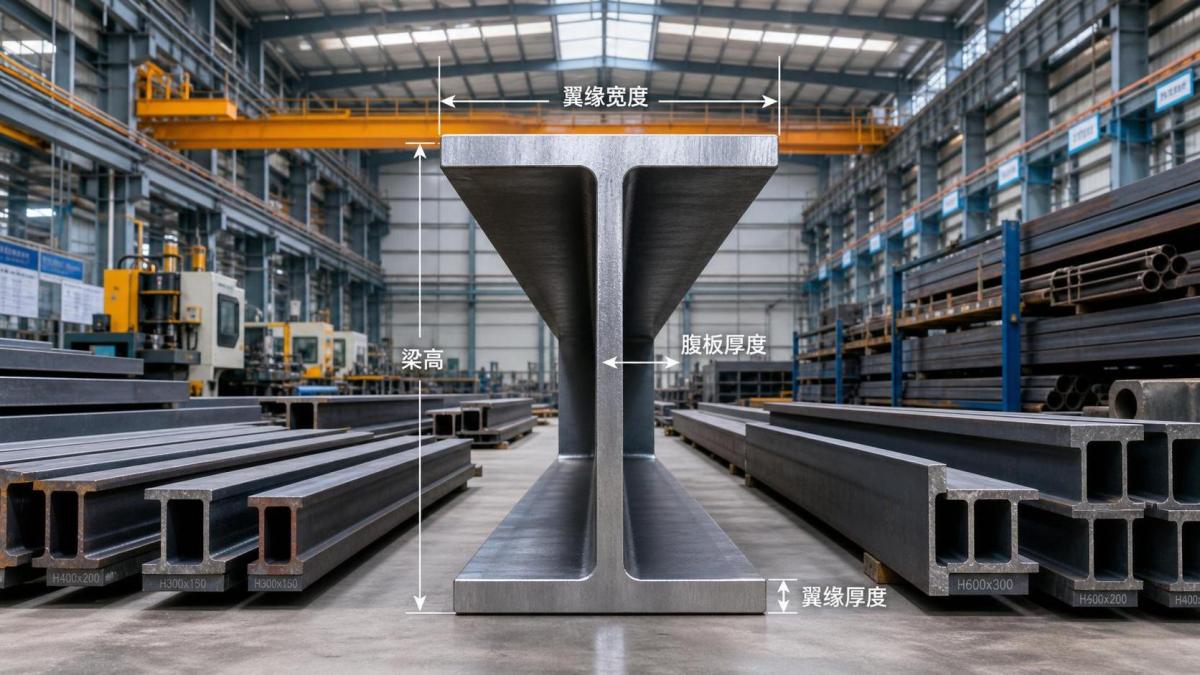
Many buyers focus only on beam height, but H beam steel dimensions include several linked values.
The key measurements are overall depth, flange width, web thickness, flange thickness, and unit weight.
These dimensions define how the beam resists bending, shear, and local deformation.
They also determine connection details, bolt clearance, weld access, and compatibility with plates or columns.
In practice, two beams with similar depth can perform very differently because flange and web proportions change.
That is where simple dimension reading becomes technical judgment.
Core dimensions to check
- Overall depth: influences bending stiffness and floor-to-floor integration.
- Flange width: affects stability, bearing area, and connection layout.
- Web thickness: matters for shear resistance and web buckling control.
- Flange thickness: supports moment capacity and welding strength.
- Weight per meter: directly impacts budget, lifting, and shipping.
A standard size table is useful, but it should never replace structural verification.
How Dimensions Affect Load Capacity
Load capacity is the main reason people study H beam steel dimensions, but capacity is not one single number.
It depends on span, support conditions, load type, unbraced length, steel grade, and connection behavior.
Still, dimensions tell you where the section’s strength is coming from.
A deeper beam usually improves bending performance because more material sits farther from the neutral axis.
Wider and thicker flanges improve moment resistance and reduce local flange issues under concentrated forces.
A thicker web helps carry shear and can reduce stiffener requirements in certain conditions.
However, increasing one dimension without reviewing the whole section can produce an inefficient result.
A quick capacity reading approach
- Start with the design load and span range.
- Check likely failure modes, not just bending.
- Compare several H beam steel dimensions, not only one preferred size.
- Review deflection limits, especially for platforms, floors, and crane-related structures.
- Confirm the chosen size still works with the planned connections.
This step is especially useful when schedule pressure pushes teams toward fast substitutions.
Fit, Clearance, and Coordination on Real Projects
A beam can meet structural demand and still create problems if the fit is wrong.
This is where H beam steel dimensions become a coordination issue, not only an engineering one.
Beam depth affects ceiling space, service routing, cladding interfaces, and equipment clearance.
Flange width can interfere with base plates, adjacent members, or compact joint conditions.
Unit weight influences crane selection, temporary supports, and lifting sequence on site.
In industrial buildings, these fit issues become more visible because services and steel often compete for the same space.
Common fit checks before release
- Headroom and service corridor clearance.
- Column-to-beam connection space.
- Transport restrictions for length and handling weight.
- Erection sequence and temporary stability.
- Compatibility with standard plates, bolts, and weld procedures.
More often than expected, a slightly smaller section with better integration lowers total project cost.
Reading Standard Size Tables Without Misjudgment
Standard catalogs make H beam steel dimensions easier to compare, but they can also create false confidence.
A listed size does not automatically mean immediate availability, code compliance, or economic advantage.
Different regions use different series, standards, and tolerances.
That matters when a project spans multiple suppliers or imported material routes.
It is also important to separate nominal dimensions from actual rolling tolerances.
In tight assemblies, tolerance differences can affect fit-up, welding gaps, and bolt alignment.
Useful questions when reviewing a table
- Which standard defines these H beam steel dimensions?
- What is the steel grade paired with the section?
- Are tolerances acceptable for the connection details?
- Is this size routinely stocked or made to order?
- What is the lead time if quantities increase late?
Those questions reduce surprises during procurement, which is often where dimension assumptions get exposed.
Typical Dimension Tradeoffs by Application
Not every project evaluates H beam steel dimensions in the same way.
A warehouse frame, equipment platform, transfer structure, and commercial building each prioritize different outcomes.
For long spans, depth usually becomes the dominant issue because stiffness and deflection control are critical.
For heavy point loads, flange and web proportions need closer review.
For modular or prefabricated systems, weight and handling limits can become more important than pure section efficiency.
This is why copying a section from a previous project can be risky.
Similar geometry does not guarantee similar loading or installation constraints.
A Practical Selection Process That Saves Time
The fastest way to manage H beam steel dimensions is to use a repeatable review process.
That process should combine engineering need with procurement realism.
Recommended workflow
- Define design loads, span, support conditions, and service criteria.
- Shortlist several H beam steel dimensions that fit the structural scheme.
- Check connection space, erection constraints, and routing conflicts.
- Verify stock range, lead time, and substitution flexibility with suppliers.
- Freeze the size only after cost, fit, and capacity align.
In actual delivery, this method usually prevents last-minute redesign caused by unavailable sections.
It also helps keep change orders under control when project conditions shift.
Final Takeaway on H Beam Steel Dimensions
H beam steel dimensions are not just catalog data.
They are decision points that influence load capacity, structural fit, fabrication logic, and supply chain timing.
The strongest choice is usually the one that balances performance with constructability and reliable sourcing.
When reviewing H beam steel dimensions, compare section properties, clearance impact, tolerances, and availability together.
That approach supports cleaner planning, fewer surprises, and better cost control from design through installation.
For the next steel package review, start by validating which H beam steel dimensions truly match the load path and site conditions.
Please give us a message
Tianjin Kaichuang Metal Material Co., Ltd
Add: No. 41, District 6, First Street, Huanghuadian Town, Wuqing District, Tianjin
Tel: + 86 137 9101 9833
E-mail: boss@kaichsteel.com