Steel Hub

How Just-in-Time Steel Delivery Keeps Erection Schedules on Track
For project managers, steel structure erection material just in time delivery is more than a logistics strategy. It protects crane utilization, crew productivity, critical milestones, and budget certainty.
When fabricated steel arrives in the correct sequence, at the confirmed time, and with complete documentation, erection teams can keep building instead of searching, waiting, rehandling, or rescheduling.
The key point is simple: just-in-time delivery works only when fabrication, inspection, transport, site readiness, and erection planning operate as one coordinated control system.
Why Delivery Timing Directly Affects Steel Erection Performance
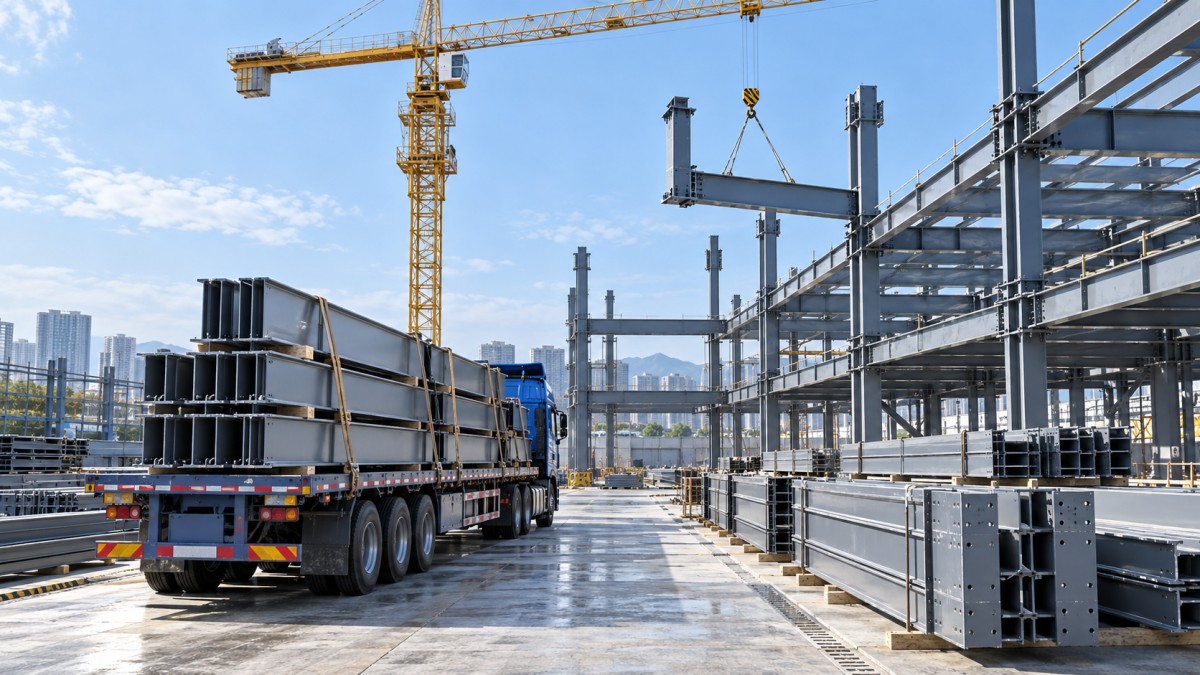
Steel erection is highly dependent on sequence. A missing connection plate, delayed column, or incorrectly loaded beam can stop an entire lifting operation even when most materials are available.
Unlike general construction materials, structural steel cannot always be substituted on site. Every member has a defined location, connection arrangement, mark number, and installation order.
Project managers therefore need more than assurance that steel has shipped. They need confidence that the right release package will reach the site before the planned lift.
Just-in-time steel delivery aligns material releases with the erection schedule. Instead of filling the site with steel weeks early, suppliers deliver prioritized assemblies when crews need them.
This approach reduces congestion, but its greater value is schedule protection. It prevents material availability from becoming the hidden cause of crane idle time and labor disruption.
For a project with expensive lifting equipment, even a short interruption can have significant consequences. Crane standby charges, overtime, remobilization, and lost productivity compound quickly.
A reliable delivery plan also protects downstream activities. Decking, concrete work, roofing, facade installation, mechanical work, and interior trades often depend on steel zones being released on time.
When erection falls behind, the impact rarely remains isolated within the steel package. The delay can affect access, safety planning, subcontractor sequencing, and overall project completion dates.
From a management perspective, delivery reliability should be treated as a schedule-control metric, not merely a purchasing or freight-management responsibility.
What “Just-in-Time” Actually Means for Structural Steel
Just-in-time does not mean delivering steel at the last possible minute. It means delivering materials within an agreed window that supports planned installation without creating excessive site inventory.
The correct window depends on site conditions, unloading capacity, weather exposure, laydown space, traffic restrictions, and the consequences of a transport delay.
For some projects, the practical buffer may be one day. For remote sites, large bridge components, or restricted urban deliveries, managers may require several days of controlled reserve.
A successful program begins with the erection sequence, not the fabrication shop schedule. The fabricator must understand which structural zones, floors, frames, or member groups are needed first.
Delivery packages should reflect erection logic. Columns, beams, braces, connection materials, and special components must arrive in a sequence that lets crews complete stable, safe work areas.
Shipping a large quantity of steel without sequence discipline may satisfy a production target, but it can create site-level disorder and slow actual installation progress.
Material marks, bundle labels, loading plans, and packing lists should all support rapid identification. The site team should not need to unload multiple bundles to locate one required member.
In practical terms, steel structure erection material just in time delivery combines physical delivery, information accuracy, and release timing. Failure in any of these areas weakens the system.
A truck arriving on time with incomplete documents can still create delays. Likewise, a complete shipment arriving several days early may create storage, safety, and handling problems.
Start With the Erection Sequence, Not the Shipping Calendar
The most common planning mistake is building a delivery schedule from fabrication completion dates. That approach is convenient for the supplier but may not match field installation priorities.
Project managers should require a rolling delivery plan tied to the latest approved erection schedule. The plan should identify work fronts, planned lifts, shipment dates, and contingency windows.
Each delivery package should be linked to a specific erection area. Typical references include grid lines, floor levels, building zones, frames, truss sections, or structural phases.
This connection allows site supervisors to confirm whether delivered materials support the next planned work package, rather than simply measuring total tonnage delivered.
Tonnage is useful for reporting progress, but it does not prove readiness. A project may receive eighty percent of its steel while still lacking the members required for tomorrow’s crane picks.
The delivery plan should also identify sequence-critical items early. These may include transfer girders, long-span trusses, heavy columns, special braces, embedded components, or nonstandard connections.
Critical members deserve separate tracking because their delay can block multiple follow-on tasks. They should not be treated as ordinary pieces within a general shipment status report.
Weekly coordination meetings should compare planned erection activities with actual fabrication, inspection, loading, transport, and delivery status. The discussion must focus on upcoming constraints, not past achievements.
A look-ahead period of two to six weeks is often effective. It gives teams time to resolve drawing issues, procurement gaps, capacity constraints, transport permits, and site access conflicts.
Control Fabrication Readiness Before Promising Delivery Dates
A delivery date is only reliable when fabrication readiness has been verified. Managers should avoid accepting dates based only on planned production output or incomplete shop-floor estimates.
Before release, steel members should have completed fabrication, dimensional checks, welding inspection, coating requirements, marking, packing, and documentation reviews required by the project specification.
Quality problems found after loading are especially disruptive. Rework may delay a complete shipment, force partial releases, or cause the site team to revise its erection sequence.
For this reason, fabrication status should distinguish between “in production,” “fabricated,” “inspected,” “approved for shipment,” and “loaded.” These stages are not interchangeable.
Project managers benefit from a simple readiness dashboard showing planned quantities, completed quantities, inspection status, release risks, and shipment commitments for each upcoming erection zone.
Color-coded reporting can help, but the underlying definitions must remain strict. A package should not appear green unless every sequence-critical member is available and cleared for shipment.
Connection materials require equal attention. Bolts, nuts, washers, shims, splice plates, temporary bracing items, and other small components can stop work despite representing little value or weight.
Where practical, these accessories should be packed by erection zone or assembly. Mixed hardware cartons increase the chance of lost parts, incorrect installation, and time-consuming sorting.
Fabricators should also communicate anticipated changes early. A credible early warning enables schedule recovery; a late surprise often leaves the field team with few workable alternatives.
Design Transport and Loading Around Site Installation Needs
Transport planning has a direct effect on how efficiently erection crews work. A shipment must be safe and compliant, but it should also minimize unnecessary unloading, sorting, and rehandling.
Loading sequence matters because materials are removed in reverse order. If priority members are buried beneath later-use steel, the site may need additional handling before installation can begin.
For constrained sites, managers should request truck-specific loading plans. These plans show the member marks, bundle locations, weights, unloading order, and required lifting equipment.
Oversized or heavy steel may require route studies, permits, escort vehicles, restricted delivery hours, or special trailers. These requirements need confirmation well before fabrication reaches completion.
Urban sites introduce additional risks. Limited street access, noise restrictions, delivery booking systems, lane closures, and local authority permits can turn a routine shipment into a critical constraint.
Weather should also be included in logistics planning. High winds may suspend crane operations, while severe rain, snow, or road conditions can affect loading, transport, unloading, and safe storage.
Managers should define who has authority to reschedule a shipment when site conditions change. Without clear decision rights, trucks may arrive during unsafe or impractical unloading conditions.
Transport providers need accurate delivery instructions, site contacts, access maps, booking times, unloading requirements, and emergency communication procedures. Vague instructions create avoidable delays at the gate.
The objective is not simply getting steel to the project. It is delivering a usable package that can be unloaded safely and erected with minimum disruption.
Reduce Site Congestion Without Creating Material Shortages
One major benefit of just-in-time delivery is reduced laydown pressure. Structural steel can occupy substantial space, especially when members require separation, dunnage, inspection access, and safe lifting clearance.
Excessive inventory can block vehicle routes, interfere with other trades, increase handling requirements, and create hazards around active crane and equipment operations.
However, an aggressive low-inventory approach can become fragile. Projects need enough material buffer to absorb realistic disruptions without forcing crews to stop work immediately.
The appropriate buffer should be based on project risk, not a generic rule. Factors include supplier distance, transport reliability, weather exposure, fabrication complexity, and availability of alternative work fronts.
A site with flexible erection zones may tolerate a smaller buffer because crews can switch areas. A project with one critical crane path may need more protected inventory.
Managers should separate “productive buffer” from “uncontrolled surplus.” Productive buffer supports the next planned lifts, while surplus consists of materials with no near-term installation purpose.
Laydown planning should show where each delivery package will be placed, how it will be accessed, and whether it can be lifted directly from the storage position.
Direct-to-crane delivery can be effective for tightly constrained sites, but it requires extremely dependable scheduling. Any transport delay can immediately affect lifting operations.
For most projects, a controlled short-term laydown area offers better resilience. It allows inspection and preparation while preserving enough flexibility to manage normal delivery variability.
Use Clear Metrics to Measure Whether the System Is Working
Managers should evaluate just-in-time delivery using schedule and operational measures, not only freight cost. Lower transport cost has limited value if late steel causes expensive erection disruption.
A useful metric is on-time, in-full delivery. This measures whether each shipment arrived within its agreed window and contained every required member, accessory, and document.
Another important measure is crane waiting time caused by material issues. Recording this separately helps distinguish logistics failures from weather, equipment, labor, or engineering constraints.
Rehandling hours are also valuable. High rehandling indicates poor loading sequence, insufficient identification, unsuitable laydown planning, or deliveries arriving before the site can use them.
Managers can also track planned versus actual erection package readiness. This metric reveals whether the project is receiving complete workable zones instead of fragmented quantities.
Exception reports should identify the root cause of every material-related delay. Typical categories include late fabrication, inspection hold, missing hardware, transport delay, site access conflict, or incorrect loading.
Over time, this data improves forecasting and supplier management. It also provides evidence when delivery performance affects contractual responsibilities, claims, or recovery planning.
Reporting should remain concise and forward-looking. A project team needs to know what threatens the next week’s activities, who owns the response, and when the issue will be resolved.
The most effective dashboard is one that supports decisions during coordination meetings. It should connect material status to the actual erection plan rather than presenting isolated logistics statistics.
Manage Risks Before They Become Erection Delays
Just-in-time delivery depends on coordination across several organizations. Fabricators, transport companies, site teams, cranes, inspectors, engineers, and subcontractors all influence the final outcome.
Because the process has multiple handoffs, managers should establish formal escalation paths. A missing member should trigger immediate investigation rather than waiting until the delivery date has passed.
Engineering changes are a frequent source of disruption. Revised drawings, changed connection details, or late approvals can affect fabrication priorities and invalidate previously agreed shipment plans.
The delivery plan should therefore be updated when design changes affect sequence-critical work. Continuing to use outdated release schedules creates misleading confidence and increases field-level confusion.
Material traceability is another important control. Each member should remain identifiable from fabrication through delivery, unloading, storage, and installation, particularly on large or complex projects.
Barcode, QR code, RFID, or digital material tracking systems can improve visibility. Their value comes from disciplined use, accurate master data, and prompt status updates by responsible teams.
Contingency planning should identify alternative work areas, backup transport options, reserve hardware, and priority recovery actions. The goal is to preserve productive work when disruptions occur.
Not every risk can be eliminated, especially weather and transport restrictions. Strong planning ensures that predictable uncertainty does not automatically become a schedule crisis.
Contract terms should also support collaboration. Delivery responsibilities, notification periods, documentation requirements, access constraints, and delay procedures should be clear before project execution begins.
When Just-in-Time Steel Delivery Is the Right Choice
Just-in-time delivery is particularly valuable where site space is limited, crane time is expensive, project sequencing is complex, or multiple trades must operate within restricted work areas.
High-rise buildings, urban commercial developments, industrial facilities, transportation projects, and phased expansions often gain significant value from disciplined delivery coordination.
It can also support projects with long steel members or heavy assemblies that are difficult to store safely. Delivering closer to erection reduces exposure to damage and repeated handling.
However, just-in-time delivery may be less suitable when road access is highly unreliable, supplier capacity is uncertain, weather conditions are severe, or the site lacks schedule flexibility.
In those cases, a hybrid approach is often stronger. The project can maintain a controlled reserve of critical steel while continuing to schedule ordinary materials close to installation dates.
The decision should be based on total project risk and cost. Managers should compare storage expense against potential losses from crane downtime, labor disruption, delayed milestones, and recovery work.
A well-managed program does not pursue minimum inventory at all costs. It pursues the best balance between site efficiency and the resilience needed to protect the erection schedule.
Conclusion: Treat Delivery as Part of the Erection Plan
Steel structure erection material just in time delivery keeps schedules on track when it is planned as an integrated construction process, not as a final transport activity.
The strongest programs begin with the erection sequence, verify fabrication and quality readiness, load materials in usable order, and maintain controlled visibility through final installation.
For project managers, the central question is not whether steel has been dispatched. It is whether complete, approved, sequence-ready material will support the next planned lift.
When teams manage that question consistently, they reduce site congestion, protect crane productivity, improve coordination with downstream trades, and create a more predictable path to project completion.
Please give us a message
Tianjin Kaichuang Metal Material Co., Ltd
Add: No. 41, District 6, First Street, Huanghuadian Town, Wuqing District, Tianjin
Tel: + 86 137 9101 9833
E-mail: boss@kaichsteel.com