Steel Hub

Why Unit Price Is a Poor Way to Compare Steel Sheet Quotes
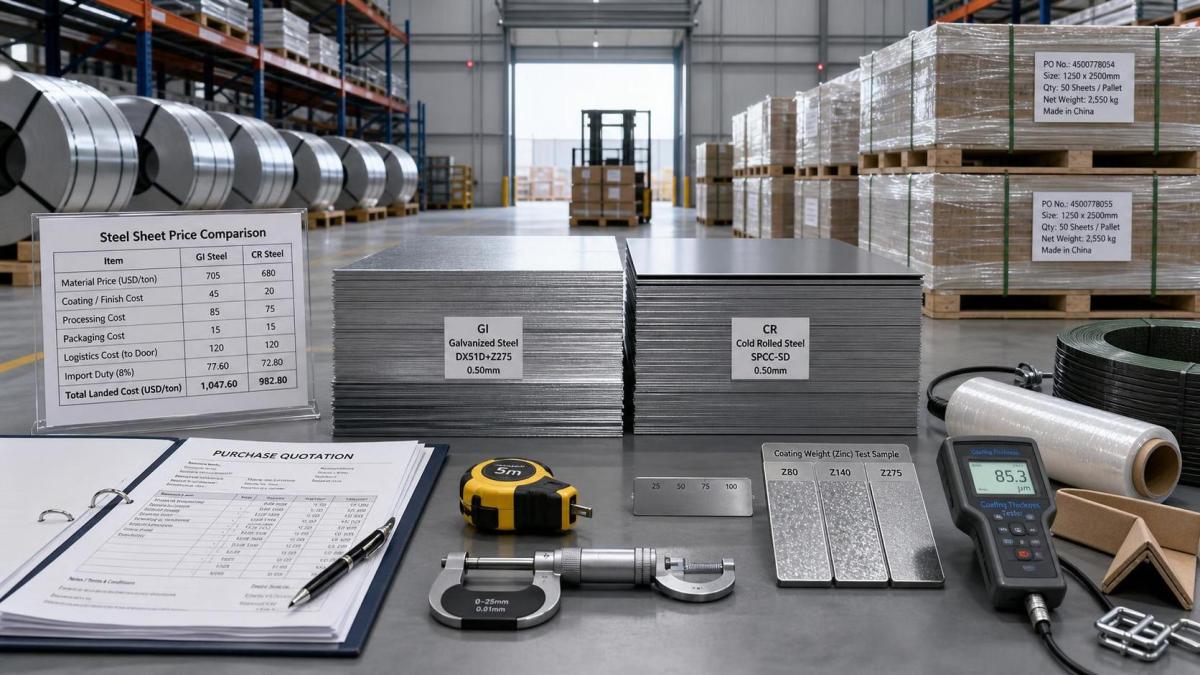
Comparing steel sheet offers by unit price looks efficient, but it often creates expensive blind spots.
A lower steel sheet price can hide specification gaps, weaker terms, or delivery risks that surface later.
That matters because steel sheet procurement affects production timing, working capital, and budget accuracy at the same time.
In practice, two suppliers may quote the same product name while offering different grades, tolerances, coatings, and logistics scope.
The result is simple.
The apparent savings on steel sheet can disappear once claims, scrap, rework, storage, or rush transport enter the picture.
A better comparison starts with total landed cost, not just the number written beside price per ton.
Start with a Like-for-Like Steel Sheet Specification Check
Before comparing any steel sheet price, confirm that every quote reflects the same technical baseline.
This is where hidden cost usually begins.
A quote for commercial-grade steel sheet is not comparable to one for a higher-strength or tighter-tolerance product.
Check these points line by line:
- Steel grade and standard, such as ASTM, JIS, EN, or GB.
- Thickness, width, length, and allowed tolerance range.
- Hot rolled, cold rolled, galvanized, or coated finish.
- Surface quality, flatness, edge condition, and oiling requirements.
- Coil versus sheet format and acceptable weight per piece or bundle.
Even a small difference in thickness tolerance can change usable yield and final processing cost.
For example, a cheaper steel sheet with wider tolerance may increase scrap during cutting or stamping.
That extra waste rarely appears in the supplier quote, but it appears very quickly in actual cost.
Look Beyond Base Steel Sheet Price to Process and Coating Variables
Not all steel sheet pricing is driven by raw steel alone.
Processing route and coating specification can move total cost more than expected.
A galvanized steel sheet quote, for instance, may include different zinc coating weights.
Those differences affect corrosion resistance, service life, and replacement risk.
The same applies to pickling, skin pass, slitting, leveling, and protective film.
When comparing steel sheet quotes, ask whether these items are included, optional, or excluded.
A quote that excludes finishing steps can look attractive at first, then become expensive after add-on charges.
More importantly, inconsistent coating or finish can trigger downstream quality claims from your own customers.
Calculate Landed Cost, Not Just Quoted Steel Sheet Price
A disciplined comparison uses landed cost as the main decision metric.
That means the steel sheet price should be evaluated together with every charge required to receive usable material.
Include these cost layers:
- Freight, fuel surcharge, port fees, and inland delivery.
- Export packing, waterproof wrapping, pallets, and reinforcement.
- Insurance, customs duty, and import clearance costs.
- Inspection, testing, and certificate charges.
- Bank fees linked to payment terms or trade instruments.
This is especially important when steel sheet suppliers use different Incoterms.
An FOB steel sheet offer cannot be judged directly against a DDP or CIF offer without adjustment.
If you compare them as if they were equal, your approval decision will be distorted from the start.
A Simple Comparison Table
Watch for Hidden Financial Costs in Payment and Inventory Terms
The steel sheet price is only one part of the funding equation.
Payment structure can either support cash flow or quietly raise the true purchase cost.
For example, a low steel sheet quote that requires full prepayment carries financing cost and higher exposure.
A slightly higher quote with balanced milestones may be more efficient from a capital perspective.
Also review minimum order quantity and shipment batch size.
If a supplier forces excess steel sheet inventory, storage and cash occupation rise together.
That is a hidden cost, even when the tonnage price appears competitive.
Recent market volatility makes this even more relevant.
Holding too much steel sheet during falling prices can create an immediate balance-sheet drag.
Measure Delivery Risk Before Approving Any Steel Sheet Purchase
Delivery reliability belongs in the price comparison, even though it does not appear on the quote face.
Late steel sheet can disrupt fabrication, assembly, and customer shipment commitments.
That usually leads to overtime, urgent rescheduling, or premium freight.
When comparing steel sheet suppliers, ask for actual lead-time performance, not only promised lead time.
Useful checks include:
- On-time delivery rate over the last six to twelve months.
- Supply source stability for raw material and rolling capacity.
- Backup plan for transport delays or port congestion.
- Claim response speed and replacement commitment.
A cheap steel sheet quote loses value quickly if the supplier cannot deliver to your production window.
Use a Practical Steel Sheet Quote Scorecard
To make faster approvals, turn the comparison into a simple weighted scorecard.
This creates consistency and reduces debate driven by headline price alone.
A useful steel sheet scorecard can include:
- Base price: 30%
- Specification compliance: 20%
- Freight and landed cost: 15%
- Payment terms and cash impact: 15%
- Delivery reliability: 10%
- Claim handling and supplier support: 10%
The exact weights can change by business model, but the principle remains stable.
Steel sheet should be approved on economic value, not on isolated quote optics.
Final Checklist for Smarter Steel Sheet Price Comparison
Before signing off on a steel sheet purchase, run one final review.
- Confirm all steel sheet specifications match exactly.
- Convert every quote into the same Incoterm and landed-cost basis.
- Check whether packaging, testing, and documentation are included.
- Estimate cash-flow impact from deposit, credit term, and inventory level.
- Review lead-time credibility and replacement support.
- Use a scorecard so the steel sheet decision stays objective.
The core idea is straightforward.
A lower steel sheet price is only better when the material, delivery, and financial terms are truly comparable.
Once you compare total cost instead of unit price, approval decisions become faster and far more reliable.
That approach reduces budget surprises, protects supply continuity, and gives purchasing teams a stronger basis for negotiation.
Please give us a message
Tianjin Kaichuang Metal Material Co., Ltd
Add: No. 41, District 6, First Street, Huanghuadian Town, Wuqing District, Tianjin
Tel: + 86 137 9101 9833
E-mail: boss@kaichsteel.com