Steel Hub

How to compare quotes for heat-treated steel plates
Comparing quotes in the heat-treated steel plates market requires more than finding the lowest price per ton. Differences in steel grade, heat treatment, plate dimensions, testing, certification, delivery terms and lead times can change both the total cost and the suitability of an order. A quote that looks attractive on a spreadsheet may leave out the inspection, cutting allowance or freight needed to put the plate into production.
The aim is not to make every supplier offer identical. It is to establish which differences matter, price the ones that can be priced, and make a deliberate decision about the remaining risks.
Start with the specification, not the price
A useful comparison begins with the purchase specification sent to suppliers. If one quotation is based on a full project specification and another on a grade name alone, the prices are not yet comparable.
Check the product standard, grade, delivery condition, thickness and dimensions shown on each offer. Where the project calls for supplementary requirements, such as additional impact testing or ultrasonic examination, verify that they appear in the quoted scope. A general statement that material is “to specification” is less useful than a clear list of the requirements the supplier has accepted.
Grade substitutions deserve particular attention. A supplier may propose a different standard or grade with similar stated properties, but similar numbers on a data sheet do not establish interchangeability. Chemical composition, thickness-dependent requirements, testing conditions and fabrication rules may differ. Send proposed substitutions to engineering or the project authority for approval before treating them as equivalent.
Also confirm the applicable edition of the standard and any project-specific overrides. A quotation that omits an edition is not necessarily wrong, but it leaves room for disagreement when inspection documents are reviewed.
Check what “heat-treated” means in each offer
Heat treatment is a delivery condition, not a single process. Depending on the grade and application, plate may be supplied normalized, quenched and tempered, or in another specified condition. These routes are not interchangeable merely because both involve heating the steel.
Ask suppliers to identify the required condition and confirm that the quoted plate will meet it in the ordered thickness. Mechanical properties and testing requirements must be checked against the relevant standard and project specification; they should not be inferred from treatment terminology alone.
The sequence of processing matters too. If a plate will be cut, welded, formed or stress relieved after delivery, discuss the planned operations with the material supplier and fabricator. Subsequent heating or forming may affect properties or acceptance requirements. The purchase order should make clear who is responsible for any additional treatment and testing after fabrication.
For stock material, ask whether the plate is already in the required final condition and whether its documentation can be supplied before dispatch. For material requiring treatment after order placement, confirm where the work will be done and whether the quoted lead time includes it.
Translate the plate price into a usable-material cost
Plate quotations can differ in ways that are easy to overlook: theoretical weight versus actual weight, full plates versus cut pieces, or different tolerances and oversupply allowances. Request the weight basis and the quantity that will be invoiced, not just the nominal size.
A lower price per tonne may be offset by extra material that cannot be used in the cutting plan. Conversely, a higher-priced cut-to-size offer may reduce handling and cutting work, provided the quoted dimensional and edge tolerances suit the fabrication process. Compare offers against the finished parts or usable plate area required, while keeping scrap ownership and disposal costs visible.
Do not assume every plate can be nested in the same way. Grain direction, edge preparation, minimum spacing between cuts and the location of any test samples can affect yield. Where yield is significant, ask the fabricator to review the proposed plate sizes before choosing on unit price.
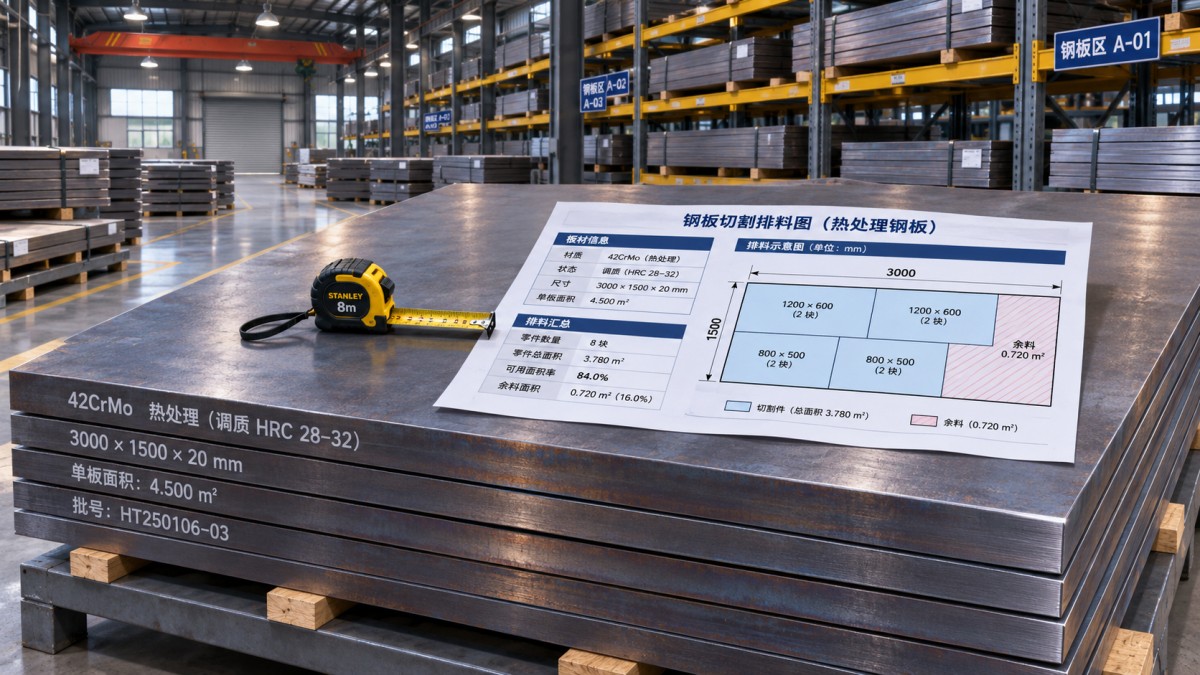
Thickness tolerance also matters commercially. If the application has a tight finished-thickness requirement, a plate that meets a general standard tolerance may still require machining or may not leave enough allowance. State the acceptable tolerance and any machining allowance in the inquiry rather than relying on a supplier’s standard practice.
Put inspection and documentation on the same footing
Testing costs are often buried in the wording of a quote. One supplier may include only the tests required by the base product standard; another may include additional examinations requested by the project. Neither offer should be marked cheaper until the scope is aligned.
Review the test type, applicable acceptance criteria, sampling requirements and whether witnessing is required. For ultrasonic testing, for example, the inquiry should identify the applicable examination standard and acceptance level where required. “Ultrasonically tested” on its own does not describe the full scope.
Clarify who pays if retesting, replacement or reinspection becomes necessary, and how nonconforming material will be handled. The answer depends on the contract and the circumstances; it should not be left until a plate fails an acceptance check.
Document requirements can affect both price and schedule. Specify the required inspection document, such as an EN 10204 type where applicable, along with traceability and marking requirements. Confirm whether documents will identify the relevant heat and plate, and when draft and final certificates will be available. If third-party inspection is required, establish who appoints and pays the inspector, and whether the inspection slot is included in the delivery plan.
Compare delivered cost using a common boundary
The fairest price comparison brings each offer to the same delivery point and includes the same scope. A mill-gate price and a delivered-site price answer different questions. Even two delivered offers may allocate unloading, insurance or import clearance differently.
For international shipments, record the named place and the applicable Incoterms rule, including its edition. Incoterms allocate certain costs, risks and responsibilities, but they do not replace agreement on payment, title transfer or remedies for nonconforming material. Duties, taxes and import requirements should be checked for the actual route and transaction rather than assumed from the quoted rule.
Where an item is excluded or unclear, request a separate price or make a documented internal estimate. Keep estimates distinct from supplier commitments. If a cost cannot be estimated reliably, flag it as an unresolved risk instead of treating it as zero.
Read lead times as a sequence of commitments
“Six weeks” is not a complete delivery promise unless its starting point and endpoint are defined. Does the clock start at quotation acceptance, purchase order receipt, technical approval or deposit? Does it end when the plate is ready at the mill, handed to a carrier or delivered to the project?
Break the schedule into material availability, processing, inspection, document release and transport. Ask whether capacity and stock are reserved or only available at the time of the quote. For a project with a fixed fabrication slot, a credible milestone schedule can be worth more than an optimistic dispatch date.
Steel supply decisions extend beyond the plate itself. Fabricators may be coordinating plate with sections, tube or other materials, and a delay in one item can interrupt the planned sequence. Consider whether partial deliveries are useful, whether mixed heats are permitted and whether the receiving site can handle the proposed shipment sizes.
A stockholder may offer faster access to existing plate, while a mill order may offer a closer match to a specific size or testing scope. Neither route is automatically preferable. Compare the available documentation, processing capability, quantity flexibility and delivery commitments for the actual order.
Resolve exceptions before issuing the order
Once prices have been normalized, review the exceptions alongside the commercial ranking. A supplier’s quotation may qualify the specification in a note, attach standard terms that conflict with the inquiry, or leave a test subject to later agreement. Those details can determine whether the quoted price is achievable.
Send each shortlisted supplier the same clarification questions and record the answers in writing. Focus on the issues that could stop acceptance or change cost: exact grade and condition, dimensions and weight basis, included tests, traceability, delivery point and schedule. If a proposed alternative remains technically unresolved, keep it out of the like-for-like price comparison until the relevant approver has reviewed it.
The final purchase order should carry the agreed specification and resolve any conflicting documents. Before release, check that the selected offer covers the plate the fabricator can actually use, delivered with the evidence the project needs and in time for the next operation. That is a more reliable basis for buying than the lowest number in the price column.
Please give us a message
Tianjin Kaichuang Metal Material Co., Ltd
Add: No. 41, District 6, First Street, Huanghuadian Town, Wuqing District, Tianjin
Tel: + 86 137 9101 9833
E-mail: boss@kaichsteel.com