Steel Hub

Stainless steel pipe can leave the mill clean and fully compliant, then arrive with surface damage, embedded iron, moisture staining, or chloride residue because the transport controls were weak. The practical answer to how to avoid stainless steel pipe contamination during transport is to control every contact surface, keep the load dry and segregated, use packaging that does not trap contaminants, and inspect the pipe before it moves to the next process.
Transport contamination is not limited to obvious dirt. A pipe may look acceptable at unloading but later develop rust spots after storage, polishing, welding, or service exposure. This often points to free iron transferred from carbon steel equipment, wet packaging, salt-bearing road spray, unsuitable marking materials, or debris trapped inside the pipe ends. Appearance matters, but contamination control is also about preserving corrosion resistance, weld quality, traceability, and downstream cleanliness requirements.
Identify the contamination mechanism before selecting packaging
Different risks require different controls. Treating every shipment as a simple wrapping problem usually leads to either unnecessary cost or incomplete protection. The first question is not “Which wrap should be used?” but “What can touch this pipe, and under what environmental conditions?”
A polished architectural tube, hygienic process pipe, and structural stainless pipe may all need different degrees of protection. The visual tolerance for a mirror or brushed finish is much tighter than for an unpolished industrial product. Pipe intended for food, chemical, pharmaceutical, or high-purity work also needs stronger control of internal cleanliness. For these products, end protection and clean handling are not secondary packaging details; they are part of product conformity.
Separate stainless steel from carbon steel at every handling point
Free-iron contamination is one of the most common avoidable causes of rust-like staining on stainless steel. The stainless alloy is corrosion resistant because of its chromium-rich passive surface, but it does not prevent transferred carbon steel particles from corroding on top of that surface. A pipe can therefore show orange-brown spots even though the base material itself is stainless steel.
The risk is created wherever pipe contacts equipment: loading bays, forklifts, forks, chains, slings, racks, trailer beds, spacers, and tie-down points. Segregation must cover the whole handling route, not only the final truck load. A clean pipe placed on a rusty steel rack for a short period can pick up contamination before it is wrapped.
Use dedicated stainless steel storage racks where possible. If shared equipment cannot be avoided, provide clean, non-metallic interface materials such as timber that is dry and free of embedded metal debris, plastic saddles, rubber pads suitable for the application, or protective sleeves. The material itself is not enough. A separator that has previously contacted carbon steel swarf, wet rust, grinding dust, or road grime is no longer a clean barrier.
Forklift operations deserve special attention. Bare steel forks can damage bundles and transfer contamination through bundle openings or damaged wrapping. Fork covers or purpose-made fork sleeves reduce this risk, especially for finished pipe. Operators should also avoid pushing bundles across a trailer floor or warehouse rack. Sliding breaks packaging and creates abrasion, which can embed debris into the surface.
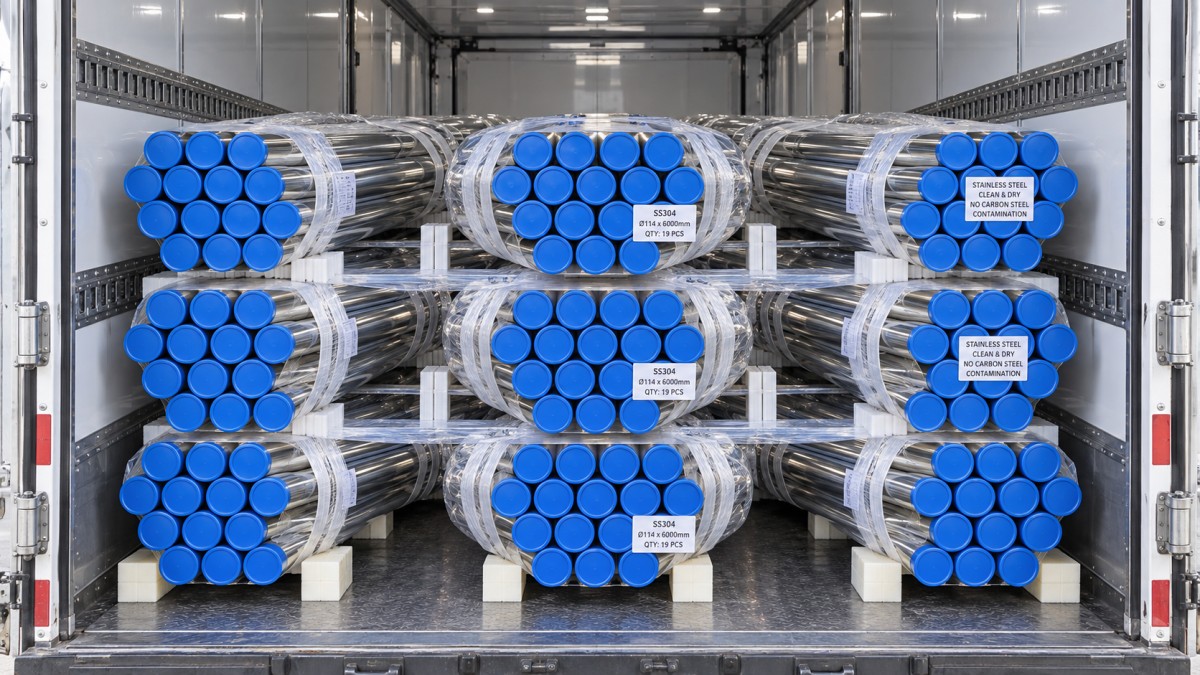
Package for the route, not just for the product
Packaging should reflect the pipe finish, bundle geometry, transport duration, vehicle type, season, and route exposure. Overpacking can trap moisture; underpacking leaves the product exposed to dust, rain, salt, and mechanical damage. The correct approach is a protective system with defined functions: surface separation, end closure, weather protection, restraint, and identification.
For mill-finish or general industrial pipe moved in covered, dry transport, clean bundle separators, secure strapping, and end caps may be sufficient when the journey is short and handling is controlled. Finished decorative pipe, thin-wall tube, or pipe with a protective film generally needs additional outer wrapping and careful bundle support so that the load does not shift. Protective films should be compatible with the surface finish and removed before long-term heat exposure or processing where adhesive transfer could become a concern.
End caps are especially important when internal cleanliness matters. They keep out dust, rainwater, insects, loose packaging fibers, and fragments from adjacent loads. Caps should fit securely without cracking the pipe edge or leaving a path for water entry. Open pipe ends facing the rear or side of an uncovered vehicle are particularly vulnerable to road splash and airborne grit.
Wooden skids and dunnage are widely used, but they must be dry, clean, and structurally sound. Wet timber can introduce moisture and staining risks. Rough or damaged timber can puncture wrapping. Reused dunnage is acceptable only when its condition is controlled; material with protruding nails, oil residue, rust flakes, or embedded swarf should not be placed under stainless bundles.
Do not seal moisture inside the package
A common mistake is to assume that a tightly wrapped bundle is always better protected. If pipe is packed while wet, or if a temperature change produces condensation after sealing, a nearly airtight wrap can hold water against the surface. The risk increases when a shipment moves between different climates, when material is loaded after rain, or when the bundle is stored outdoors before dispatch.
Pipe should be dry and reasonably clean before packing. When waterproof outer protection is needed, arrange the wrapping so water cannot pool in folds or low points. Protect exposed ends, overlap closures to shed water, and keep the bundle elevated from wet trailer decks. For long or moisture-prone shipments, the package design should balance weather resistance with moisture management rather than simply adding more layers of film.
Control the loading environment and the truck condition
A clean package can be compromised by a contaminated vehicle. Before loading, inspect the trailer bed, sidewalls, roof, and drainage condition. Remove loose steel scale, welding debris, sand, salt residue, oily rags, broken pallets, and old packaging. These materials can contaminate the outer wrap, puncture it during transit, or enter open ends.
Covered transport is preferred where rain, road spray, industrial dust, or salt exposure is possible. A cover only works when it remains intact and does not rub against the load. Torn tarpaulins, wet covers, and covers previously used for dirty bulk materials can transfer contamination. The same principle applies to reusable blankets and straps: cleanliness is part of their suitability.
Secure the load without allowing chains, ratchets, or steel edges to bear directly on the pipe or its finished wrapping. Use clean edge protectors and suitable load restraints. Tight restraints prevent movement, but excessive point loading can deform thin-wall pipe, crush bundle corners, and cut through the protective layer. The restraint plan should account for braking, cornering, and vibration rather than relying on one heavily tightened strap.
Mixed loads need a defined hierarchy. Stainless pipe should not be placed below carbon steel bars, plate, castings, or fabricated components that can shed rust, scale, or sharp debris. If mixed loading is unavoidable, isolate materials with reliable physical barriers and ensure that upper loads cannot shift onto the pipe. Storing stainless pipe beside wet chemicals, salt-containing products, or leaking containers creates an equally unacceptable risk.
Keep labels, markings, and traceability outside the contamination path
Transport protection should not break traceability. Each bundle or protected unit needs identification that remains readable through loading and unloading, but the marking method must not introduce surface problems. In many cases, applying labels to the outer wrap or bundle tag is preferable to placing adhesive directly on a finished pipe surface.
Where individual pipe identification is necessary, use an approved marking method that fits the customer requirement and later processing route. Avoid unapproved paints, permanent markers, greasy crayons, and adhesive tapes that may leave residues or become difficult to remove. A marking that is harmless on rough industrial pipe may be unacceptable on a polished tube or on material intended for sanitary fabrication.
Traceability records should link the pipe grade, heat or batch identification, dimensions, surface condition, packaging condition, carrier, dispatch date, and inspection release. This is not administrative excess. When contamination is found at receipt, these records help distinguish a manufacturing issue from a packing, loading, transport, or receiving issue. They also make corrective action specific instead of assuming that all stainless pipe requires more packaging.
Use a release inspection before dispatch and a receiving inspection after arrival
Contamination prevention is more reliable when inspection has clear hold points. A final dispatch check should confirm that the pipe is dry, ends are protected where required, separators are intact, wrapping has no major tears, labels are legible, and no carbon steel contact is visible. Inspect the underside of bundles as well as the visible top surface. Damage frequently occurs where the load rests on dunnage or where straps cross the bundle.
At receipt, inspect before the bundle is moved into uncontrolled storage or unpacked in a dirty fabrication area. Record damaged packaging, wet bundles, broken caps, visible staining, foreign debris, and signs of load movement. Photographs taken before unloading are useful when the condition of the package matters. Do not clean or repack suspected material before recording the original condition, or the cause may become impossible to establish.
Surface discoloration should not automatically be treated as harmless cosmetic staining. Determine whether it is external dirt, adhesive residue, water staining, transferred iron, chloride exposure, or actual corrosion. The response is different in each case. Wiping a surface may remove dust but will not address embedded iron. Aggressive grinding may remove a visible mark while damaging a specified finish. Cleaning and restoration should follow the pipe grade, surface finish, customer specification, and intended service conditions.
Common controls that fail in practice
- “Stainless does not rust, so handling is less critical.” Stainless steel resists corrosion, but foreign iron and chloride residues can still create visible corrosion and localized damage.
- Using any plastic wrap available. Dirty, damaged, or poorly applied wrap can trap water, abrade the surface, or allow contaminants into the bundle.
- Assuming a covered truck is automatically clean. Trailer floors, tarpaulins, straps, and old cargo residue need inspection.
- Checking only the outside of the bundle. Contamination may be inside open pipe ends, between closely packed pipes, or beneath dunnage.
- Reusing protective materials without condition control. Reused caps, spacers, slings, and wraps can carry grit, oil, iron particles, or salt residue from previous loads.
- Leaving responsibility undefined. Packaging, loading, carrier handoff, and receiving checks need named ownership. A process fails when every party assumes another party inspected the load.
Set the transport standard around the highest-risk downstream use
The required control level should be based on the consequences of contamination after delivery. Pipe going directly to cutting or heavy fabrication may tolerate a different packaging arrangement from pipe destined for exposed architectural work, precision fabrication, hygienic systems, or corrosion-sensitive service. The latter should be protected against both external damage and internal debris, with stricter control of handling tools, packaging cleanliness, and exposure to moisture and salts.
Before approving a transport method, define the pipe finish, open-end condition, bundle configuration, transport duration, weather exposure, loading equipment, mixed-load risk, storage conditions at both ends, and acceptance criteria on arrival. This turns contamination prevention from a general instruction into a repeatable release standard.
For stainless steel pipe, the most effective transport control is rarely a single premium packaging material. It is a disciplined system: clean interfaces, dry pipe, protected ends, segregation from carbon steel, stable restraint, route-appropriate weather protection, and documented inspection. When those controls are applied together, pipes arrive ready for fabrication or installation instead of creating avoidable cleaning, rejection, and traceability work.
Please give us a message
Tianjin Kaichuang Metal Material Co., Ltd
Add: No. 41, District 6, First Street, Huanghuadian Town, Wuqing District, Tianjin
Tel: + 86 137 9101 9833
E-mail: boss@kaichsteel.com