Steel Hub

Rail can cost less than road transport in steel logistics when a substantial, repeatable volume moves over a sufficiently long route and both ends have economical access to rail. The strongest opportunity is a flow between facilities with usable sidings, suitable loading equipment, and enough scheduling flexibility to receive full railcar loads. Rail can also work through a transloading terminal, but the line-haul saving must cover terminal handling, local trucking, and any additional inventory cost.
There is no universal distance at which rail becomes cheaper. A long movement with expensive terminal access can lose to a direct truck delivery, while a shorter movement between rail-connected facilities may be competitive. Procurement teams need to compare the cost of delivering usable steel to the receiving point within the required delivery window. A low station-to-station rate answers only part of that question.
Where rail’s cost advantage starts—and where it disappears
Rail’s economic case strengthens when the shipment makes effective use of the equipment. Dense steel products can support substantial loads, but usable capacity depends on the product, railcar design, load distribution, securement requirements, and route restrictions. A nominal payload figure is not enough to establish the cost per delivered tonne.
For coils, the loading plan must accommodate coil dimensions, individual weights, orientation, and suitable restraints. Long sections and pipe introduce different constraints: length, support spacing, stacking arrangements, and unloading access can limit how much material fits safely into a car. Plate requires appropriate support and handling equipment. An attractive rate per car becomes less attractive if the actual loading plan leaves much of its capacity unused.
Volume also needs to be available at the right time. A buyer may purchase considerable tonnage over a year while ordering small quantities across many grades, dimensions, and destinations. Those purchases do not automatically create economical rail shipments. Consolidating them may require earlier purchasing, additional storage, or a change in the supplier’s dispatch schedule.
Distance helps because the potential line-haul saving has more opportunity to absorb costs incurred at the terminals. However, the relevant comparison is between the actual routes offered. Rail routing, interchanges, terminal locations, and local truck movements can make the rail option materially different from the direct road route. Straight-line distance provides little guidance for a purchasing decision.
Access at each end can be decisive. A siding is valuable only if it is operational, served on a workable schedule, and supported by enough space and equipment to load or unload the proposed cars. Check who provides switching, whether separate charges apply, and how quickly cars must be released. Physical rail access does not by itself establish an economical service.
Transloading creates another possible route to savings. Steel travels by rail for the main haul and transfers to trucks near the destination. This can suit buyers without sidings, particularly when the terminal is close to the receiving operation. Each transfer, however, adds handling charges, scheduling dependencies, and another opportunity for damage or product identification errors.
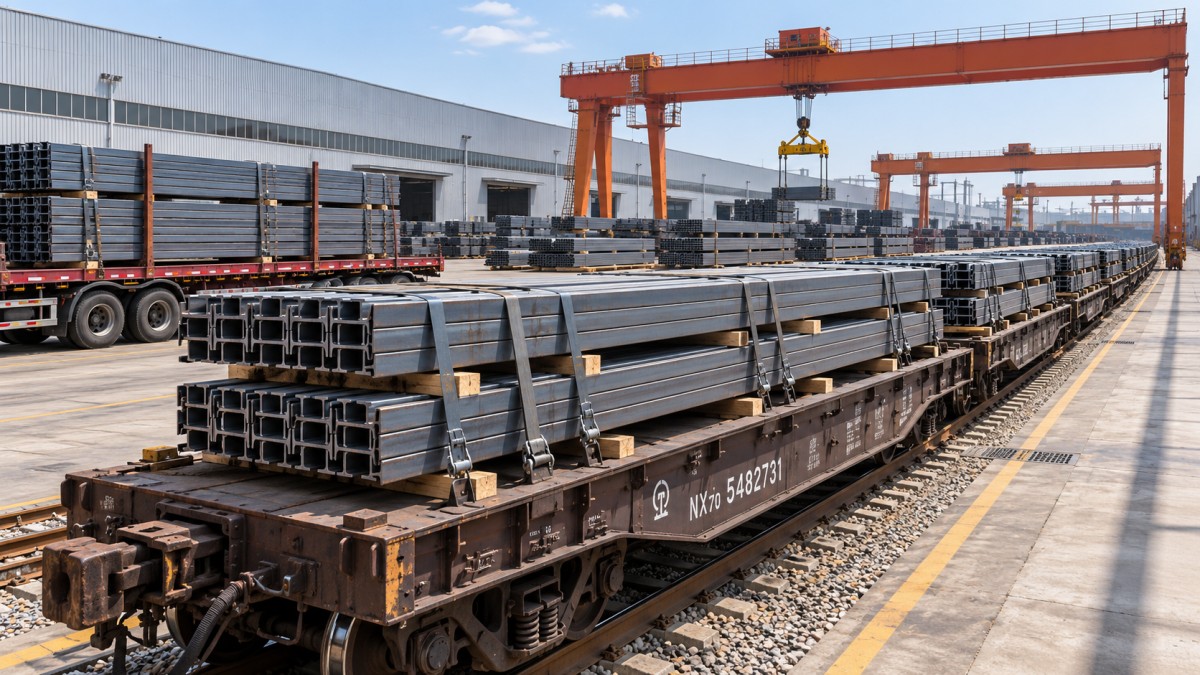
A useful first screen is therefore straightforward: identify the usable load per car, the volume available for each dispatch, the actual rail route, and the handling required at both ends. If the rail proposal depends on uncertain loading assumptions or lengthy local truck movements, resolve those points before treating the quoted line-haul saving as achievable.
Compare the full delivered cost on the same basis
Rail and road quotations can cover different portions of the journey. One may include collection and delivery, while another ends at a terminal. One may include loading or unloading time, while another allows only a limited period before additional charges begin. Put both offers on the same origin, destination, shipment quantity, product specification, and service requirement.
For the rail option, build the comparison from the following cost groups:
- Main transport: rail freight, applicable switching or interchange charges, and any equipment-related charges included in the proposal.
- Access and transfers: collection trucking, terminal handling, storage, and final delivery to the receiving facility.
- Product preparation: packaging, weather protection, dunnage, securement, and loading or unloading work specific to the route.
- Time-related exposure: inventory carrying cost, charges for holding equipment or terminal space, and the cost of any additional receiving capacity required.
- Service and condition: a reasonable allowance for damage, emergency replacement transport, or delivery disruption where evidence supports one.
Apply the same discipline to road transport. Include relevant accessorial charges, unloading delays, special equipment, and any additional protection required for the steel. Otherwise, a detailed rail estimate can appear expensive simply because it is being compared with an incomplete truck quotation.
The decision rule can be expressed without assuming a market rate: rail is cheaper when its line-haul saving exceeds the additional access, handling, inventory, and service costs associated with that route. Calculate the result per delivered tonne using the load that can actually be shipped. Also retain the total cost per dispatch, because minimum charges and underfilled equipment can materially affect smaller orders.
Ask for each quotation’s assumptions in writing. These should cover the product and loading arrangement, chargeable weight, equipment provision, included services, rate validity, applicable surcharges, and responsibility for loading and unloading. Where charges depend on time, establish when the clock starts, what free time applies, and who controls the activity that stops it.
A particularly important distinction is between charges for retaining rail equipment and charges for using terminal storage. Moving steel out of a car may end one exposure while starting another. The buyer needs to understand the entire sequence through to collection and receipt, especially if a terminal operates as temporary storage.
Keep the commercial purchase terms consistent as well. If the supplier includes freight in the steel price, request a comparable delivered offer or a clear transport breakdown. Comparing supplier-arranged road delivery with buyer-arranged rail collection can obscure differences in handling responsibility, risk allocation, and the point at which the buyer must fund the inventory.
Delivery timing and steel condition can reverse the result
Transit time matters through its effect on the operation. A slower service may be economical for predictable replenishment into a stockholding facility. The same service may be unsuitable for a fabrication job that needs a particular section size before production can begin. Assess the required arrival window and the consequences of missing it, rather than comparing average transit times alone.
Variability deserves separate attention. A rail schedule that works on average may still require additional buffer stock if arrival times are inconsistent. Obtain route-specific information on departure frequency, interchange arrangements, terminal availability, and receiving appointments. Use that information to establish a practical replenishment plan, including how the buyer would cover a late shipment.
Additional inventory has a measurable cost. Estimate the extra average tonnes held because of longer replenishment time, larger delivery batches, or additional safety stock, then apply the business’s carrying-cost assumptions. Include financing and storage where relevant, while avoiding double counting charges already included elsewhere. Responsibility for the steel during transit depends on the purchase terms and should be reflected in the calculation.
Large arrivals can also strain the receiving operation. A facility may be able to unload individual trucks throughout the week but struggle to clear several railcars within the available time. Crane capacity, labour availability, storage positions, and identification checks all affect the unloading cycle. Savings at the transport level can disappear if the receiving plan generates equipment-holding charges or repeated internal movements.
Product condition adds another constraint. Surface-sensitive sheet and coil, cut-to-size plate, structural sections, and pipe do not have identical protection requirements. Exposure to moisture, damaged packaging, edge impacts, or unsuitable lifting methods can affect acceptance and subsequent processing. The loading and transfer arrangements should match the condition in which the buyer needs to receive the material.
For a transloading route, establish whether the terminal has the appropriate lifting equipment, support arrangements, storage conditions, and identification controls for the particular steel. Confirm how bundles, coils, or pieces remain traceable through the transfer, and who records condition at each handover. Additional handling can be economical, but its method and responsibility need to be explicit.
Emergency road transport can form part of a workable rail strategy. A buyer may move predictable base demand by rail while reserving trucks for urgent shortages or irregular items. Price that arrangement realistically: if emergency trucks become a frequent requirement, they belong in the rail option’s operating cost rather than being treated as exceptional expenses.
Turn a promising quote into a purchasing decision
The best candidate for rail is usually a defined, repeatable flow: the same origin and receiving point, compatible products, sufficient load size, and a replenishment schedule that accommodates the service. Start with a specific lane and product group. A broad comparison of annual rail and truck expenditure can hide the conditions that make individual movements economical.
Build a shipment profile from actual purchasing and receiving records. Capture tonnes per dispatch, product dimensions and weights, order frequency, required delivery windows, and demand fluctuations. Identify which orders can be combined without buying unwanted material or delaying a customer requirement. This establishes the volume available to rail more reliably than an annual purchasing total.
Then ask carriers and terminals to price the same defined movement. Require a workable loading plan and a clear description of collection, transfers, delivery, and unloading responsibilities. Check equipment availability for the proposed dispatch pattern. A favourable rate has limited value if the necessary cars cannot be supplied when production releases the steel.
Test the comparison under a small number of plausible operating conditions:
- Planned operation: the expected load, normal handling, and the intended receiving schedule.
- Lower shipment volume: reduced demand or a partial load that spreads fixed charges across fewer tonnes.
- Delayed receipt: extra storage, equipment-holding time, or buffer inventory caused by a credible disruption.
- Urgent replenishment: supplementary truck delivery needed to protect production or a committed customer date.
These checks show how much room the quoted saving provides. A rail proposal that works only with maximum loading and immediate unloading is sensitive to routine changes in demand and scheduling. A proposal that retains a meaningful saving under the buyer’s expected operating conditions is a stronger procurement candidate.
For a new route, a controlled trial can establish costs that quotations cannot fully resolve. Record actual payload, handling invoices, elapsed time, receiving effort, product condition, and any accessorial charges. Use comparable road movements as the baseline, adjusting for differences in shipment size and delivery requirements. One successful arrival establishes feasibility; repeated movements provide a better basis for a recurring commitment.
The purchasing decision should ultimately state the conditions under which rail earns its place: the minimum economical dispatch, the required terminal access, the acceptable replenishment window, and the receiving capacity needed to avoid extra charges. When those conditions hold, rail can reduce delivered steel cost. When an order falls outside them, a truck may remain the more economical way to meet the requirement.
Please give us a message
Tianjin Kaichuang Metal Material Co., Ltd
Add: No. 41, District 6, First Street, Huanghuadian Town, Wuqing District, Tianjin
Tel: + 86 137 9101 9833
E-mail: boss@kaichsteel.com