Steel Hub

A structural package can look settled on paper and still become unstable the moment procurement, detailing, fabrication, and site sequencing begin to overlap. A beam size changes to clear a service run. A connection is revised after a coordination meeting. The specified section is technically acceptable but difficult to obtain in the required length, grade, or delivery window. None of these issues is unusual on its own. The problem is that they often arrive together, when there is little time left to absorb them.
In a complex build, steel is not merely a line item to purchase after design approval. Its grade, section availability, tolerances, connection requirements, coating needs, transport limits, and fabrication sequence can alter the practical path to construction. When those factors are reviewed too late, the team may face redesign, substitutions that require renewed approval, idle follow-on work, or arguments about whether a delay came from design, supply, or fabrication. This is the point at which steel consulting can reduce risk: not by making uncertainty disappear, but by exposing it early enough to make controlled decisions.
The warning signs usually appear before the steel package fails
Many difficult steel situations begin with a familiar statement: “The drawings are nearly complete, so we can start asking for prices.” That approach can work for repetitive, readily available sections with straightforward connections. It becomes unreliable when the structure includes transfer members, long spans, architecturally exposed steel, mixed steel-and-concrete interfaces, heavy lifting constraints, unusual corrosion exposure, or a tight sequence around other trades.
The early warning signs are often subtle. A supplier requests clarification on a grade designation that appears clear in the drawings. A fabricator asks whether a member can be spliced because transport length is restricted. The design team issues a revised connection detail without confirming the effect on bolt access or weld sequence. Material lead times are discussed in general terms, while no one has identified which individual sections are likely to control the release date.
Another common problem is treating all steel as equally substitutable. Two sections may offer similar nominal strength, yet differ in local availability, rolling dimensions, weldability considerations, connection geometry, fabrication effort, or weight distribution. A substitution may appear economical when viewed only as kilograms of steel, then create more cutting, additional plates, different bolt arrangements, or a more difficult erection sequence. The cost and schedule effect often sits outside the original comparison.
Steel consulting is most useful when it is brought into these grey areas before they turn into formal changes. The work is less about choosing a “best” material in isolation and more about testing whether the specified solution can move through the whole chain: design intent, procurement, detailing, fabrication, delivery, erection, and inspection.
Separate the symptom from the actual source of exposure
When a steel package starts slipping, teams often focus on the most visible symptom: a late quotation, an unavailable section, a rejected shop drawing, or a fabrication query. Those are important, but they are not always the root cause. A late quotation may be caused by incomplete member schedules. A procurement difficulty may result from a grade that was selected without considering regional supply conditions. Repeated detailing queries can point to unresolved load paths or connection responsibility rather than a slow fabricator.
A useful review begins by sorting the issue into four linked questions:
- Is the engineering intent fixed? Confirm the load path, performance requirements, deflection criteria, fire strategy, corrosion assumptions, and interface loads before comparing alternatives.
- Is the specification buildable? Review section sizes, plate thicknesses, connection types, welding access, tolerances, splice locations, and practical erection restraints.
- Is the material commercially realistic? Identify which grades, dimensions, lengths, and finishing requirements may be difficult to source within the required window.
- Can the package be released in the right order? Determine whether critical members, connection information, and approvals can be issued ahead of less time-sensitive steel.
These questions should not be handled as separate departmental tasks. A technically correct answer to one can create trouble in another. For example, increasing a member depth may simplify structural performance but interfere with ceiling zones. Splitting a long member may ease transport but introduce a splice that changes erection planning. Specifying a protective system may suit the service environment while adding curing, handling, or repair constraints that need to be reflected in the programme.
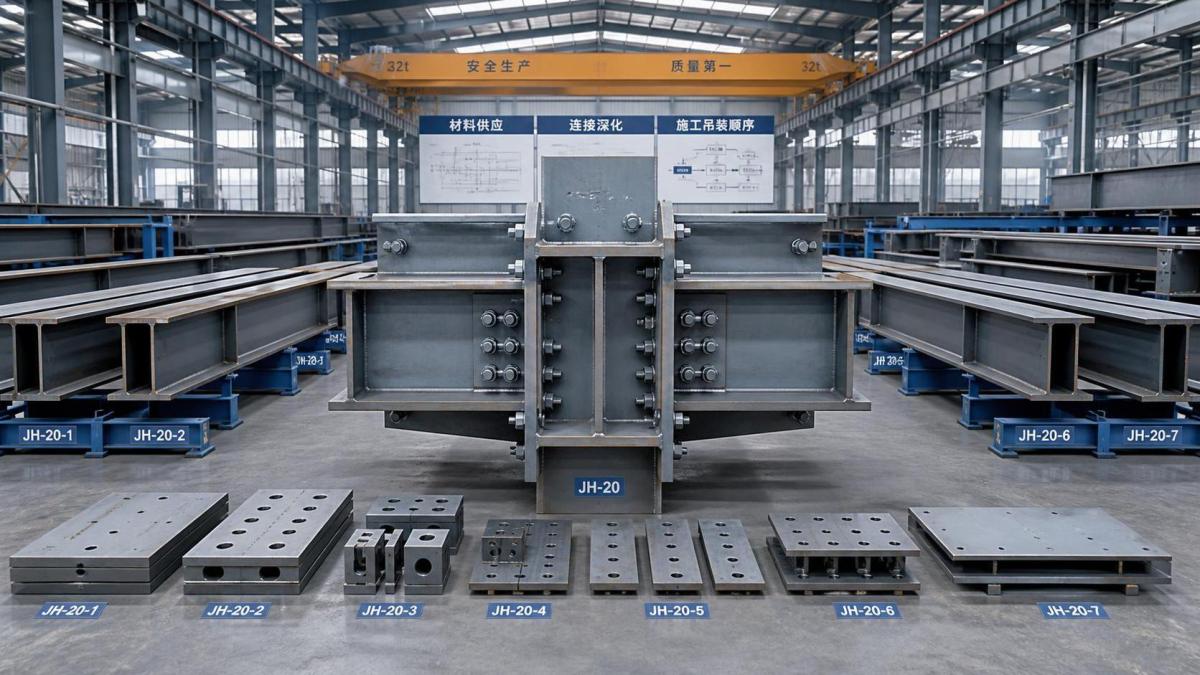
Bring the steel conversation forward, but make it specific
Early involvement only reduces risk when the discussion has usable inputs. A broad request to “review the steel design” usually produces broad observations. A better starting point is a controlled package of information that shows what is known, what is still moving, and what decisions cannot wait.
Start with the members that can hold up everything else
Not every beam deserves the same level of attention. The first review should focus on steel that has a disproportionate effect on programme or coordination: transfer girders, major trusses, columns at crowded interfaces, heavily loaded connection zones, long or heavy members, exposed elements, and members required before other structural areas can proceed.
For each of these items, record the governing design condition, proposed section or built-up form, required grade, connection concept, expected fabrication route, coating or fire protection requirement, and erection dependency. The purpose is not paperwork for its own sake. It reveals whether a “single member” is actually carrying several unresolved decisions.
For instance, a large transfer member may depend on final penetrations from building services, approval of a connection arrangement, confirmation of transport feasibility, and a lifting study. If those dependencies are hidden inside separate drawing packages, the member can remain apparently approved while being impossible to release for fabrication.
Review substitutions as engineered alternatives, not purchasing swaps
Material substitution is often where pressure builds. A requested alternative may be driven by availability, mill practice, fabrication preference, or delivery timing. It should be evaluated beyond a simple comparison of nominal size and strength.
The review should consider design capacity and serviceability, but it also needs to examine connection consequences, member weight, stiffness, buckling behavior, local reinforcement, weld requirements, bolt availability, coatings, fire protection interfaces, and potential changes to adjacent work. The alternative may be entirely suitable, but the reasoning should be traceable and agreed by the relevant technical parties before it is embedded in shop drawings or purchase orders.
This is one practical area where steel consulting creates discipline. It establishes a route for asking: does this replacement preserve the design intent, and what else changes if it is accepted? That question prevents the false economy of approving a section because it is obtainable without seeing the downstream adjustments it creates.
Do not leave connections until the structure is “finished”
Connection design is frequently treated as a detail-stage activity. In straightforward work, that can be manageable. In congested or highly loaded areas, it can be a major source of risk. The connection determines whether members can be assembled, whether bolts can be installed and inspected, whether welding can be performed safely, and whether tolerances can be accommodated.
Early connection review is especially valuable at steel-to-concrete interfaces, moment-resisting frames, truss nodes, column splices, transfer zones, façade support points, and locations where services or architectural finishes restrict access. The question is not merely whether a connection works structurally. It is whether the intended connection can be fabricated, transported, erected, tightened or welded, inspected, and protected after installation.
A practical sequence when drawings are still changing
Complex projects rarely reach a perfect moment when every drawing is final and all commercial conditions are stable. Waiting for that moment can create a late release; releasing everything too soon can lock in bad assumptions. The better approach is to manage steel decisions by maturity and consequence.
First, identify the design information that must be fixed before a particular steel item can be ordered. This may include grid locations, levels, governing loads, interface reactions, fire exposure assumptions, architectural visibility, penetrations, and connection forces. Mark each item as confirmed, pending, or dependent on another discipline. A member with several pending inputs should not be treated as equivalent to a routine, fully coordinated beam.
Next, develop a release logic rather than relying on a single “steel package complete” date. Primary members with stable geometry may be suitable for an earlier controlled release, while secondary steel or final connection components remain under development. This only works if the boundaries are explicit. The released information must state which dimensions, loads, interfaces, and finishes are frozen, and which are not.
Then test the fabrication sequence against the site sequence. A fabrication shop may prefer an efficient batching arrangement, while the site may need specific members first to establish stability or open access for following trades. Neither priority is automatically wrong. The issue is whether the chosen sequence has been checked against delivery slots, storage space, lifting capacity, temporary works, installation order, and inspection hold points.
Finally, use change control that distinguishes between a drawing revision and a steel-impacting revision. A revised plan note may have no consequence. A small shift in a support, a changed opening, or a revised fire protection build-up can affect detailing, cutting, connection plates, coating repairs, or already released material. Changes should be assessed against the stage of procurement and fabrication, not only against the drawing register.
Where risk is often underestimated
Material availability receives attention because it is visible and commercial. Several other areas deserve the same discipline.
Dimensional tolerance and fit-up. Steel, concrete, anchors, façade systems, and mechanical equipment are made and installed through different processes. A connection may be correctly designed yet difficult to assemble when accumulated tolerances are not considered. Early agreement on survey control, adjustment provisions, slot direction, shim strategy, and allowable field modifications can prevent rushed decisions during erection.
Fabrication capacity versus nominal capability. A fabricator may be capable of producing a certain type of member, but the timing and workflow still matter. Built-up sections, complex welds, intricate nodes, heavy sections, and special finish requirements can require more review or handling than standard rolling shapes. The question is not whether the work can be done in theory, but whether it can be done in the required sequence with the available information.
Protection systems and repair responsibility. Coatings, galvanizing, fire protection, and site touch-up are often addressed late because they follow steel fabrication. Yet they influence hole details, drainage, venting, handling, welding restrictions, repair methods, and interface sequencing. Ambiguity over who restores damaged protection after site modifications can become a quality dispute.
Documentation that does not match the physical flow. Mill documentation, material identification, traceability needs, weld procedures, inspection records, and delivery records should be planned to match the package’s actual control points. Excess paperwork without a clear purpose slows review; missing evidence can stop acceptance when the steel is already at site.
When outside technical input is worth bringing in
Not every steel order needs extensive external review. Standardized, repetitive work with stable specifications and familiar supply routes may be managed through established internal procedures. The value of specialist steel consulting rises when several uncertainties overlap: a demanding structural system, unfamiliar grades or product forms, high consequences of late changes, constrained fabrication or transport, complex interfaces, or a programme that leaves little recovery time.
It is also useful when different parties are each making reasonable decisions within their own scope but no one is testing the combined effect. The designer may protect structural performance, procurement may seek availability, the fabricator may seek manufacturability, and the site team may need erection certainty. A focused technical review can translate between those needs and identify decisions that require joint agreement.
The aim should be a short list of resolved actions, not an extra layer of commentary. Good steel consulting produces clearer release conditions, documented assumptions, technically reviewed alternatives, and a visible route for managing changes. It should make later conversations easier because the basis for a decision is already recorded.
A calmer steel package is usually built before fabrication starts
The most expensive steel problems are rarely caused by steel alone. They emerge from assumptions that travel too far without being checked: that a section is obtainable, that a connection can be installed, that a revised opening is minor, or that fabrication can wait until every other issue is complete. Complex projects need a way to test those assumptions while there is still room to act.
If the structure has critical members, changing interfaces, unusual material requirements, or a compressed delivery path, begin by identifying the decisions that control release rather than reviewing every item with equal intensity. Confirm the engineering basis, test practical supply and fabrication constraints, involve connection and erection considerations early, and treat substitutions as design decisions with consequences beyond price. That is where steel consulting becomes a risk-control tool rather than a late response to a problem already on site.
Please give us a message
Tianjin Kaichuang Metal Material Co., Ltd
Add: No. 41, District 6, First Street, Huanghuadian Town, Wuqing District, Tianjin
Tel: + 86 137 9101 9833
E-mail: boss@kaichsteel.com