Steel Hub

Yes. Steel supply contracts can include financial consequences for late delivery if the parties agree on the terms and those terms comply with the governing law. Buyers often call them “penalties,” but a clause described as liquidated damages may be treated differently from a punitive provision. The wording alone does not determine whether it is enforceable.
For a procurement professional, the more useful question is what the clause is designed to protect. A late plate shipment may interrupt fabrication; a missing section may delay an erection sequence; and pipe arriving without required documentation may be unusable even if it reaches the site on time. The contract should connect the remedy to a clear delivery obligation and a realistic assessment of delay-related loss.
Can steel supply contracts include a penalty for late delivery?
They can include an agreed payment or other remedy for delay, but enforceability depends on the applicable law and the clause’s design. In many transactions, the parties use liquidated damages: an amount agreed in advance to address losses that may be difficult to calculate later.
For example, under the U.S. Uniform Commercial Code, an agreed amount must be reasonable in light of anticipated or actual harm, the difficulty of proving loss, and the difficulty of obtaining another adequate remedy. Unreasonably large liquidated damages are void as a penalty. State law and the facts of the transaction still matter. Source: Uniform Commercial Code § 2-718(1), Legal Information Institute, Cornell Law School: https://www.law.cornell.edu/ucc/2/2-718.
English law takes a different approach. The UK Supreme Court has explained that the penalty rule examines whether a secondary obligation imposes a detriment out of all proportion to the innocent party’s legitimate interest in enforcing the primary obligation. It is therefore unsafe to assume that a clause valid in one jurisdiction will work unchanged in another. Source: Cavendish Square Holding BV v Talal El Makdessi; ParkingEye Ltd v Beavis, UK Supreme Court judgment summary: https://www.supremecourt.uk/cases/docs/uksc-2013-0280-press-summary.pdf.
Before negotiating a percentage or daily amount, ask counsel to confirm the governing law and whether an international sales convention may apply. For example, the United Nations Convention on Contracts for the International Sale of Goods can apply to qualifying international sales unless properly excluded; it addresses damages and exemption for certain impediments, but local legal advice is still important when assessing a stipulated damages clause. Source: UNCITRAL, CISG, Articles 1, 6, 74 and 79: https://uncitral.un.org/en/texts/salegoods/conventions/sale_of_goods/cisg.
Define delivery before calculating delay
A damages rate is of little value if the parties disagree about when the steel was due or what constituted delivery. A purchase order that says “shipment in June” leaves different questions unanswered from one requiring arrival at a named fabrication site by a particular date.
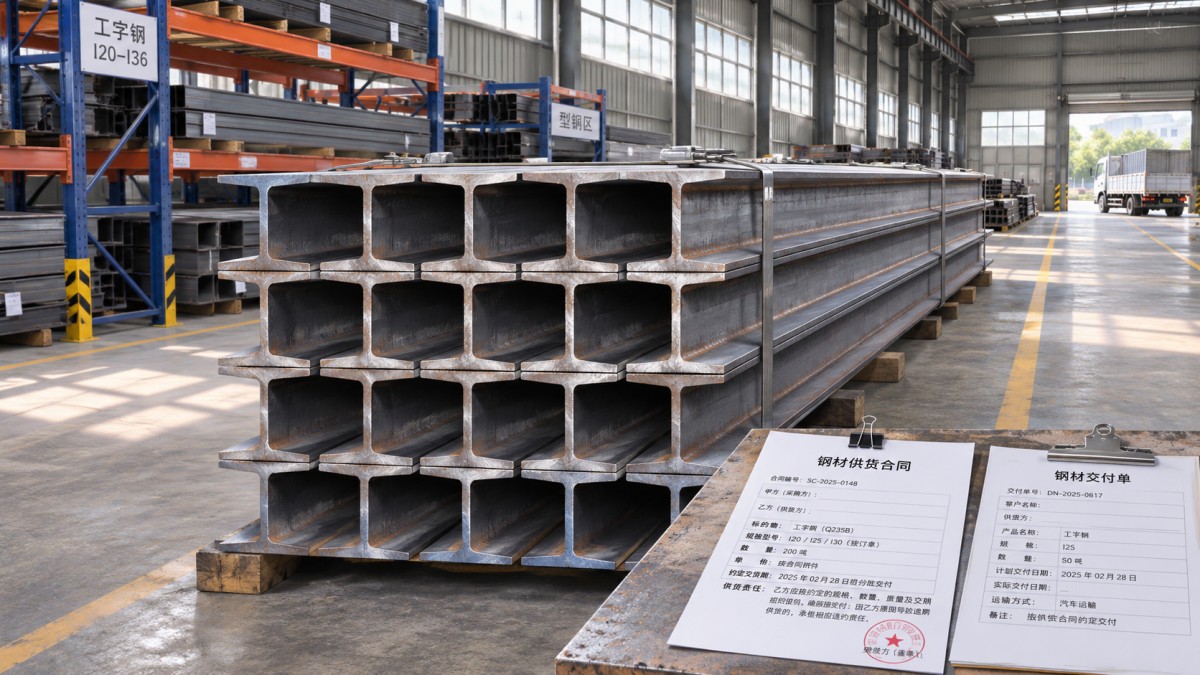
Work through the physical and documentary journey of the material. For a steel order, the delivery obligation should identify:
- The goods: Product form, grade, dimensions, quantity and any allocation to specific releases or project packages.
- The deadline: A calendar date or a clearly calculated period, including the time zone and treatment of weekends or holidays where relevant.
- The delivery point: The named mill, port, warehouse or project site, together with the agreed delivery terms.
- The completion event: Whether the deadline concerns dispatch, arrival, unloading, or another expressly defined event.
- Required documents: Which inspection records, test certificates or shipping documents must accompany the goods, and whether missing documents affect the delivery obligation or trigger a separate remedy.
- Partial deliveries: Whether delay is measured against each release, each line item or the order as a whole.
Do not assume that transfer of risk, delivery under a trade term and contractual acceptance all occur at the same moment. Incoterms® rules allocate certain transport responsibilities, costs and risks, but the parties must still agree on matters such as payment and remedies for breach. Source: International Chamber of Commerce, Incoterms® 2020 introduction: https://iccwbo.org/business-solutions/incoterms-rules/incoterms-2020/.
Separate late arrival from nonconforming steel
A truck can arrive on time carrying the wrong grade, damaged pipe or an incomplete quantity. Equally, a shipment can arrive with correct material but incomplete paperwork. These situations may require different remedies, and the contract should say how they interact.
One approach is to define timely delivery by reference to the agreed quantity of conforming goods and specified essential documents. If the buyer needs time to inspect, define the inspection process and its consequences rather than leaving the supplier exposed to an undefined delay period after arrival. Legal review is important: the choice affects when damages accrue and how acceptance, rejection and cure are handled.
Choose a remedy that fits the supply risk
There is no universal rate for late steel delivery. The appropriate structure depends on how the material is used, the difficulty of estimating loss and the degree of control each party has over the schedule. Consider these alternatives before accepting a standard supplier clause.
A percentage of the entire order value may not reflect the impact of a small late balance. Conversely, using only the value of a low-cost component may understate its importance if it prevents completion of a much larger assembly. Document the commercial reasoning behind the chosen base and rate; that record can support the negotiation and later legal assessment.
Also check whether liquidated damages are the exclusive monetary remedy for delay. If they are, the buyer may be unable to recover additional delay losses even when those losses exceed the agreed amount. If they are not, the drafting should address overlap and avoid recovery twice for the same loss. The result depends on the contract and governing law.
Five details that determine whether the clause works
1. Start and stop the clock precisely
State whether damages begin immediately after the deadline or after a grace period, and whether they accrue by calendar day, business day or completed week. Define when accrual stops: for example, when the delayed quantity reaches the agreed delivery point and satisfies the specified delivery requirements.
If the supplier delivers in stages, reduce the calculation base as qualifying material arrives, if that is the commercial intent. Specify whether the final incomplete day or week is counted in full or prorated. Ambiguity over a short delay can consume more time than the amount at stake.
2. Set a cap and understand its consequences
Suppliers commonly seek a maximum liability for delay. A cap can make risk more predictable, but procurement should assess what happens when it is reached. Does it merely stop further accrual, or can the buyer cancel the undelivered balance? Does a separate overall liability cap also apply?
Review exclusions for indirect, consequential or production-related losses alongside the delay clause. A seemingly generous remedy can have a narrower effect when read with the rest of the contract.
3. Address buyer-caused changes and excusable events
Late drawings, revised dimensions, delayed approvals or an unavailable unloading site may affect the supplier’s schedule. The contract should require prompt notice, identify the impact on the critical delivery obligation and provide a method for agreeing an extension.
Force majeure provisions deserve the same care. Identify covered events, notice and evidence requirements, mitigation duties, and what happens if disruption continues. Avoid treating every supply difficulty as automatically excused or assuming that every external disruption automatically removes liability. Under the CISG, where applicable, Article 79 sets conditions for exemption based on an impediment beyond a party’s control; the contract and governing law require separate review. Source: UNCITRAL, CISG Article 79: https://uncitral.un.org/en/texts/salegoods/conventions/sale_of_goods/cisg.
4. Make notice and records practical
A clause should tell both parties whom to notify, how quickly and with what information. Procurement teams should retain the purchase order, revisions, approved schedule, shipping notices, delivery receipts, inspection records and correspondence about disruptions.
Ask for a recovery plan when a delay becomes likely, not only after the due date passes. Depending on the contract, useful information may include the affected line items, available quantities, proposed dispatch dates and any actions needed from the buyer. An early warning does not necessarily excuse delay, but it gives both parties a chance to reduce disruption.
5. Coordinate set-off, payment and dispute procedures
Buyers sometimes expect to deduct delay damages from an invoice. The contract should address whether and how deductions or set-off are permitted, including notice and dispute procedures. Do not assume a withholding right exists simply because a charge appears justified; payment obligations and local law may limit the options.
A procurement check before signing
- Map the operational dependency. Identify which steel items affect fabrication, installation or production milestones, and whether substitute material is feasible.
- Test the dates. Compare the supplier’s production and transport schedule with the contractual deadline, including approvals and buyer-controlled activities.
- Model a partial delay. Calculate the result if one line item arrives late while the rest of the order arrives on time. Check that the outcome reflects the negotiated intent.
- Read the remedies together. Compare the delay clause with liability caps, exclusions, termination, force majeure, inspection and payment provisions.
- Escalate legal uncertainty. Ask qualified counsel to review enforceability, governing law and dispute resolution, especially for cross-border or high-value orders.
A useful clause is not necessarily the one with the highest stated charge. It is one both parties can administer, that allocates controllable risks sensibly and that gives the buyer a workable response when a delivery threatens the schedule.
Frequently asked questions
Can a buyer claim liquidated damages and actual losses for the same delay?
That depends on the contract and applicable law. The agreement may make liquidated damages the exclusive remedy for delay, permit other defined claims, or address separate losses differently. It should also prevent double recovery for the same harm.
Should delay damages apply to the full steel order or only the late quantity?
Either basis may be proposed, but the choice should reflect the commercial impact and be legally reviewed. For divisible deliveries, a base tied to the delayed quantity can be easier to administer. Where one missing item blocks an entire project package, the buyer should explain that dependency rather than relying on an arbitrary full-order charge.
What if the supplier warns of a delay before the due date?
Review the notice provisions and request a documented recovery plan. Check whether the cause qualifies for a contractual extension and whether the buyer contributed to the delay. Preserve any contractual rights while evaluating alternatives such as resequencing work, accepting partial delivery or arranging replacement supply.
Please give us a message
Tianjin Kaichuang Metal Material Co., Ltd
Add: No. 41, District 6, First Street, Huanghuadian Town, Wuqing District, Tianjin
Tel: + 86 137 9101 9833
E-mail: boss@kaichsteel.com