Steel Hub

On August 1, 2026, the EU moved the transitional period of CBAM for steel imports into a third reporting stage. For imported steel products such as sections, medium and heavy plate, and H-beams, the reporting requirement now extends to embedded carbon data across the full supply chain and, for the first time, includes third-party verification. This matters directly to exporters shipping steel into the EU, importers arranging customs clearance, and procurement teams reviewing supplier readiness, because compliance cost, document preparation time, and delivery coordination are now more closely tied to carbon-footprint documentation and certification capability.
What the new reporting stage now requires
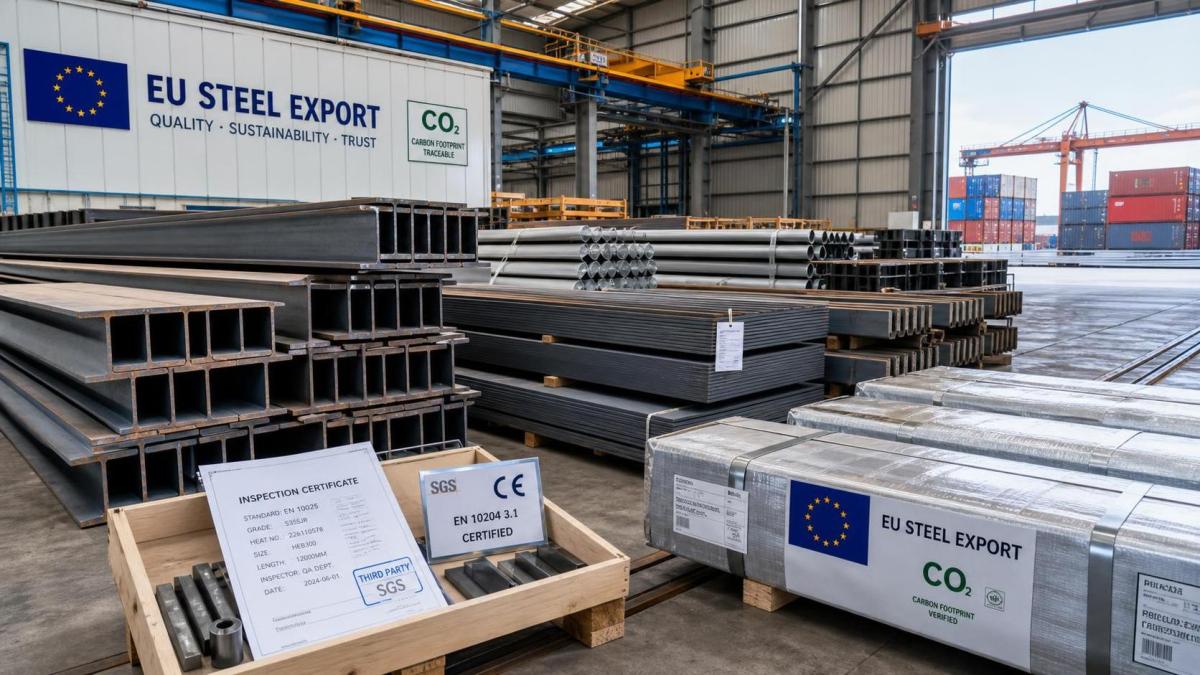
The confirmed change is that, from August 1, 2026, the EU CBAM transitional framework for imported steel products entered its third-stage data reporting requirement. The covered products include steel sections, medium and heavy plate, and H-beams. Under this stage, reporting must cover embedded carbon emissions across the full supply chain. The change also brings in third-party verification for the first time. The event summary further indicates that this development directly affects the compliance cost of Chinese steel exporters, the time needed to prepare documentation, and the customs clearance process for buyers. Importers are also required to confirm before placing orders whether suppliers have the capability to provide carbon-footprint certification under ISO 14067 or EN 15804.
Where the pressure is likely to appear first
Export shipments to the EU face a heavier document burden
Chinese steel exporters are likely to feel the change first because delivery to EU buyers now depends more directly on whether embedded carbon information can be assembled across the supply chain and supported by third-party verification. The practical impact is likely to fall on pre-shipment documentation, coordination with upstream suppliers, and timing alignment with customer clearance requirements.
Importers must move supplier screening earlier in the order cycle
For importers, the stated requirement to confirm ISO 14067 or EN 15804 carbon-footprint certification capability before ordering shifts part of compliance review from post-contract paperwork to supplier selection itself. This means procurement and import compliance functions may need to examine not only product specifications and price, but also whether a supplier can support the carbon-related documentation expected for CBAM reporting.
Verification and certification readiness becomes part of trade execution
Because third-party verification is now included for the first time, certification-related service capacity becomes more relevant to the steel trade flow. From an industry perspective, the effect is not limited to filing obligations; it also touches how quickly a transaction can move from order confirmation to document completion and then to buyer-side clearance.
What companies should review now
Check whether carbon data can be traced across the supply chain
Analysis shows that one immediate priority is traceability. If the reporting requirement covers full supply chain embedded emissions, companies involved in EU-bound steel orders should review whether upstream carbon data can be collected in a usable and consistent form. Where that chain is incomplete, document preparation time may become a bottleneck.
Verify certification capability before commercial commitments
What deserves closer attention is the pre-order qualification step. The event summary specifically points to ISO 14067 and EN 15804 capability, so importers and exporters should pay close attention to whether this can be evidenced before contracts, tenders, or shipment scheduling are finalized. Where such capability is uncertain, the commercial risk may shift into procurement timing and customer acceptance.
Allow for longer lead time in customs and delivery planning
Observably, the change should be read as a warning that compliance work may now affect delivery rhythm. Since the summary already identifies customs clearance and file preparation as affected areas, companies should watch whether transaction timelines, handover milestones, and internal approval steps need to be adjusted for EU-bound steel business.
Monitor how buyers translate the rule into procurement documents
The input does not provide detailed enforcement language, so it would be premature to treat market practice as settled. Even so, companies should closely watch how buyers reflect the new requirement in purchase orders, technical documents, qualification reviews, and supporting file requests, especially where carbon-footprint evidence may become a practical gate for shipment or clearance.
Why this should be read as an execution signal
Analysis shows that this development is more than a routine reporting update. The extension to full supply chain embedded emissions, together with the introduction of third-party verification, suggests a more operational phase of CBAM compliance for steel trade into the EU. At the same time, it is more appropriate to understand this as a rule now entering a stricter implementation stage rather than as a fully settled market outcome, because the input does not provide detailed execution interpretations, transaction examples, or buyer-side practice standards.
From an industry perspective, the most important point is that carbon-footprint capability is moving closer to the center of trade readiness. That does not automatically determine commercial results, but it does indicate that compliance documentation, certification support, and supplier screening are becoming more tightly connected to order execution.
How the market should frame this change
The most reasonable reading of this event is that CBAM compliance for steel imports into the EU has moved into a more demanding operational phase as of August 1, 2026. The confirmed facts point to broader reporting coverage, the first use of third-party verification in this stage, and more direct pressure on exporter documentation, importer checks, and buyer clearance processes. It is therefore better understood as an implemented compliance signal with immediate practical consequences, while the detailed market response and execution standards still require continued observation.
Basis of this article and what still needs verification
This article is generated from the user-provided news title, event date, and event summary. For developments of this kind, commonly relevant source types may include official announcements, releases from regulatory authorities, customs or trade administration updates, industry association notices, standard-organization documents, and reporting from authoritative media. No specific official source link was provided in the input, so the exact official reference still needs to be verified on an ongoing basis. Further observation is also needed on detailed policy wording, certification application standards, procurement document changes, market feedback, and how companies are implementing the requirement in actual export and import workflows.
Please give us a message
Tianjin Kaichuang Metal Material Co., Ltd
Add: No. 41, District 6, First Street, Huanghuadian Town, Wuqing District, Tianjin
Tel: + 86 137 9101 9833
E-mail: boss@kaichsteel.com