Steel Hub

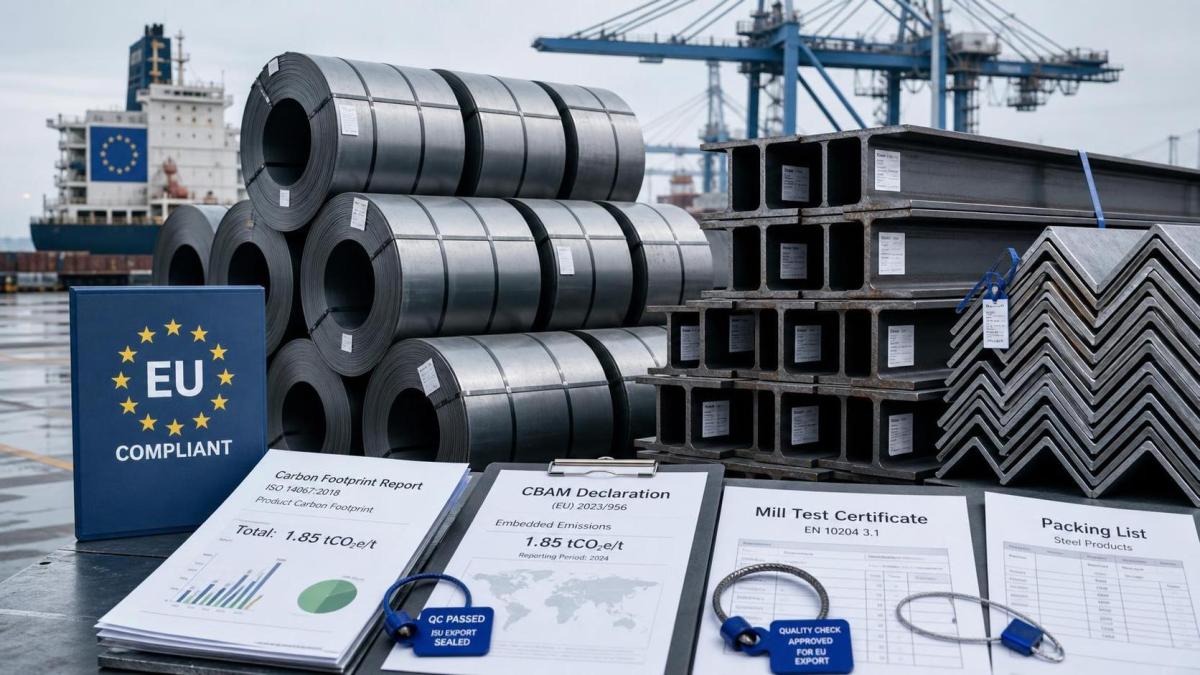
On July 22, 2026, the European Commission released a revised implementation guide linked to the Carbon Border Adjustment Mechanism for steel and section products, setting a clearer compliance requirement for certain steel imports from October 1, 2026. The update matters directly to exporters, importers, buyers, and customs-related operations involving hot-rolled coil, H-beams, angle steel, and other structural sections and plates entering the EU, because product access and procurement compliance will now depend on a verified life-cycle carbon footprint declaration aligned with the stated standard.
What the revised EU requirement says
According to the information provided, the revised guide was issued by the European Commission on July 22, 2026. It states that, from October 1, 2026, imports into the EU of hot-rolled coil, H-beams, angle steel, and other structural sections and plate products must be accompanied by a full life-cycle carbon footprint declaration compliant with EN 15804+A2:2023. The declaration must be issued by an EU-recognized verification body. The requirement is described as directly affecting customs clearance access for Chinese exporters and compliance-oriented procurement procedures for buyers.
Where the pressure is likely to appear first
Export shipments facing customs access checks
From an industry perspective, direct trading companies shipping covered steel products into the EU are likely to feel the impact first at the documentation stage. The practical pressure point is whether the required declaration is available, valid, and accepted for customs-related use. What deserves closer attention is the connection between product eligibility and document readiness, because the requirement is tied to market entry rather than only internal reporting.
Procurement teams under tighter compliance review
Buyers sourcing covered steel products for the EU market may need to pay closer attention to supplier-side documentation before orders move into execution. The impact is likely to appear in supplier screening, order confirmation, and compliance review processes. Analysis shows that procurement workflows may need to place greater weight on whether a supplier can provide a declaration verified by an EU-recognized body and aligned with EN 15804+A2:2023.
Supply chain and service providers handling execution risk
Observably, logistics coordinators, customs service providers, and other supply chain intermediaries may also be affected because incomplete or non-compliant documentation can disrupt shipment timing and handover. Their attention is likely to focus on document collection, pre-clearance coordination, and communication between exporters and EU-side customers.
Practical points companies should track now
Check which product lines fall into the immediate compliance scope
Companies dealing in hot-rolled coil, H-beams, angle steel, structural sections, and plate products should review whether their active EU business involves the product categories named in the update. The immediate task is not broad strategy, but identifying which shipments and customer programs may require the declaration from October 1, 2026.
Review document readiness before shipment and order commitment
What deserves closer attention is whether the required life-cycle carbon footprint declaration can be prepared in time and whether it is issued by an EU-recognized verification body. For exporters and suppliers, this is a contract execution issue as much as a compliance issue, because document timing may affect shipment planning and customer acceptance.
Separate policy language from operational implementation
Analysis shows that businesses should distinguish between the formal rule statement and the way it is applied in day-to-day trade execution. In practice, companies will need to watch how the requirement is reflected in customs documentation, buyer checklists, and supplier qualification requests rather than assuming that the published wording alone answers every operational question.
Prepare customer and supplier communication paths early
For sales, procurement, and supply chain teams, a near-term priority is communication. Exporters may need to explain document status and verification arrangements to EU customers, while buyers may need to request clearer proof from suppliers before finalizing procurement decisions. This is especially relevant where lead times, document review, and delivery commitments are closely linked.
Why this looks like more than a short-term paperwork update
As an editorial observation, this development is more appropriate to understand as a concrete compliance signal rather than a routine administrative adjustment. The confirmed fact is the new mandatory declaration requirement from October 1, 2026. The broader industry reading, however, should remain cautious: it suggests stricter alignment between carbon-related product information and EU import access, but the full operational impact still depends on how companies, buyers, and service providers translate the rule into transaction-level processes.
How the market may reasonably read this update
At this stage, the industry significance lies in the closer link between carbon documentation and the ability to move covered steel products into the EU market. A neutral reading is that this is not only a short-term change in forms, but also not yet a basis for sweeping conclusions beyond the stated scope. It is more appropriate to understand the update as an actionable compliance development with immediate relevance for affected steel trade flows and with longer-term implications that still require observation.
Basis of this article and points for continued verification
This article is based on the user-provided news title, event date, and event summary. For topics of this kind, source types typically relevant to verification include official notices, regulatory implementation documents, company compliance disclosures, industry association updates, authoritative media reporting, and standard-related documentation. No specific official source link was provided in the input, so the exact official link remains to be continuously verified. Further attention should remain on any subsequent official wording, implementation clarifications, and transaction-level compliance requirements affecting customs clearance and procurement practice.
Please give us a message
Tianjin Kaichuang Metal Material Co., Ltd
Add: No. 41, District 6, First Street, Huanghuadian Town, Wuqing District, Tianjin
Tel: + 86 137 9101 9833
E-mail: boss@kaichsteel.com