Steel Hub

Just-in-time delivery reduces structural steel erection costs when the savings from storage, handling, and inventory exceed the added freight, coordination, and disruption costs. It works best when fabrication releases, transport slots, and erection sequences remain closely aligned. A lower quantity of steel on site does not establish a saving by itself: a missing connection plate or an inaccessible beam can stop productive lifting while cranes and crews continue accumulating cost.
The useful comparison is total installed cost for the same erection scope and completion requirement. A just-in-time plan should therefore be evaluated against a realistic alternative, including the actual storage space, handling arrangements, and delivery restrictions available on the project.
Where the savings actually come from
Steel delivered well ahead of erection needs somewhere to sit. That space requires suitable access, bearing conditions, dunnage, and room for safe unloading and retrieval. On a constrained site, storage can also compete with crane positions, access roads, or other trades. Reducing the stockpile has value when it removes a measurable expense or releases space needed for productive work.
Repeated handling is often the more direct saving. A member unloaded into a storage area, moved to open access, and later transferred within crane reach consumes equipment time and labor at each stage. It also creates further opportunities for coating damage, distorted attachments, lost identification, or misplaced small components. Delivery near the installation point, in usable sequence, can remove some of those movements.
Inventory financing requires closer examination. If payment becomes due at fabrication completion, delaying transport does not necessarily reduce the purchaser’s financing cost. If payment follows delivery, later arrivals can change cash flow, although the supplier’s quotation may include the cost of holding finished steel. The payment terms and ownership transfer determine where that cost sits.
There is also a distinction between reducing a variable expense and improving utilization. Fewer crane hours create an immediate saving under an hourly arrangement only if the chargeable hours actually fall. Under a fixed hire period or minimum shift charge, the benefit may instead be additional erection progress within the paid period.
A usable load follows the erection sequence
A truck filled efficiently by weight does not necessarily carry an efficient erection package. Columns, beams, bracing, connection plates, bolts, and any erection aids required by the approved method must reach the workface in the order they are needed. A heavy primary member has little immediate value if its supporting members or essential connections are unavailable.
The delivery sequence should follow the erection plan and its stability requirements. A frame section that needs bracing before further erection cannot be treated as a collection of interchangeable tonnes. Removing bracing from an early load to improve truck utilization can create a much larger delay than the freight saving justifies.
Loading order matters as much as the shipping list. A required beam buried beneath later-stage members forces extra unloading and sorting. Direct lifting from a trailer into position can eliminate intermediate storage, but only where the lifting plan, trailer arrangement, lifting points, restraints, and site conditions support it. Otherwise, a small organized laydown area provides a necessary transition between transport and erection.
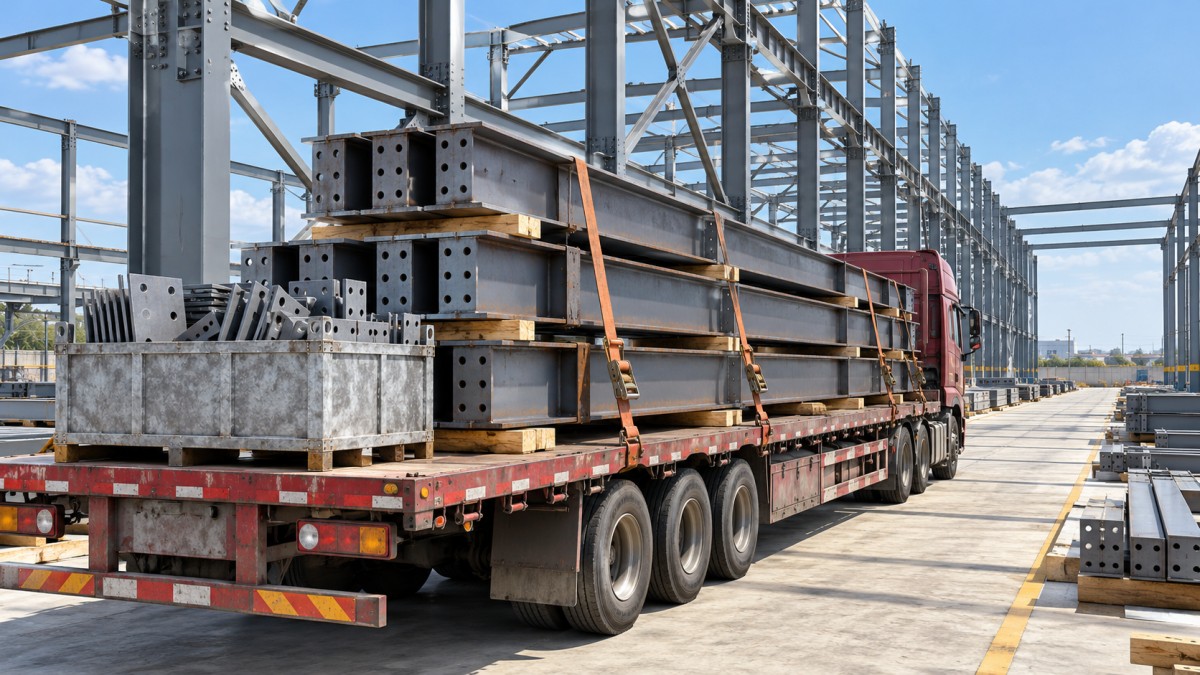
Each shipment needs an identifiable erection purpose: a bay, grid area, floor zone, or other defined work package. Piece marks must connect the physical members to the current drawings and packing list. Small items need traceability to that same package, even when they travel separately. “All main steel delivered” is an inadequate readiness measure if the connections needed to install it remain elsewhere.
Compare the delivery options on the same cost basis
The relevant alternatives are rarely limited to a full stockpile or delivery immediately before every lift. Phased deliveries, a nearby holding yard, and a small site buffer can each balance transport efficiency against erection continuity. Their costs belong in the same comparison.
A practical calculation is: net saving = avoided storage, handling, financing, and damage-related costs − additional logistics, coordination, and expected disruption costs. Count only changes attributable to the delivery strategy. Counting the same crane time once as handling savings and again as labor productivity improvement would overstate the result.
Disruption should be tested through concrete scenarios. Consider a late truck, a rejected member, and a site closure that prevents unloading. For each event, identify the resources that become idle, the work available elsewhere, and the recovery expense. Where reliable project records exist, they can support frequency assumptions. Without that evidence, show the break-even exposure rather than presenting an unsupported average saving.
The smallest practical buffer is rarely zero
A delivery buffer should reflect the time required to recover from a credible interruption. Distance from the fabrication shop matters, but so do dispatch flexibility, permitted delivery hours, traffic variability, and the availability of replacement transport. An abnormal load with restricted movement windows has different recovery options from a standard trailer operating on an unrestricted route.
Expressing the buffer in tonnes can hide the real exposure. A large stockpile of later-stage beams offers little protection when the next erection sequence lacks its columns. The useful measure is the amount of complete, accessible erection work available, with the connections and stability provisions needed to proceed.
A selective buffer often makes more sense than holding every item equally. Difficult-to-replace fabricated members, essential bracing, and project-specific connections deserve attention because their absence can stop a sequence. Standard small items may be easier to replenish, but only if the correct grade, dimensions, finish, and required documentation are available locally.
Off-site holding can protect a restricted site from excess inventory while keeping steel within reach. It introduces handling, storage, and another transport leg. Its value depends on whether those charges are lower than the site costs and interruption exposure it avoids.
Site readiness controls whether timing has value
A shipment arriving at its booked time is useful only if the site can receive and erect it. Foundations, anchor bolt positions, surveys, access routes, crane setup areas, and preceding work must be sufficiently complete for the planned sequence. Dispatching against an outdated programme can turn a punctual delivery into an obstruction.
The release decision needs a clear link between short-term site readiness and fabrication status. A scheduled delivery date alone does not establish that members have completed welding, inspection, coating, identification, and any required release documentation. Equally, fabrication completion does not establish that the workface is available.
Some uncertainty comes from the erection operation itself. Wind restrictions, crane outages, or delayed preceding work can suspend lifting after transport has already begun. The plan needs an agreed response: hold at source, redirect to an approved yard, or unload into reserved space. An improvised response at the gate can create waiting charges and congestion before the steel reaches the workface.
There is a practical limit to delivery precision. Requiring every truck to meet a narrow arrival window increases coordination demands and makes ordinary variation more disruptive. A workable receiving window, supported by enough accessible material to maintain erection, can cost less than an excessively tight schedule.
Quotation terms that change the result
Comparable quotations need the same delivery assumptions. A price based on consolidated full loads cannot be compared directly with one that includes sequenced packages, timed arrivals, and supplier-held inventory. The difference may reflect genuine service costs rather than a difference in steel price.
The commercial scope should make the following points explicit:
- Delivery package and sequence: identify the work areas covered, required accompanying components, and the agreed loading arrangement. Member length and weight can prevent a package from fitting a single vehicle.
- Unloading responsibility, permitted vehicle waiting time, and the basis for detention charges need to match the site’s receiving capacity.
- Schedule changes require a defined notice period. State what happens when fabrication is complete but dispatch is deferred, including storage charges and limits on holding capacity.
- For shortages or nonconforming pieces, establish the notification route, replacement arrangements, and responsibility for additional transport. A broad delivery promise leaves these costs unresolved.
Delivery performance should be assessed against the agreed erection package. An on-time truck carrying most of the scheduled weight can still fail its purpose if an essential member is missing. Records should distinguish arrival punctuality, package completeness, conformity, and whether the load was accessible in the required order.
When the saving is convincing
The strongest case occurs where site storage is expensive or physically restrictive, repeated handling is substantial, and the erection sequence is stable enough to release complete packages confidently. Reliable fabrication progress, workable transport windows, and a practical recovery route support that case. Freight premiums then have identifiable costs to offset.
The case weakens when programme changes are frequent, delivery routes are difficult to recover, or erection consumes material faster than delayed shipments can be replaced. Generous low-cost storage and efficient bulk unloading also reduce the potential saving. Under those conditions, phased bulk deliveries or a larger buffer may produce a lower installed cost.
A bounded trial on a defined erection area can test the assumptions before extending the arrangement. Record additional freight, handling movements, vehicle waiting, erection interruptions, and the reason for each delay. Separate delivery failures from weather, unavailable foundations, or crane problems so that the result reflects the delivery strategy.
The purchasing decision becomes defensible when the quoted logistics premium is compared with avoidable project costs and a stated interruption allowance. If a modest delivery disruption consumes the projected saving, the package size, receiving window, or buffer needs adjustment before the arrangement is committed.
Please give us a message
Tianjin Kaichuang Metal Material Co., Ltd
Add: No. 41, District 6, First Street, Huanghuadian Town, Wuqing District, Tianjin
Tel: + 86 137 9101 9833
E-mail: boss@kaichsteel.com