Steel Hub

Approving a carbon steel pipe manufacturer is rarely a paperwork exercise. In steel supply chains, pipe quality reflects upstream discipline in melting, rolling, forming, heat treatment, testing, and traceability. A weak audit can leave hidden risks inside every shipment.
That matters because carbon steel pipe moves into construction, energy, equipment manufacturing, shipbuilding, and transport projects where failure can trigger shutdowns, leaks, injury, and expensive replacement. Before approval, the manufacturer must prove process control, not just provide certificates.
Start with the manufacturer behind the pipe
A capable carbon steel pipe manufacturer is more than a trading name or a catalog. The audit should confirm whether the company is an actual producer, a processor, or a mixed operation using outsourced stages.
That distinction affects control over chemistry, dimensional accuracy, weld quality, coating, lead time, and corrective action speed. In practice, ownership of the process often tells more than the sales presentation.
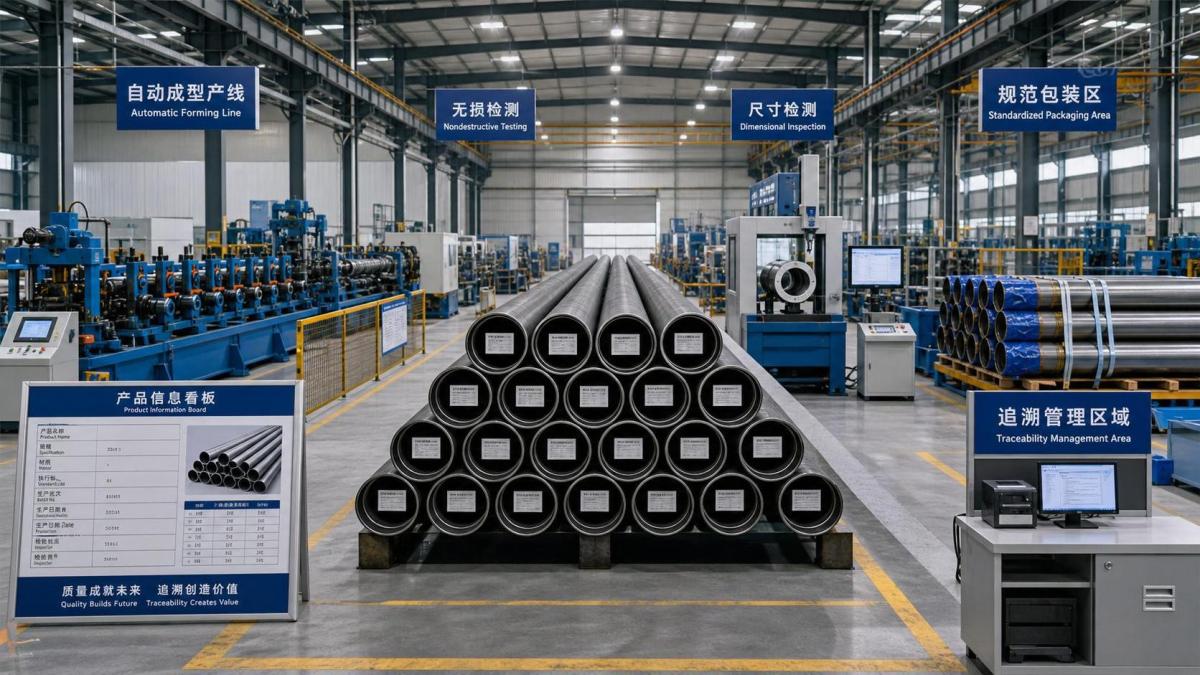
At this stage, basic facts should already match. Registration records, plant address, production lines, annual output, main standards, export history, and quality certifications should be consistent across documents and site evidence.
What to verify early
- Legal entity, plant location, and scope of manufacturing licenses
- Main pipe types, such as seamless, ERW, or LSAW
- Applicable standards, including ASTM, API, EN, or customer specifications
- Critical subcontracted steps, if any
- Recent nonconformance history, recalls, or major customer complaints
Check whether production capability matches the claimed range
Many approval failures begin with a gap between declared capability and real plant performance. A carbon steel pipe manufacturer may list broad sizes and grades, yet only run a narrow and stable range well.
Audit the route from raw material intake to finished packing. For seamless pipe, focus on billet control, piercing, elongation, sizing, heat treatment, and final inspection. For welded pipe, inspect strip preparation, forming, welding parameters, bead treatment, and online testing.
Equipment condition matters as much as equipment presence. A line that exists but runs infrequently may not deliver repeatable quality under production pressure.
Useful capability questions
Traceability is the backbone of approval
In steel and section product purchasing, traceability separates controlled supply from blind trust. A carbon steel pipe manufacturer should link each pipe or bundle to heat number, raw material source, process route, inspection status, and release decision.
This is especially important when pipe enters pressure service, structural use, fire systems, or energy infrastructure. If a defect appears later, traceability determines whether the issue can be contained or spreads across multiple lots.
Ask the plant to demonstrate record flow on a live batch. Do not rely only on sample forms. Follow one order from incoming billet or coil through production, testing, marking, storage, and shipment release.
Strong traceability usually includes
- Heat number control without manual gaps
- Separation of accepted, pending, and rejected material
- Clear status marking during each process stage
- Mill test reports tied to actual inspection data
- Retention of records for complaint investigation
Review testing discipline, not just test equipment
A qualified carbon steel pipe manufacturer should show both laboratory capability and testing discipline on the shop floor. Mechanical, chemical, dimensional, visual, hydrostatic, and non-destructive testing must align with the relevant standard and order requirements.
The critical question is consistency. Test machines can look impressive while sampling plans, specimen preparation, calibration, or result review remain weak.
Check whether operators understand acceptance criteria. Confirm who can release a lot, who can stop shipment, and how retests are controlled after failures.
Testing areas that deserve close attention
- Chemical analysis methods and frequency
- Tensile, flattening, bend, hardness, or impact testing where required
- UT, ET, RT, or hydrotest settings for weld and body integrity
- Gauge calibration for diameter, thickness, ovality, and length
- Disposition process for nonconforming product
Do not separate quality review from safety and compliance
Pre-approval should also examine the plant’s safety culture and compliance behavior. In pipe manufacturing, poor safety control often signals weak process discipline elsewhere.
Observe coil handling, hot work control, furnace operation, pressure testing zones, crane use, chemical storage, and personal protection. Serious risks in these areas can disrupt production and create supply instability even when product documents look acceptable.
Environmental and regulatory compliance also matters. Wastewater, emissions, pickling acids, coatings, and scrap management can affect operating continuity, especially in regions with stricter enforcement.
Signs of a stable operation
Look beyond the audit day
One visit offers a snapshot, not a full picture. A carbon steel pipe manufacturer should also be judged by performance trends, responsiveness, and transparency after questions are raised.
Review complaint handling, corrective action quality, delivery history, and consistency of mill test reports across several lots. Ask for recent production data from orders close to your target specification.
It also helps to compare the manufacturer against the needs of the final application. Structural pipe, line pipe, mechanical tubing, and general service pipe do not carry the same risk profile or control depth.
A practical approval path
- Define the exact standards, grade, size range, and service conditions first
- Rank audit points by failure impact, not by document convenience
- Use a trial order if the plant is technically acceptable but still unproven
- Set hold points for first lots, witness tests, or third-party review where needed
- Convert audit findings into a monitored supplier control plan
A sound audit does more than approve a carbon steel pipe manufacturer. It clarifies whether the plant can support stable quality, safe production, and dependable supply under real operating conditions.
The next step is to align audit criteria with the pipe’s end use, critical risks, and required standards. That approach turns supplier approval from a formality into a reliable decision framework.
Please give us a message
Tianjin Kaichuang Metal Material Co., Ltd
Add: No. 41, District 6, First Street, Huanghuadian Town, Wuqing District, Tianjin
Tel: + 86 137 9101 9833
E-mail: boss@kaichsteel.com