Steel Hub

Choosing between seamless tube and welded tube is rarely a simple material swap. The decision affects pressure capacity, wall integrity, dimensional tolerance, delivery timing, and overall project economics. In steel-intensive sectors such as energy, equipment manufacturing, shipbuilding, transport, and construction support systems, tube selection also influences fabrication efficiency and long-term service reliability.
That matters because pipe and tube are part of a much larger steel supply chain. From ironmaking and steelmaking through rolling and finishing, upstream process stability shapes downstream cost, availability, and consistency. Within that context, seamless tube often carries a premium for good reasons, but welded tube has become technically capable enough that the better option depends on the service condition, not on assumption.
How the two products are made
The manufacturing route explains most of the practical differences. A seamless tube is produced from a solid billet that is heated, pierced, elongated, and reduced to the required diameter and wall thickness. Because there is no longitudinal seam, the tube body is continuous around the full circumference.
Welded tube starts from steel strip or plate. The material is formed into a round section and then joined along a seam, usually by electric resistance welding or fusion welding, depending on product type and specification. Modern weld quality can be very high, especially when process control and non-destructive testing are strong.
A visual comparison helps frame the discussion.
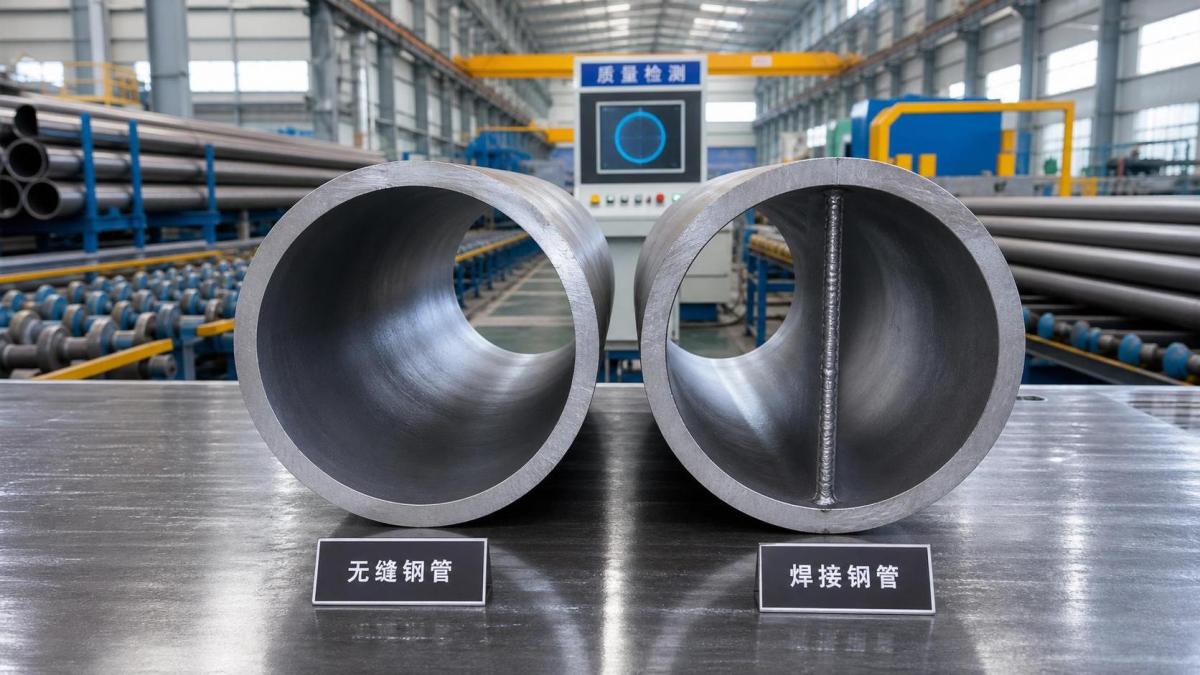
The key point is not that one route is universally superior. It is that each route creates different strengths, risks, and cost profiles.
Core differences at a glance
Why seamless tube still matters in demanding service
The strongest case for seamless tube appears where consequence of failure is high. High-pressure fluid handling, elevated temperature service, cyclic loading, and corrosive process lines often justify the extra cost. In those conditions, eliminating the weld seam can reduce one major inspection and performance concern.
Seamless tube is also valued when the design margin is tight. In boilers, heat exchangers, hydraulic systems, mechanical tubing, and some energy applications, the material is expected to perform predictably under stress concentration, pressure fluctuation, or thermal expansion. The benefit is not only strength. It is confidence in uniformity through the wall and around the circumference.
This is especially relevant in the broader steel industry, where upstream quality variation can influence finished product behavior. When service conditions are severe, buyers often prefer a route that removes seam-related variables from the equation.
Situations where the premium is easier to justify
- High internal pressure with limited tolerance for leakage or rupture
- Frequent temperature change that creates thermal fatigue risk
- Critical process piping with strict code or end-user standards
- Mechanical applications requiring reliable strength after machining
- Low-temperature or high-temperature service where defect sensitivity increases
Where welded tube can be the smarter choice
Welded tube is not simply a lower-grade substitute. In many applications, it is the more practical and economically sound choice. Structural members, general fluid transfer, low to moderate pressure systems, furniture frames, automotive components, and many fabricated assemblies can perform very well with welded tube.
Modern forming and welding technology has narrowed the performance gap in many commercial and industrial uses. Good process control, online inspection, and post-weld heat treatment where required can produce reliable results. For larger diameters, welded tube may also offer better supply flexibility and cost efficiency than seamless tube.
Another advantage is dimensional consistency. Depending on the grade and manufacturing line, welded tube can provide tight outside diameter control and good straightness, which simplifies downstream forming, cutting, and assembly.
Why the industry pays close attention to this comparison
Steel products serve sectors where timing and cost discipline matter as much as performance. A tube choice that is technically acceptable but operationally inefficient can slow fabrication, increase scrap, or extend procurement cycles. In periods of volatile steel prices or tight mill capacity, the difference between seamless tube and welded tube becomes part of a larger supply-chain decision.
That is why evaluation now goes beyond a simple question of strength. Material route, specification fit, test requirements, mill capability, and delivery reliability all carry weight.
Key evaluation points before making a selection
A useful comparison starts with service conditions, then moves to standards and manufacturing capability. Without that order, projects often overbuy seamless tube or underestimate what a welded product can handle.
Pressure, temperature, and media
The first screen is operating pressure, temperature range, and conveyed media. Clean water at moderate pressure is one case. High-pressure steam, hydrogen-bearing media, or corrosive chemicals are very different cases. The more severe the service, the more often seamless tube enters the shortlist.
Codes, standards, and inspection scope
Applicable standards can decide the answer quickly. Some designs allow either product form if tests are met. Others strongly favor seamless tube because of code history, end-user practice, or inspection philosophy. Mill test certificates, hydrotesting, ultrasonic testing, and weld examination requirements should be reviewed together, not separately.
Fabrication and downstream processing
Bending, flaring, threading, machining, and heat input during fabrication can affect the choice. If the seam area may become a processing limitation, seamless tube can reduce risk. If the fabrication route is straightforward and repeatable, welded tube may deliver the same functional result at lower cost.
Lead time and total project cost
Unit price is only one part of the equation. Availability by size, minimum order quantity, testing cost, scrap rate, and delivery certainty can change the real comparison. A lower-priced welded tube is not cheaper if it creates delays or extra qualification work. The reverse is also true for seamless tube.
Typical application patterns
In practice, the dividing line is often visible by application type rather than by abstract preference.
A practical way to judge when seamless tube matters
A useful rule is to treat seamless tube as a performance-driven decision, not a default upgrade. If the service environment, code requirement, or fabrication risk makes the seam a meaningful concern, the premium is easier to defend. If not, welded tube may protect both budget and schedule without reducing functional value.
It also helps to compare at the specification level rather than the product name level. Grade, heat treatment, testing method, dimensional tolerance, and source mill capability often matter more than a broad label alone. Two tubes with the same nominal size can behave very differently in production and service.
The next step is usually straightforward: define the actual operating envelope, map it to the relevant standard, and compare seamless tube and welded tube against the same acceptance criteria. That approach turns a familiar debate into a clearer technical decision, with fewer surprises in cost, lead time, and field performance.
Please give us a message
Tianjin Kaichuang Metal Material Co., Ltd
Add: No. 41, District 6, First Street, Huanghuadian Town, Wuqing District, Tianjin
Tel: + 86 137 9101 9833
E-mail: boss@kaichsteel.com