Steel Hub

Why does steel construction for warehouse budgeting change so quickly?
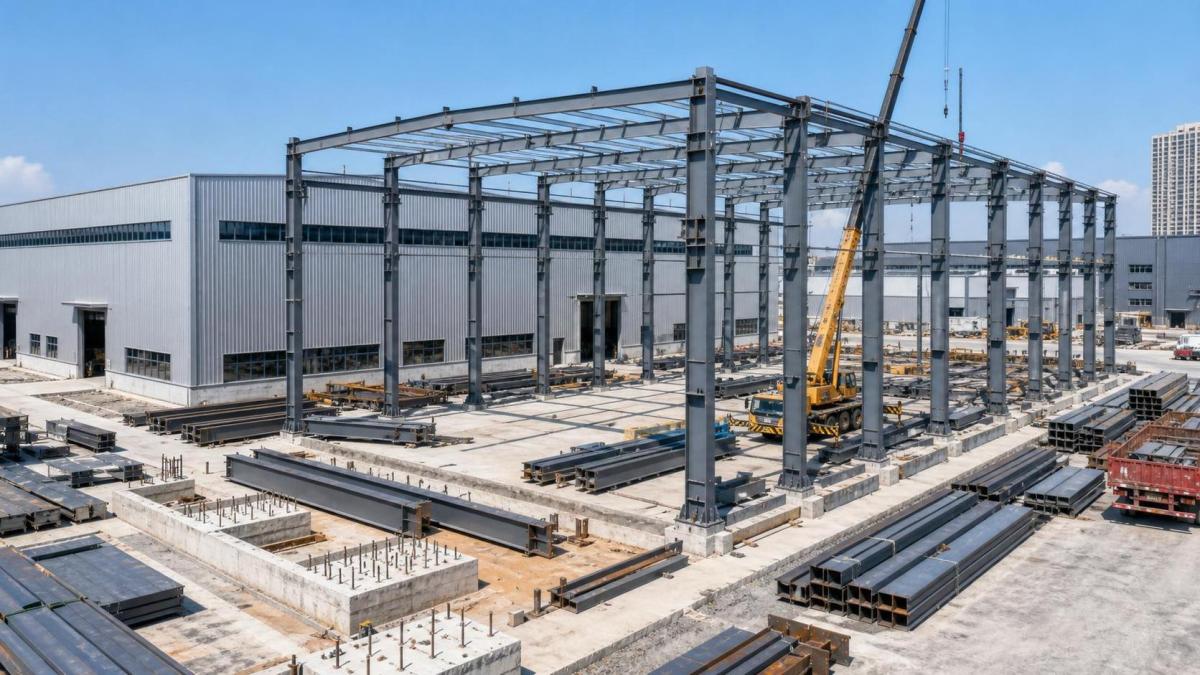
Steel construction for warehouse planning often looks simple at concept stage. The budget becomes less predictable when structural loads, span, and site conditions are defined in detail.
That happens because a warehouse frame is not only a steel tonnage question. It is also a question of fabrication complexity, logistics timing, foundation demand, and erection efficiency.
In practical terms, two buildings with similar floor area can have very different costs. A wider clear span, higher eave height, or heavier crane load changes the member sizes quickly.
Supply conditions matter as well. Steel comes from an upstream industry linked to iron ore, scrap steel, rolling capacity, and transport availability. Price stability and delivery speed downstream are affected by that chain.
For that reason, early decisions in steel construction for warehouse projects should not focus only on the lowest quoted rate per ton. The real issue is the total installed cost and the risk behind it.
Which design choices usually drive the biggest cost increase?
The biggest cost drivers are usually span, height, loading, and repetition. These factors influence section size, fabrication hours, connection details, and transport limits.
A long clear span is often requested for storage flexibility. It reduces internal columns, but it usually raises steel weight per square meter and may require deeper rafters.
Height can be just as influential. A taller warehouse needs longer columns, stronger bracing, and often more attention to lateral stability during installation.
Loading is another turning point. Roof equipment, solar systems, suspended services, mezzanines, and crane beams can push a standard frame into a much heavier design class.
What surprises many teams is the effect of connection design. Simple repetitive bolted joints are easier to fabricate and erect. Irregular geometry and many special nodes usually cost more than expected.
The table below helps separate headline cost items from the hidden ones that often appear later.
How should span, layout, and future expansion be judged together?
This is where steel construction for warehouse design often becomes a trade-off exercise rather than a pure engineering calculation.
A wide span supports forklift movement, racking freedom, and cleaner circulation. Yet the most economical frame is not always the widest one.
A more balanced approach is to compare three layouts. One should favor minimum steel weight, one should favor operating flexibility, and one should reserve expansion edges.
Future expansion deserves special attention. Many warehouse projects are designed for current throughput only. Later additions then interrupt drainage lines, traffic flow, or structural bracing paths.
If expansion is likely, confirm whether the end bay can be extended, whether foundations can accept future loads, and whether cladding details allow clean tie-ins.
- Reserve practical grid spacing for racking, dock positions, and equipment lanes.
- Check if future extensions require temporary shutdown of operations.
- Align roof drainage and expansion joints before tender stage.
- Avoid layouts that save steel today but block site circulation later.
In other words, the best steel construction for warehouse scheme is usually the one that protects both initial cost and future adaptability.
Where do the main design risks appear after procurement starts?
Several risks do not show up clearly in early quotations. They become visible when fabrication drawings, coating requirements, and site installation plans are developed.
Corrosion exposure is a common example. A warehouse near the coast, a chemical process line, or high indoor humidity may need a stronger protection system than standard shop primer.
That choice affects more than paint cost. It can change surface preparation, fabrication lead time, repair procedures, and maintenance planning.
Installation delay is another frequent risk. Long members may exceed transport limits. Site cranes may need larger capacity than expected. Anchor bolt misalignment can slow the entire erection sequence.
There is also the risk of underdefined interfaces. Mezzanines, sprinkler supports, conveyor loads, and wall openings often move between disciplines unless responsibilities are written clearly.
A practical review should include these checkpoints before orders are released.
- Coating category matches actual environment, not only general building use.
- Transportable member sizes are checked against route restrictions.
- Connection strategy suits available crane time and site access.
- Openings, hangers, and service loads are frozen before detailing.
- Material grade and rolling availability are confirmed with realistic delivery windows.
Because steel supply is linked to wider manufacturing and infrastructure demand, delivery risk should be reviewed together with design risk, not as a separate purchasing issue.
Is the lowest steel price really the best benchmark?
Usually not. In steel construction for warehouse work, a low unit price can hide higher fabrication hours, more site welding, or longer installation duration.
A better comparison looks at total project effect. That includes steel weight, coating system, shop detailing scope, bolt supply, transport packaging, erection time, and rework exposure.
It is also useful to compare proposal assumptions, not just totals. One bidder may price for standard roof load, while another includes solar allowance or heavier purlins.
The same applies to material source. Plate, sections, pipes, and long products come through different rolling routes and stock positions. Availability can affect both schedule and substitution risk.
If two quotations are close, the stronger option is often the one with fewer exclusions and clearer fabrication responsibility.
A quick comparison checklist
What should be confirmed before finalizing steel construction for warehouse procurement?
Before procurement closes, the most valuable step is alignment. Geometry, loads, coatings, interfaces, and schedule assumptions should all be locked to the same version.
It helps to issue a decision sheet rather than relying on scattered drawing notes. That sheet can capture span logic, future expansion intent, fire or corrosion requirements, and excluded loads.
For steel construction for warehouse projects, clarity usually saves more money than aggressive last-minute negotiation. The reason is simple: fabrication and erection penalties become expensive very quickly.
A sound next step is to compare at least two structural options against the same operating brief. Then review total installed cost, schedule sensitivity, and long-term maintainability side by side.
If those checks are done early, the project is more likely to reach a practical balance between steel usage, delivery certainty, and service life. That is usually the real target behind a successful warehouse build.
Please give us a message
Tianjin Kaichuang Metal Material Co., Ltd
Add: No. 41, District 6, First Street, Huanghuadian Town, Wuqing District, Tianjin
Tel: + 86 137 9101 9833
E-mail: boss@kaichsteel.com