Steel Hub

Why does welded pipe deserve closer quality review in structural work?
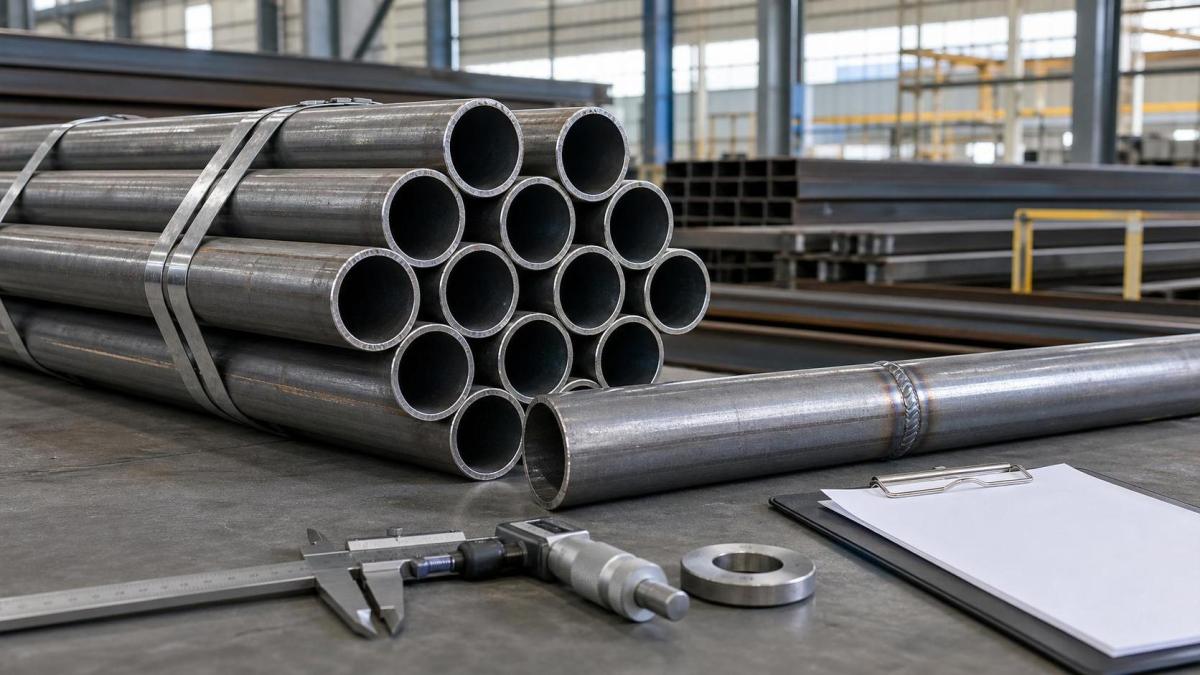
In structural projects, welded pipe is often chosen for cost control, supply availability, and fabrication flexibility.
That makes sense. The steel industry supports construction and manufacturing by delivering plate, section, pipe, and long products at scale.
But welded pipe is only a practical choice when quality is checked beyond the mill test certificate.
A pipe can meet basic paperwork requirements and still create trouble during cutting, fit-up, welding, coating, or installation.
In real projects, the biggest losses rarely come from the pipe price itself.
They usually come from schedule disruption, rejected batches, repeated inspection, field correction, and avoidable safety exposure.
So the better question is not simply whether welded pipe is acceptable.
It is whether the selected welded pipe is consistent enough for the actual structural load path, fabrication route, and site conditions.
Which quality risks show up most often before installation starts?
The common risks are not mysterious. They are usually visible in production records, dimensional checks, and incoming inspection.
Weld seam quality comes first because it directly affects structural reliability and downstream fabrication behavior.
Look for incomplete fusion, excessive reinforcement, undercut, porosity, seam misalignment, and inconsistent heat input.
The next issue is dimensional accuracy. Out-of-roundness, wall thickness variation, and poor straightness can slow assembly immediately.
Surface condition matters more than many teams expect.
Laminations, scale, dents, edge damage, and coating contamination can affect cutting quality, corrosion protection, and weld preparation.
Material inconsistency is another hidden problem.
When chemistry or mechanical properties drift between heats, welded pipe may behave differently across the same package.
That is where traceability becomes important, especially for infrastructure, transport, and energy-adjacent structures.
- Check seam appearance against the specified manufacturing standard.
- Confirm outside diameter, thickness, length, straightness, and ovality with sampling records.
- Review heat numbers and test certificates for batch consistency.
- Inspect end condition because damaged bevels slow site welding.
How can you judge whether welded pipe quality is good enough for the actual structure?
A useful approach is to judge welded pipe against the real application, not against generic acceptance language alone.
For lightly loaded frames, supports, and secondary members, standard commercial consistency may be acceptable.
For primary load-bearing members, repeated connections, exposed environments, or tight fabrication tolerances, the threshold should be higher.
The table below helps turn that judgment into a practical review.
A welded pipe package should also match the fabrication method.
If the structure needs repeated coping, slotting, or robotic welding, variability that seems minor at delivery becomes expensive later.
Where do teams misjudge welded pipe most often?
The most common mistake is treating welded pipe as a commodity with uniform performance across suppliers and mills.
In reality, forming, welding, sizing, and inspection discipline vary noticeably.
Another weak point is relying on nominal dimensions without checking actual tolerance bands.
A small wall thickness shortfall can change section capacity and welding response at the same time.
There is also a paperwork trap. Certificates may be complete, while marking on the pipe bundle is incomplete or mixed.
That creates confusion when part of the batch must be held, re-tested, or matched to a specific structure zone.
More subtle misjudgment happens when procurement compares only initial price.
For structural schedules, a lower-cost welded pipe option can become more expensive if acceptance, repair, or coating preparation takes longer.
A better comparison is total installed cost, including inspection effort and fabrication productivity.
What should be checked at receiving inspection, and what can wait?
Receiving inspection should focus on what is hardest to correct after cutting starts.
That usually means identity, dimensions, seam condition, visible defects, and quantity accuracy.
It helps to separate immediate release checks from deeper review.
- Release now: heat number match, standard grade, size, wall thickness, length, visible seam defects.
- Review next: mechanical test records, NDT coverage, coating compatibility, and special project clauses.
- Escalate quickly: mixed bundles, unclear marking, repeated ovality, or surface damage near the seam.
When welded pipe is intended for exposed structures, add corrosion-related checks early.
Poor surface cleanliness or mill scale condition can affect primer adhesion and long-term maintenance cycles.
If delivery is phased, keep the inspection standard the same for every batch.
Many inconsistencies appear only when later shipments arrive from a different production run.
Can lower-cost welded pipe still be the right choice?
Yes, but only when the risk profile is understood clearly.
Welded pipe remains a strong option for many structural projects because the steel supply chain values stable output and delivery efficiency.
That matters when schedules depend on reliable volume, not just premium specifications.
The practical decision is to match inspection depth to consequence of failure.
If the welded pipe supports secondary framing in a controlled environment, moderate inspection may be enough.
If it is part of a critical structural system, tighter controls are justified even when they increase lead time slightly.
In other words, low price is not the problem. Unpriced risk is.
That is why supplier capability, process stability, and documentation discipline matter as much as nominal grade.
What is the smartest next step before approving a welded pipe package?
Start by mapping the pipe to its actual structural duty, exposure condition, and fabrication sequence.
Then build a short approval checklist around the risks that would hurt schedule or safety most.
For most projects, that checklist should cover seam integrity, dimensional tolerance, traceability, surface condition, and batch consistency.
Where uncertainty remains, ask for additional sampling or targeted third-party inspection before site release.
That step is usually cheaper than correcting a poor welded pipe batch after fabrication has begun.
A disciplined review does not slow a project down.
More often, it protects cost control, delivery rhythm, and structural reliability at the same time.
When comparing options, focus on installed performance, not only purchase price, and define acceptance standards before the next order is placed.
Please give us a message
Tianjin Kaichuang Metal Material Co., Ltd
Add: No. 41, District 6, First Street, Huanghuadian Town, Wuqing District, Tianjin
Tel: + 86 137 9101 9833
E-mail: boss@kaichsteel.com