Steel Hub

What Affects Lead Times for Custom Steel Fabrication Projects?
Lead time in custom steel fabrication is rarely determined by the shop floor alone. A fabricated beam, platform, pipe support, machine frame, or structural assembly may look straightforward on a drawing, yet its delivery date depends on decisions made long before cutting begins. Material sourcing, design maturity, connection details, welding requirements, inspection hold points, coating systems, shipping constraints, and site readiness can all move the schedule.
For construction, industrial manufacturing, energy, rail, and infrastructure work, this matters because fabricated steel often sits on the critical path. Concrete works may need embedded plates before a pour. Equipment installation may depend on base frames or access platforms. A delayed structural package can leave cranes, crews, and downstream trades waiting. The resulting cost is not limited to the steel purchase order; it can include resequencing, expedited freight, storage, rework, and lost installation windows.
The steel industry itself is an upstream link in a much larger supply chain. Steel made from iron ore and scrap is processed into plate, sections, pipe and tube, wire rod, and other forms used across buildings, shipbuilding, automotive production, machinery, appliances, power facilities, and transport networks. That broad demand means availability and mill rolling schedules can influence a custom project even when the fabrication shop has open capacity. A reliable schedule therefore requires visibility from the required steel grade through final delivery, not just a promised fabrication date.
Lead Time Starts with Scope Definition, Not Production
The most common planning mistake is treating the issue date of a purchase order as the start of fabrication. In reality, work may be unable to proceed until drawings are approved, interfaces are resolved, materials are released, and technical requirements are clear. A supplier can reserve capacity based on preliminary information, but reserving capacity is not the same as being ready to cut steel.
A quote based on a concept drawing often carries assumptions: steel grade, section sizes, tolerances, weld categories, coating scope, bolt supply, packing method, and delivery sequence. When these assumptions change after award, the fabrication route may change with them. A revised plate thickness may require different stock. A late requirement for galvanized surfaces can alter vent-hole details and handling. A request to split an assembly for site access can create new splice connections, additional drilling, and more inspection work.
Before comparing delivery promises, it is useful to ask what the supplier considers the “release for fabrication” date. It should normally be tied to an agreed drawing revision, complete specifications, and a clear list of client-supplied information. Without that definition, two quotations may appear to offer the same lead time while measuring it from entirely different points.
Design Complexity Creates Both Direct and Hidden Delays
Not all tonnes of steel take the same effort to fabricate. Standard rolled sections cut to length with routine holes are very different from built-up box members, heavy plate girders, curved components, closely spaced stiffeners, multi-axis pipe supports, or assemblies with extensive fit-up requirements. Weight is relevant to capacity planning, but it is not a reliable measure of labor content or schedule risk.
Complexity becomes more significant when one part must align with another party’s work. For example, fabricated steel may need to match anchor bolt patterns set in concrete, equipment nozzles supplied by an OEM, cladding rails, crane runway geometry, or field-installed piping. The steel fabricator can produce accurately to the approved drawing, but uncertainty at these interfaces frequently leads to late revisions or site modifications.
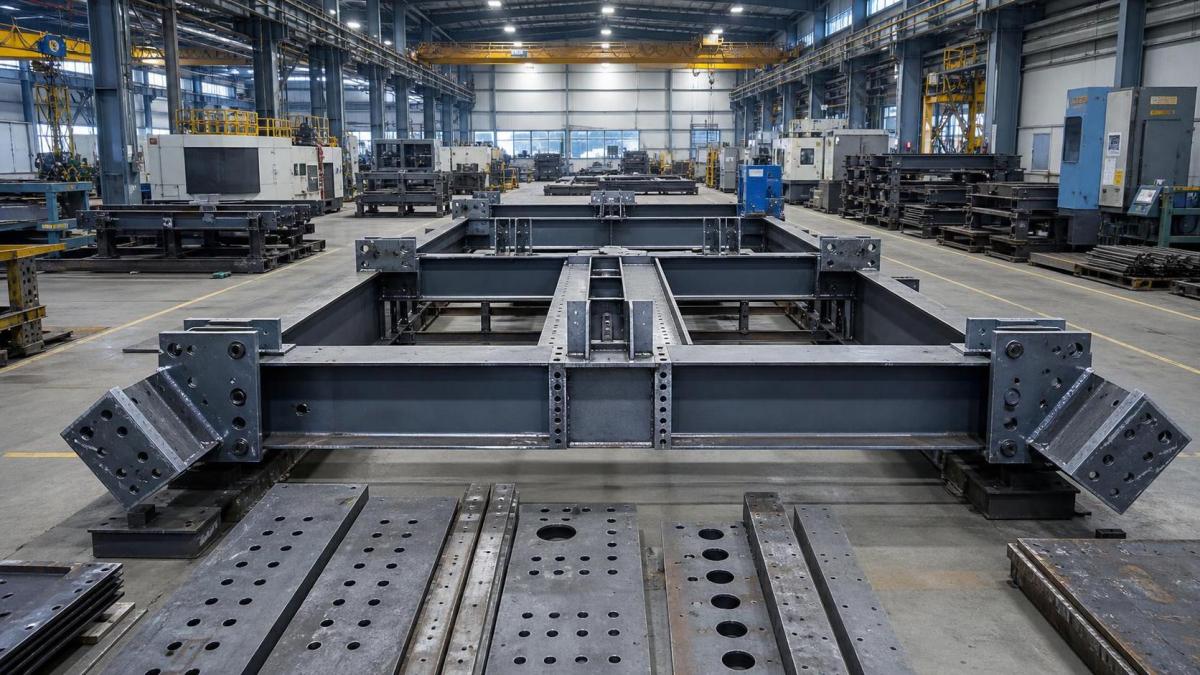
Connection design deserves particular attention. Bolt sizes, access for tightening, weld access, edge distances, coping geometry, and member orientation may appear minor in a model but can materially affect fabrication time. Details that are difficult to weld, inspect, coat, or assemble increase shop handling and may require special fixtures. Early constructability review is often less expensive than trying to recover lost days after materials are already cut.
Material Availability Is More Than a Question of Steel Grade
Material procurement is one of the largest variables in a steel fabrication schedule. Common section sizes and ordinary plate dimensions may be available from service centers or local stockholders, depending on the market. However, availability can change quickly when a project requires unusual thicknesses, nonstandard flange dimensions, long lengths, special chemistry, low-temperature performance, specific through-thickness properties, or a particular source of mill documentation.
The required form matters as much as the nominal grade. A fabricator may have access to a suitable plate grade but not to the required width, length, or thickness. Substituting multiple plates or changing the nesting plan can introduce butt welds, extra testing, more distortion control, and additional engineering review. Similarly, choosing a heavier section simply because it is in stock may affect connected members, foundation loads, transport weight, and cost.
Traceability requirements also influence timing. When material certificates, heat-number tracking, or segregation of specific materials are required, the shop must maintain traceability through receiving, cutting, assembly, and inspection. This is normal practice for many controlled projects, but it needs to be included in the schedule and price rather than treated as an administrative afterthought.
Buying material early can protect a schedule, but it is not always the lowest-risk choice. If drawings remain unstable, early procurement may leave the project with unusable or inefficient stock. The practical approach is to identify long-lead materials early, freeze the dimensions and grades that are genuinely settled, and keep uncertain items visible rather than burying them in a general schedule.
Shop Capacity Must Be Matched to the Actual Work Content
A fabrication shop’s stated monthly capacity does not automatically indicate how quickly a specific package can be delivered. Capacity may be constrained by a bottleneck rather than total labor hours: a CNC plate processor, a drilling line, a press brake, a large assembly bay, a welding positioner, blast cleaning, painting, or a lifting arrangement for oversized pieces. A project containing many similar small components may flow efficiently through automated equipment. A few large, awkward assemblies may occupy a bay and crane for much longer.
Welding is a frequent source of schedule variation. The time required includes edge preparation, fit-up, welding, interpass control where applicable, visual examination, any required non-destructive examination, repair if needed, and distortion correction. Thick sections and restrained assemblies can demand slower, more controlled welding sequences than light fabricated items. It is risky to estimate delivery based only on cutting and assembly dates.
Capacity commitments should also be checked against the supplier’s existing workload. A short quoted lead time may be realistic when capacity is reserved at order placement, but much less certain if it depends on another project finishing as expected. A useful discussion is not simply “Can you deliver in six weeks?” but “Which operations are scheduled when, and what assumptions must remain true for that plan to hold?”
Approvals, Quality Hold Points, and Coatings Need Their Own Schedule
Approval cycles are often underestimated because they are not physically visible in the workshop. Shop drawings, material submittals, welding documentation, inspection and test plans, sample approvals, and coating data may require review by several parties. A single unanswered technical query can stop release of an entire assembly if the affected item controls fit-up or sequence.
The right level of quality control depends on the project requirements. Dimensional checks, weld visual inspection, and material verification are common activities, while additional examination or witness points may be specified for certain applications. These requirements should not be viewed as avoidable delay; they are part of the delivery scope. The schedule problem arises when inspection requirements are unclear, inspectors are not available at the required time, or hold points are added after fabrication has started.
Surface treatment can be equally decisive. Blast cleaning, primer systems, multi-coat paint application, curing periods, galvanizing, fire protection, and touch-up work all need planning. Weather and humidity may affect some coating operations, especially where work is performed outside controlled conditions. Galvanizing requires design coordination as well: enclosed areas, drainage, venting, distortion risk, and post-galvanizing rework should be reviewed before fabrication, not when parts are ready for dispatch.
Transport and Site Conditions Can Undo a Good Shop Schedule
Fabrication is only complete when the required steel reaches the correct location in usable condition. Long girders, wide frames, heavy modules, and irregular shapes may need route planning, special trailers, lifting plans, export packing, or transport permits depending on the route and local rules. These arrangements can take longer than expected, particularly if the final piece dimensions are not confirmed early.
Site access introduces another layer of risk. Delivery slots, crane availability, laydown space, lifting capacity, road restrictions, receiving hours, and weather exposure should influence the fabrication sequence. Shipping the full package at once may reduce freight coordination, but phased delivery can be better when installation follows a defined sequence or storage space is limited. The lowest freight cost is not necessarily the lowest total project cost if it forces double handling or leaves critical parts inaccessible under later deliveries.
How to Make Lead Times More Predictable Without Paying for Avoidable Expedite Costs
Expediting has a place, but it cannot solve every constraint. Paying for priority cutting does little if the required plate has not arrived, drawings are under review, or a coating system has a necessary curing period. The better strategy is to expose the true critical path early and protect it with timely decisions.
A practical procurement package should separate information that is fixed from information still under development. It should state material grades and product forms, drawing revision status, connection responsibilities, welding and inspection requirements, surface treatment, traceability needs, delivery lots, and destination constraints. If alternatives are acceptable, identify the decision process in advance. For instance, a fabricator may be able to suggest an available section or plate format, but any substitution should be reviewed for structural, connection, corrosion, and downstream implications rather than approved solely to preserve a date.
Request a milestone schedule that distinguishes material purchase, drawing approval, fabrication release, cutting, assembly, inspection, coating, packing, and dispatch. It does not need to be overly detailed, but it should show dependencies. This makes it easier to see whether a promised delivery date depends on a pending approval, an unconfirmed material source, or a logistics assumption outside the fabricator’s control.
The most dependable custom steel fabrication schedules are built around complete information and realistic handoffs. When comparing suppliers, focus less on the shortest headline lead time and more on whether the proposed sequence accounts for engineering, material, production, quality, finishing, and delivery. That level of clarity gives a project team a better basis for controlling both schedule exposure and the cost of late changes.
Please give us a message
Tianjin Kaichuang Metal Material Co., Ltd
Add: No. 41, District 6, First Street, Huanghuadian Town, Wuqing District, Tianjin
Tel: + 86 137 9101 9833
E-mail: boss@kaichsteel.com