Steel Hub

For commercial evaluators, the real question is not whether a steel warehouse is “cheaper” in the abstract. It is whether it lowers the full project cost compared with a conventional storage building under the conditions that actually shape return on investment: schedule pressure, required clear span, expansion plans, operating loads, and the cost of being wrong. In many cases, a steel warehouse does cost less, but the savings usually come from the overall project logic rather than from a simple comparison of material price per square meter.
That distinction matters. A conventional building may appear economical on paper if the comparison is limited to one line item, such as wall material or initial structural cost. But procurement decisions in industrial storage are rarely decided by one line item. They are decided by how quickly the facility can go live, how efficiently it supports inventory flow, how much it costs to maintain over time, and how well it adapts when the business changes.
Where the cost advantage usually starts
A steel warehouse tends to be less expensive than conventional storage buildings when the project requires a large, unobstructed interior. In steel and profile distribution, that is common. Long products, sections, pipes, coils, and fabricated items do not move efficiently through a building crowded by interior columns. Every extra structural obstacle affects forklift routing, crane coverage, rack layout, and loading discipline.
Steel framing is often better suited to long spans and high eave heights without forcing a major redesign. That can reduce the number of structural compromises needed to make the storage operation work. A lower-cost building that constrains material handling is rarely lower cost for long.
The second source of savings is speed. In projects where the warehouse must support a new contract, seasonal stock buildup, or relocation from leased space, construction duration has direct financial value. Pre-engineered or fabrication-based steel systems can shorten the overall timeline because much of the structural work is standardized and prepared before site installation. Faster completion can mean earlier revenue, lower temporary storage expenses, fewer disruption costs, and less exposure to labor volatility on site.
That is why a steel warehouse often compares well against conventional masonry or concrete-heavy solutions in fast-moving B2B environments. The more expensive delay becomes, the more attractive schedule certainty becomes.
When “cheaper” means lower total cost, not lower bid price
Many procurement teams make the wrong comparison first. They compare the tendered construction price of one building type against another without establishing the same operating requirement. A fair comparison should ask whether both buildings deliver the same usable storage volume, loading performance, fire strategy, handling access, and future flexibility.
Consider three common examples:
- A building with internal columns may look cheaper initially, but it can reduce rack density or create dead zones for long steel products.
- A lower eave height may reduce structural cost, but it can also force a larger footprint to achieve the same storage capacity.
- A slower-build option may save on the construction package while increasing lease overlap, temporary yard costs, or customer service risk.
In other words, the cost question is operational before it is architectural. A steel warehouse is more likely to cost less when it preserves usable space and shortens time to use.
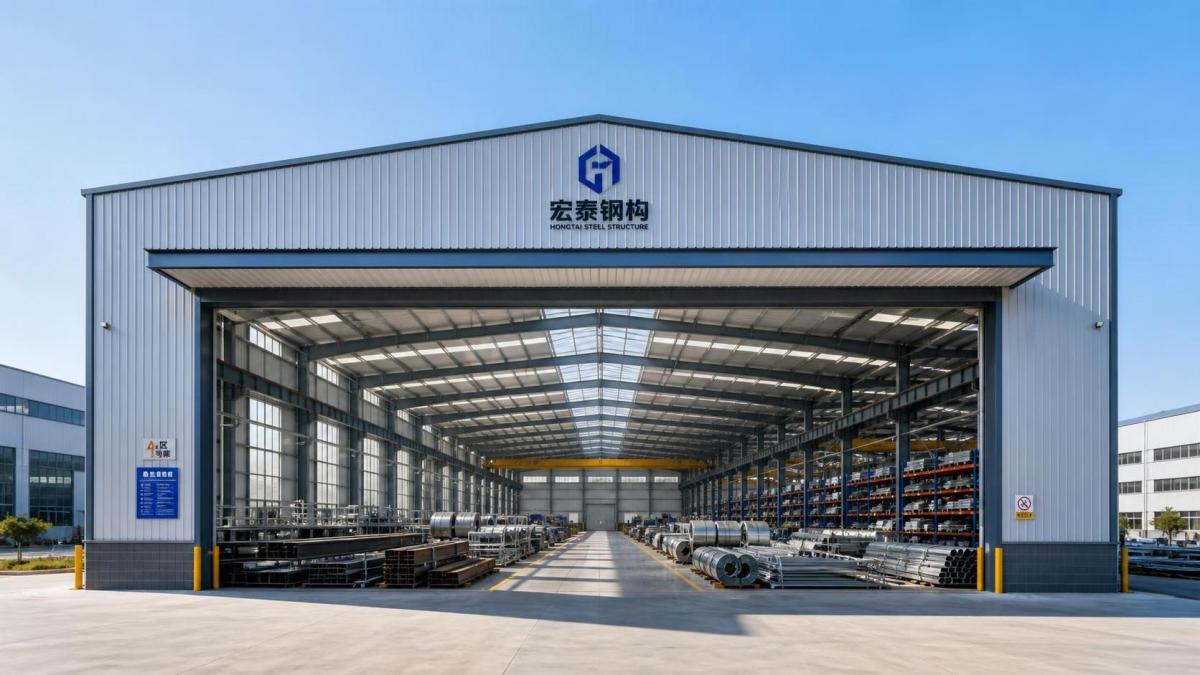
The scenarios where steel warehouses tend to outperform conventional buildings
Not every storage project benefits equally. The strongest cost case usually appears in a few specific business situations.
1. Large-span storage for long or bulky products
Stocking beams, channels, tubes, coils, plates, or fabricated assemblies often requires wide bay spacing and flexible movement paths. If the building must accommodate overhead cranes, side-loading vehicles, or future racking changes, steel framing usually fits more naturally than conventional systems designed around heavier walls or shorter spans.
In these cases, the saving is not only in structure. It shows up in throughput, less handling interference, fewer damaged goods, and cleaner traffic planning.
2. Time-sensitive expansion
When an operator is adding capacity to support a signed customer program or entering a new region, delay has a visible cost. Steel systems often reduce coordination complexity because structural members, connection details, and enclosure systems can be integrated early in the procurement cycle. That does not eliminate project risk, but it can make the timeline easier to control.
For commercial evaluators, that improves predictability. Predictability itself has value, especially when financing, lease termination dates, or committed delivery windows are involved.
3. Future expansion is likely
If the business expects SKU growth, heavier inventory swings, or process changes, a steel warehouse can be more economical because expansion is usually easier to phase. Adding bays, extending length, or modifying internal layouts may be simpler than altering a conventional structure with more rigid constraints.
This matters in steel distribution and processing, where product mix can change faster than the original building brief suggests. A warehouse that can absorb those changes without major reconstruction often wins the cost comparison over its lifecycle.
4. Sites with foundation sensitivity
Depending on the design approach and local conditions, steel buildings can sometimes reduce structural dead load compared with heavier alternatives, which may help foundation requirements. That does not automatically mean lower substructure cost; soil conditions, seismic requirements, wind loads, and local code obligations can change the picture quickly. But on difficult sites, lower superstructure weight can become a meaningful advantage and deserves evaluation rather than assumption.
Where the conventional option may still make more sense
A steel warehouse is not automatically the cheaper answer. There are cases where a conventional storage building can remain competitive or even preferable.
If the building is relatively small, has limited clear-span needs, and faces no meaningful schedule pressure, the premium for certain steel solutions may not be justified. Likewise, if the operational profile is simple and future change is unlikely, the flexibility benefit may be overvalued.
Another issue is environment. In corrosive settings, coastal zones, or facilities with aggressive chemical exposure, protective systems and maintenance planning become critical. If corrosion protection is underspecified, the apparent cost advantage can erode over time. Similar caution applies to fire protection. Required ratings, insurance standards, or customer audit expectations may add significant cost depending on jurisdiction and occupancy use. These requirements vary widely and should be treated as project-specific rather than assumed standard【待核实】.
There is also a procurement reality: some buyers compare a fully engineered steel warehouse package with a very basic conventional shell. That is not a like-for-like exercise. If one option includes crane readiness, insulation, drainage integration, and expansion allowances while the other does not, the lower number says little.
What actually drives the cost difference
Commercial evaluators should break the decision into cost drivers instead of broad building labels. In practice, the following factors usually determine whether a steel warehouse comes out ahead:
This framework is more useful than asking which building type is “generally cheaper.” There is no stable answer without understanding which of these drivers dominates the project.
Common claims that need a closer look
One common claim is that steel buildings are always cheaper because they use less material and install faster. That is too simplistic. Fabrication complexity, steel price cycles, coating systems, transportation distance, and local erection capacity can all narrow or reverse the expected advantage. In periods of volatile raw material pricing, quoted savings may not hold for long unless procurement timing and contract terms are managed carefully.
Another claim is that conventional buildings are more durable by default. That is also incomplete. Durability is a specification outcome, not a generic category outcome. A well-designed and properly protected steel warehouse can serve for decades, while a poorly detailed conventional structure can create its own maintenance and moisture problems. The comparison should focus on design quality, environmental fit, and maintenance discipline.
A third mistake is to assume that lower maintenance automatically belongs to one material system. In reality, maintenance cost depends on envelope detailing, drainage, coating quality, joint performance, roof access, and inspection routines. Buyers should request maintenance assumptions explicitly instead of treating them as hidden constants.
How procurement teams should evaluate the decision
For a business case that can survive internal review, the evaluation should move beyond supplier brochure logic. A practical comparison usually needs at least these questions answered:
- What is the required usable storage volume, not just the building footprint?
- Will the operation need cranes, tall racks, side-loading access, or wide turning radii?
- How much does each month of project delay cost the business?
- Is the facility likely to expand or change product mix within three to five years?
- What site conditions could alter foundation or drainage cost?
- What are the fire, insurance, and local compliance implications【待核实】?
- What maintenance regime is assumed over the building life?
These questions help filter out cosmetic savings. They also expose where a steel warehouse creates value beyond the structure itself, especially in industrial supply chains where inventory flow and service reliability matter as much as construction cost.
Risk points that deserve commercial attention
Even when the steel option looks favorable, several risks can distort the outcome if they are not controlled early.
First is scope ambiguity. Buyers should confirm whether the quotation covers only the primary frame or also includes cladding, insulation, doors, loading interfaces, drainage, accessories, erection, and design coordination. A low headline price with fragmented scope can become expensive in execution.
Second is design freeze timing. Steel projects gain speed partly because decisions are made early. If the buyer changes crane loads, bay spacing, mezzanine plans, or fire strategy late in the process, cost savings can disappear.
Third is supplier capability. For steel warehouses, engineering quality, detailing accuracy, and installation sequencing matter as much as base material cost. A cheaper supplier with weak project control can create schedule loss that wipes out the initial discount.
Fourth is lifecycle mismatch. Some buyers overinvest in specification for a short-horizon use case, while others underinvest in coatings, enclosure performance, or expansion readiness for an asset meant to last. Both errors distort the cost comparison.
What to watch in the current decision environment
For evaluators working today, the decision is becoming less about simple shell cost and more about supply chain resilience. Steel users increasingly care about how fast a warehouse can be delivered, how reliably it can support inventory turnover, and how easily it can be adapted when product structures change. That favors solutions with predictable execution and modular logic.
At the same time, volatility in steel input prices, freight, labor, and compliance requirements means the “cheapest” option at bid stage may not remain cheapest at handover. Sensitivity testing is worth doing. A modest scenario review on schedule slippage, coating upgrades, code-related additions, and foundation changes often reveals more than a nominal price comparison.
So when does a steel warehouse cost less than a conventional storage building? Usually when the project values speed, clear-span performance, future flexibility, and controlled lifecycle cost more than the comfort of familiar building methods. For commercial evaluators, that is the real threshold. The decision becomes clearer once the building is treated as an operating asset rather than a construction category.
Please give us a message
Tianjin Kaichuang Metal Material Co., Ltd
Add: No. 41, District 6, First Street, Huanghuadian Town, Wuqing District, Tianjin
Tel: + 86 137 9101 9833
E-mail: boss@kaichsteel.com