Steel Hub

Warehouse expansion rarely happens in a calm moment. More often, it starts when storage is tight, production is being squeezed, or inbound and outbound flows are no longer matching the original building plan. At that point, project managers are not just comparing materials. They are asking a sharper question: how do we add usable space without turning the site into a long-running disruption?
That is where steel construction for warehouse projects often stands out. The time-saving benefit is real, but it is not automatic in every situation. Steel does not shorten every phase equally. It tends to save the most time on site when the project is designed around prefabrication, when the expansion ties into an active facility, and when schedule certainty matters as much as pure speed. For teams planning an extension, annex, loading area, or production-linked storage building, understanding those conditions makes the difference between a fast build and a rushed one.
In practice, the question is less “Is steel fast?” and more “At what point in this project does steel become the smarter way to compress the site schedule?”
Where steel saves time—and where it doesn’t
Traditional construction methods often bring more fabrication, cutting, forming, and adjustment onto the job site. Steel shifts much of that work upstream. Structural members, columns, rafters, purlins, and connection components are typically fabricated in advance, then delivered ready for assembly. For a project manager, that changes the rhythm of the build.
Instead of managing a long sequence of wet trades and curing intervals, the site can move more quickly into erection. Crews spend less time waiting for one operation to stabilize before the next begins. This is especially important in warehouse environments, where access roads, forklift routes, loading bays, and adjacent operations may need to remain active during construction.
That said, steel construction for warehouse expansion does not save time simply because the frame is steel. If design coordination is incomplete, if anchor points are off, or if procurement decisions are delayed, steel can lose part of its speed advantage. The real time savings come when fabrication, logistics, and installation are aligned early.
The best-fit scenarios for faster on-site delivery
Some warehouse projects benefit more from steel than others. In the following conditions, the schedule advantage is usually much easier to capture.
1. When the existing facility must keep operating
This is one of the strongest reasons to choose steel. Many expansion projects happen next to a functioning warehouse, manufacturing line, or distribution center. Site access is limited. Noise windows may be restricted. Safety separation between construction and operations becomes a daily issue.
Because steel components arrive pre-made, erection can be more controlled and condensed. Fewer on-site forming processes mean fewer unpredictable site activities. That helps project teams isolate the work zone, limit cross-interference, and reduce the period during which existing operations are exposed to disruption.
If a client cannot afford months of construction congestion around loading docks or vehicle circulation paths, steel often becomes the practical option rather than just a structural preference.
2. When the expansion uses a simple, repeatable structural grid
Warehouses are often well suited to modular steel framing. If the expansion requires clear spans, regular bay spacing, straightforward roof geometry, and standardized connection details, fabrication can move efficiently and installation can proceed with fewer surprises.
The more repetitive the design, the more steel can reduce on-site labor time. This is particularly useful for storage extensions, side-bay additions, covered logistics areas, and new buildings that mirror an existing warehouse form.
By contrast, if the project includes highly irregular shapes, many late-stage design changes, or complex interfaces with old structures that have not been accurately surveyed, the speed benefit may narrow.
3. When weather exposure is a serious schedule risk
On many sites, weather is not just an inconvenience; it is a schedule threat. Steel does not eliminate weather risk, but it can reduce reliance on weather-sensitive site work compared with methods that depend heavily on prolonged wet processes.
Once foundations are ready, steel erection can often move forward in a more compressed window. For project managers working in rainy seasons, cold climates, or regions where site conditions shift quickly, this matters. A shorter structural assembly period can protect the downstream trades and reduce cascading delays.
That is why steel construction for warehouse projects is frequently chosen for schedule-critical industrial and logistics facilities where operating deadlines are tied to sales cycles, peak inventory periods, or production ramp-ups.
4. When crane access and logistics can be planned clearly
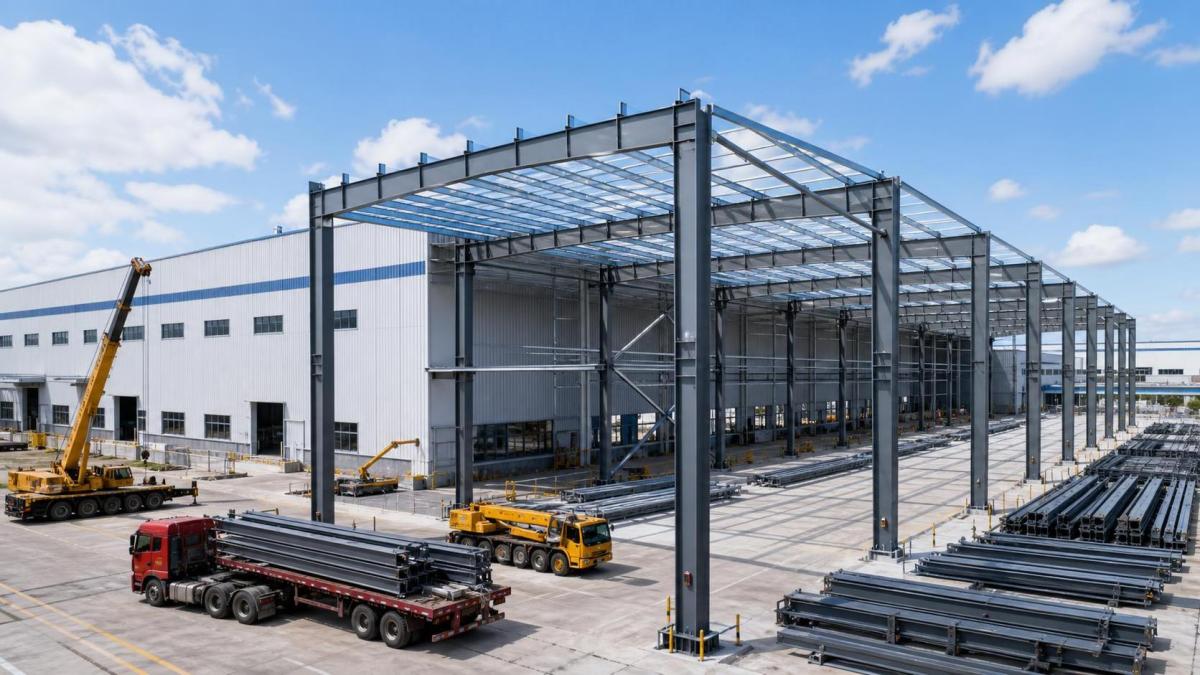
Steel can be fast on site, but only if deliveries and lifting operations are carefully organized. The components are fabricated elsewhere; the site then becomes an assembly point. That means access roads, laydown areas, lift paths, and erection sequencing must be thought through before the trucks arrive.
When this planning is done well, the construction site feels more like a coordinated installation process than an open-ended build. When it is not, steel deliveries can stack up, access can clog, and the speed advantage disappears into avoidable waiting time.
For warehouse expansion, where the existing building may already occupy most of the plot, early logistics planning is often what turns steel from a theoretical fast-track choice into a practical one.
Why project managers often prefer steel for phased expansion
Many expansions are not built in one uninterrupted campaign. They are phased around operations, capital release, permitting, or equipment installation. Steel works well in this environment because it supports a more predictable sequence between off-site fabrication and on-site assembly.
A team can finalize the structural package, release it to fabrication, and use that period to complete foundations, utilities planning, and traffic management preparation. This overlap is one of the most valuable time-saving features. It does not necessarily shorten every calendar day in the project, but it can reduce idle gaps between disciplines.
For busy project managers, predictability matters almost as much as speed. A warehouse expansion touches procurement, civil works, safety coordination, MEP routing, fire protection, door systems, cladding, and operational handover. If the structural frame can be scheduled with fewer unknowns, the rest of the program becomes easier to control.
What usually delays a steel warehouse expansion anyway
It is worth being honest about the weak points. Steel is often fast, but the path to that speed can be undermined by a few recurring mistakes.
Late design freeze
Prefabrication only works well when key dimensions, loads, openings, and interfaces are defined in time. Frequent design revisions after fabrication release can lead to rework, replacement parts, or awkward field modifications.
Poor survey of the existing building
In expansion projects, the new frame must connect to what is already there. If the original building drawings are incomplete or conditions on site differ from the documents, even a well-fabricated steel package can run into fit-up issues.
Underestimating foundations and anchors
Project teams sometimes focus on the speed of the steel frame but overlook the importance of base preparation. Steel erection depends on foundations, anchor bolt placement, and level tolerances being correct. If civil works drift behind schedule, the promised site speed never materializes.
Fragmented procurement
When structure, cladding, doors, roof accessories, and connection hardware are sourced without strong coordination, schedule gaps can open up between a completed frame and a weather-tight envelope. For warehouse use, that gap can be costly because interior work often depends on quick enclosure.
How to judge if steel construction for warehouse expansion is the right time-saving choice
If you are managing a project and need a practical decision filter, a few questions usually reveal whether steel is likely to save meaningful time on site.
- Does the existing facility need to remain operational during most of construction?
- Can the structural layout be standardized and released early for fabrication?
- Is weather likely to disrupt trades that depend heavily on site-built processes?
- Do you need faster enclosure to protect inventory, equipment, or follow-on trades?
- Is there enough planning discipline to coordinate survey, foundations, fabrication, and erection logistics?
If the answer to most of these is yes, steel is usually more than a material option. It becomes a schedule strategy.
Steel’s role in the wider industrial supply chain
There is also a broader reason steel remains central in warehouse construction. The steel industry sits upstream of manufacturing, infrastructure, energy, transport, and equipment production. Because of that role, steel products—from sections and plate to tubes and long products—are deeply integrated into industrial project delivery.
For warehouse expansion, that matters in practical terms. Structural steel systems are supported by mature fabrication capabilities, standard connection practices, and supply chains familiar with industrial building needs. Project managers benefit from that ecosystem because repeatable production and established detailing standards often translate into better coordination and fewer installation surprises than less familiar alternatives.
This does not mean every steel package arrives without issues, but it does mean the material is supported by a robust industrial base that fits the pace and discipline of logistics and manufacturing projects.
Not just faster erection, but faster readiness
One common misunderstanding is that erection speed alone defines success. For warehouse users, the real milestone is not “steel up.” It is “space ready for operation.” That includes envelope completion, floor readiness, door installation, lighting, sprinkler integration, ventilation, rack planning, and circulation safety.
Steel contributes to this broader objective because its assembly sequence often allows downstream work to begin with greater confidence. Once the frame and enclosure are advancing predictably, teams can plan follow-on trades with less contingency padding.
This is especially useful in expansions linked to seasonal inventory peaks or production transfers. A one-month improvement in site assembly does not help much if the interior handover remains chaotic. The better result is when steel shortens uncertainty across the project, not just labor hours in one trade.
The practical takeaway for project leaders
Steel construction for warehouse expansion saves time on site when the project is shaped to take advantage of prefabrication, controlled erection, and coordinated logistics. It is most effective when operations must continue, when geometry is relatively clean, when weather risk is real, and when the team has enough discipline to lock design and manage interfaces early.
For project managers, that makes steel less of a generic “fast build” answer and more of a fit-for-purpose solution. In the right conditions, it reduces on-site complexity, shortens the period of operational disruption, and makes the schedule easier to trust. In the wrong conditions, it can still perform well—but only if the upstream decisions are just as strong as the frame itself.
When time pressure is growing and warehouse capacity cannot wait, that distinction is what matters most. The speed advantage of steel is real, but it rewards preparation. The projects that save the most time on site are usually the ones that started thinking about site time long before the first truck arrived.
Please give us a message
Tianjin Kaichuang Metal Material Co., Ltd
Add: No. 41, District 6, First Street, Huanghuadian Town, Wuqing District, Tianjin
Tel: + 86 137 9101 9833
E-mail: boss@kaichsteel.com