Steel Hub

Meta Title: When Does Steel Construction for Warehouse Lower Total Build Cost?
If you are comparing warehouse building options, the right question is not whether steel is always cheaper. It is when steel construction for warehouse actually lowers total build cost after structure, schedule, foundations, labor, future expansion, and operational needs are all counted together. In many practical projects, steel wins when the building needs long clear spans, fast erection, predictable delivery, or easy later modification. In other cases, it may only look cheaper on paper. The difference usually comes down to what cost categories you include and what risks you ignore too early.
A lot of buyers get stuck because they compare only the price per square meter of the main structure. That is too narrow. A warehouse is not a showroom piece; it is an operating asset. If a steel solution cuts weeks from the schedule, reduces foundation load, avoids interior columns, or supports future production changes, those savings can outweigh a higher material quote. That is where better decisions are made.
When steel construction for warehouse makes the cost picture better
The lowest total build cost usually appears when the project benefits from the strengths of steel, not simply because steel is used. Warehouses are one of the clearest examples. They often need wide spans, open interiors, dock flexibility, equipment access, and phased expansion. These conditions tend to favor steel framing.
One direct reason is speed. Steel members are fabricated off-site and then assembled on-site, which can reduce field labor and shorten the critical path. That matters more than many teams expect. Every week saved can reduce site overhead, temporary facility cost, financing pressure, and the business impact of delayed operations. If the warehouse supports production, e-commerce, cold chain, or seasonal inventory, schedule savings may have real commercial value, not just contractor convenience.
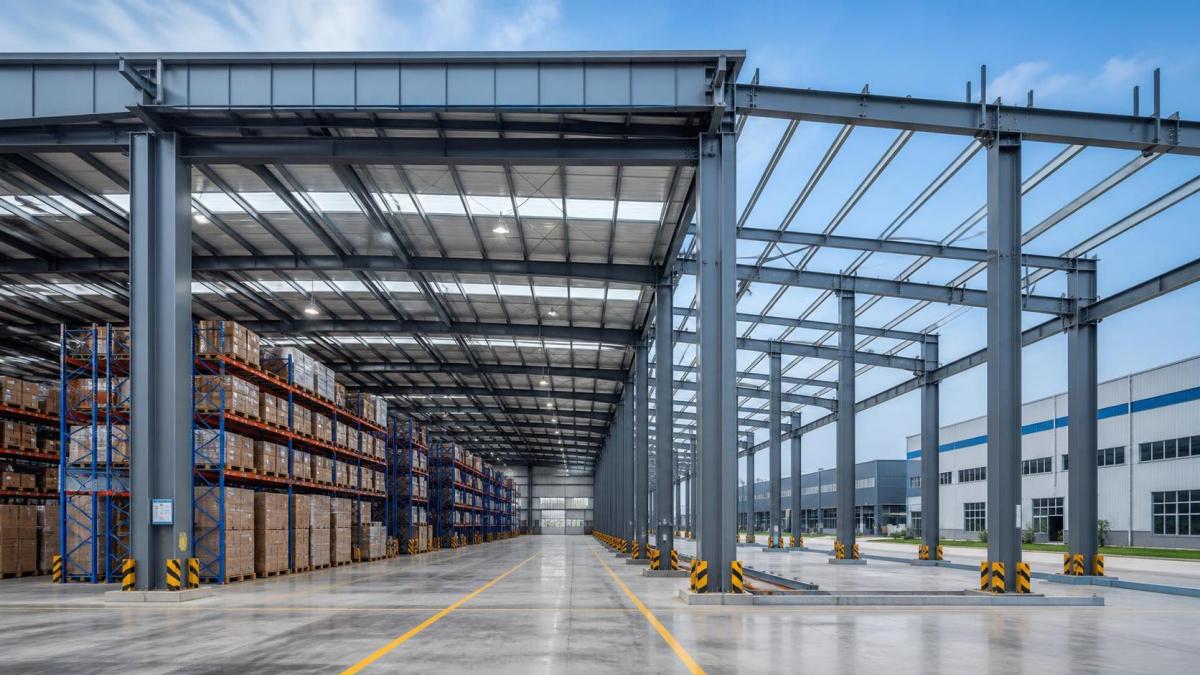
Another reason is span efficiency. Many warehouse users need fewer internal columns for racking layouts, forklifts, conveyor lines, or truck circulation. Steel handles clear-span design well. Fewer columns can improve usable floor area and reduce layout constraints. That is not a small operational detail. In some projects, better internal flow becomes part of the cost advantage because the building works harder over time.
Foundation cost is also worth attention. Steel structures are often lighter than competing structural systems for the same warehouse function, though the actual result depends on design, loads, and soil conditions. On weak soil or sites where foundation work is expensive, lower structural weight can translate into meaningful savings below ground, which many initial comparisons miss.
There is also a practical supply-chain angle. The steel industry is a core upstream sector for construction and manufacturing, and warehouse projects depend heavily on stable availability of sections, plates, tubes, and related fabricated components. In periods where local steel supply, fabrication capacity, and logistics are reliable, a steel warehouse project can move with fewer interruptions. That stability affects not just price, but delivery confidence.
The projects where steel usually performs best on total cost
Not every warehouse has the same economics. Steel tends to make more financial sense in a few common situations.
First, larger single-story warehouses with open-plan interiors. As building width and span requirements increase, steel often becomes more attractive because it can achieve those spans efficiently and keep erection practical. This is especially true when the user wants flexibility for future changes in storage density or equipment layout.
Second, projects with aggressive timelines. If your business case depends on opening before a season, consolidating rented storage, or reducing production bottlenecks, time has a cost. In those cases, a slightly higher frame price may still produce a lower overall project cost.
Third, expansion-driven facilities. Many owners underestimate how often warehouse needs change within three to five years. A steel building is often easier to extend, reinforce, or modify for mezzanines, canopies, dock additions, and process equipment. When future adaptation is likely, that option value matters.
Fourth, sites with labor constraints. In markets where skilled site labor is hard to secure or where wet-trade work faces delays, more off-site fabrication can reduce execution risk. That does not guarantee savings, but it improves cost predictability, which procurement teams should value.
Where the “steel is cheaper” assumption goes wrong
One common mistake is treating steel as automatically low-cost for every warehouse. It is not. Small, simple, low-span buildings in areas with cheap labor or strong alternatives may not show a clear cost advantage. If the design does not need long spans, if schedule is not sensitive, and if future expansion is unlikely, the business case for steel gets weaker.
Another mistake is looking only at tonnage price. Buyers often ask for a steel price quickly and then compare it against another structural concept without aligning scope. That leads to bad decisions. The right comparison should include at least:
- Primary structure
- Secondary framing and roof/wall support
- Connections and erection
- Foundations
- Fire protection requirements where applicable
- Envelope integration
- Schedule impact
- Future modification cost
A low steel quote with underdeveloped scope is not a low total-cost solution. It is just an incomplete number.
There is also the issue of volatility. Steel products come from a large industrial chain based on iron ore, scrap steel, steelmaking, and rolling, and pricing can move with raw materials, energy, fabrication load, freight, and local demand. If you are evaluating steel construction for warehouse during a volatile procurement window, the timing of sourcing and the quality of the supplier’s quotation assumptions become part of the cost decision. That should be checked, not guessed.
What experienced buyers usually check before deciding
The better procurement teams rarely start with “Which structure is cheapest?” They start with “What are the real cost drivers in this project?” That shift matters.
In practice, the first check is operational use. Will the warehouse hold standard pallet racking, automated storage, cranes, temperature-controlled systems, heavy equipment, or frequent truck loading? Structural choice should follow the use case, because loading, clear height, floor traffic, and future equipment all influence what “cheap” actually means.
The second check is the site. Soil quality, access for erection, local labor conditions, weather exposure, and fire code requirements can move the balance fast. A steel structure that looks efficient in one region may lose its advantage in another if coatings, protection systems, or logistics become difficult.
The third check is design maturity. Early budget comparisons often fail because one option is well developed and the other is still conceptual. Before comparing costs, make sure span grid, bay spacing, eave height, roof loads, fire strategy, envelope standard, and expansion assumptions are aligned. Without that, price comparisons create false confidence.
Here is the short answer many decision-makers want: steel construction for warehouse lowers total build cost when the project values time, long spans, lower foundation demand, construction predictability, and future flexibility more than the lowest possible initial frame price.
A cost comparison that is actually useful
Rather than asking for a single number, ask your design and supply teams for a scenario-based comparison. One baseline model is usually enough to expose the difference:
- Base case: lowest upfront capital cost
- Fast-track case: cost including schedule value
- Flexible-use case: cost including likely future modification
This tends to produce a more honest decision. A warehouse intended for stable, low-intensity storage may favor one answer. A distribution hub expected to scale, automate, or reconfigure may favor another.
It also helps to separate hard savings from soft savings. Hard savings include reduced foundation quantities, shorter site labor duration, or lower modification cost. Soft savings include lower schedule risk, fewer layout constraints, and easier business expansion. Both matter, but they should not be mixed casually.
Some savings show up later, not in the tender summary
This is where many warehouse decisions become shortsighted. Steel can support lower lifetime friction even when the day-one structure price is not the lowest. For example, adding dock positions, extending a bay, hanging utilities, or adjusting internal processes is often more straightforward in a steel-framed building. If your operation changes often, that adaptability has real financial value.
Maintenance should also be judged realistically. A well-specified steel warehouse is not a problem building by default, but coating systems, moisture exposure, local climate, and usage conditions need to be matched properly. If the environment is corrosive or poorly controlled, lifecycle cost needs closer review. That does not rule steel out. It just means the cheapest specification is not always the cheapest decision.
Another point buyers overlook is supplier capability. In steel projects, the gap between a disciplined fabricator and a weak one can erase expected savings through rework, delays, or connection issues. Procurement should assess fabrication quality, drawing coordination, delivery discipline, and erection experience, not only base price.
When steel is probably not the low-cost answer
There are cases where steel should not be forced into the project just because it is common in warehousing.
If the warehouse is small, structurally simple, not time-sensitive, and unlikely to change over its life, the total cost edge may be limited. The same caution applies if local market conditions make fabrication or steel erection unusually expensive, or if corrosion protection and fire protection requirements become heavy enough to offset the normal advantages.
It is also not wise to assume future flexibility has value when the business model is stable and the building will serve a narrow use for a long time. Flexibility is valuable only if you are likely to use it.
How to make the procurement decision cleaner
If you are still comparing options, ask your team for three things before approving a direction: a scope-aligned cost comparison, a schedule comparison with business impact stated clearly, and a short note on probable future changes in warehouse use. Those three items usually reveal whether steel is a strategic cost saver or simply a familiar default.
For many industrial and logistics projects, steel construction for warehouse lowers total build cost when the building must be delivered quickly, stay open and adaptable inside, and remain easy to expand later. That is where steel stops being just a material choice and becomes a better capital decision.
FAQ
Is steel always the cheapest warehouse structure?
No. It is often competitive, but total cost depends on span, schedule, foundations, labor market, protection requirements, and future flexibility needs.
Should I compare warehouse options by cost per square meter alone?
Not if you want a reliable decision. Cost per square meter can hide differences in foundation work, erection speed, usable space, and future modification cost.
Does faster erection really change total project cost?
Often yes. Shorter construction can reduce site overhead, financing pressure, and lost time before operations start. The value is higher when the facility supports active revenue or production.
What is the biggest procurement risk in a steel warehouse project?
Incomplete scope comparison. Many “cheap” offers exclude items or rely on assumptions that later become change costs.
Image Placeholder List
Suggested placement: after the section discussing the project types where steel performs best on total cost.
Suggested image content: side-by-side visual of a clear-span steel warehouse frame, forklift circulation path, and future expansion concept.
Suggested alt text: Clear-span steel warehouse design showing cost-saving layout and expansion flexibility.
Internal Link Anchor Text Suggestions
- warehouse steel structure cost factors: page about pricing variables or budgeting guidance
- clear span warehouse design: page about span planning and layout efficiency
- steel fabrication lead time: page about procurement timelines and delivery planning
- warehouse expansion planning: page about future-proof industrial building design
- structural steel grades and sections: page about material selection basics
External Authority Source Suggestions
- industry association reports on structural steel construction costs and project delivery trends
- government or building code authority pages covering fire, structural, and warehouse compliance requirements
- official technical documents from established steel producers or structural engineering institutions
Please give us a message
Tianjin Kaichuang Metal Material Co., Ltd
Add: No. 41, District 6, First Street, Huanghuadian Town, Wuqing District, Tianjin
Tel: + 86 137 9101 9833
E-mail: boss@kaichsteel.com