Steel Hub

Fire resistance requirements shape structural steel selection long before the first beam reaches site. A member that performs well under everyday loading may lose a substantial portion of its strength and stiffness when exposed to elevated temperatures. For quality control personnel and safety managers, the issue is not simply whether a steel grade is “fireproof.” Structural steel is not inherently fireproof; its fire performance depends on the member size, applied load, exposure conditions, protection system, connection details, and the fire design method required by the governing code.
That distinction matters in real projects. A warehouse frame, an airport concourse, a high-rise core, and an industrial processing platform can all use structural steel, yet they may require very different fire-resistance strategies. Selecting the right material and protection approach early helps avoid late redesigns, inconsistent certification records, installation gaps, and difficult discussions at final inspection.
Why structural steel needs a fire-resistance strategy
Steel does not burn, but it conducts heat rapidly. During a fire, an unprotected steel section can heat up quickly enough for its mechanical properties to change well before the steel melts. As temperature rises, yield strength, elastic modulus, and connection stiffness reduce. Increased deflection, local buckling, instability, and excessive movement at joints may then become the governing concerns.
This is why the question is rarely, “Which structural steel grade has the best fire resistance?” More often, the correct question is: Can this steel member, at this load level and geometry, maintain its required load-bearing function for the specified fire duration?
Fire-resistance ratings are typically expressed in time periods under defined test or calculation conditions, such as 30, 60, 90, or 120 minutes. The exact requirements depend on local building regulations, occupancy type, building height, fire compartmentation, evacuation strategy, sprinkler provisions, and the role of the structural element. A protected column supporting several floors may need a higher rating than a secondary roof member in an open, low-risk structure.
Start with the fire design requirement, not the steel catalogue
One of the most common project errors is to select structural steel based only on ambient-temperature strength, availability, or fabrication preference, then treat fire protection as a separate finishing item. That sequence can create problems. A lighter section may be structurally adequate in normal service but heat up faster than a heavier member. A complex built-up section may be efficient for gravity loads while becoming difficult to coat uniformly. A connection may be concealed behind protection in drawings but remain partially exposed in the workshop or on site.
Before selecting members and grades, the project team should establish the fire design basis. Depending on the jurisdiction, this may refer to prescriptive building-code provisions, tested fire-resistance assemblies, or performance-based structural fire engineering. Commonly referenced frameworks include national building codes and standards such as Eurocode 3 for structural fire design, ASTM or UL tested assemblies in North America, and equivalent local regulations elsewhere. These documents are not interchangeable; the project must follow the code and approval route applicable to its location.
For the quality and safety team, the design basis should answer several practical questions:
- Which structural members require a fire-resistance rating?
- What rating is required for each member category?
- Is the member protected, partially protected, or intentionally exposed?
- Which fire exposure curve, design fire scenario, or tested assembly applies?
- Are sprinklers, compartment walls, or active suppression systems permitted to affect the design assumptions?
- How will steel sections, connections, penetrations, and interfaces be inspected and documented?
When these points remain unclear, specifying a steel grade alone cannot resolve the risk.
Material grade matters—but usually not in the way people expect
Common structural steel grades are selected primarily for yield strength, toughness, weldability, chemical composition, thickness range, and delivery requirements. Higher-strength steel can reduce section weight in certain applications, but it does not automatically provide a proportionally better fire outcome. Under high temperatures, the reduction in mechanical properties must be assessed according to the relevant design standard. A high-strength grade may still require robust protection, especially when it carries a high percentage of its ambient design load.
In other words, using a stronger steel grade is not a substitute for fire protection. The fire design checks must account for temperature-dependent reduction factors, member buckling behaviour, restraint conditions, and accidental fire load combinations. This is particularly important for slender columns and long-span beams, where stiffness loss and instability may control before simple yielding becomes critical.
Steel chemistry can also influence fabrication decisions. Carbon equivalent, weldability, lamellar tearing risk, and low-temperature toughness may affect the choice of plate or section, especially for heavy welded members. These characteristics are important to quality assurance, but they should not be confused with a fire-resistance rating. Certificates confirming grade compliance do not, by themselves, demonstrate that the finished structure meets a specified fire duration.
Section factor: the hidden variable behind many fire-protection decisions
Section geometry has a direct effect on heating rate. This relationship is often described through the section factor, also called the massivity factor. In simple terms, it compares the heated perimeter of a steel member with its cross-sectional volume or mass. A member with more exposed surface area relative to its volume will generally heat faster than a more massive member under the same fire exposure.
Thin-walled hollow sections, small angles, light channels, and slender fabricated elements may therefore need more attention than their room-temperature capacity suggests. Conversely, a larger section may heat more slowly, although it may not always be the most economical total solution once steel weight, fabrication, coating, transport, and installation are considered.
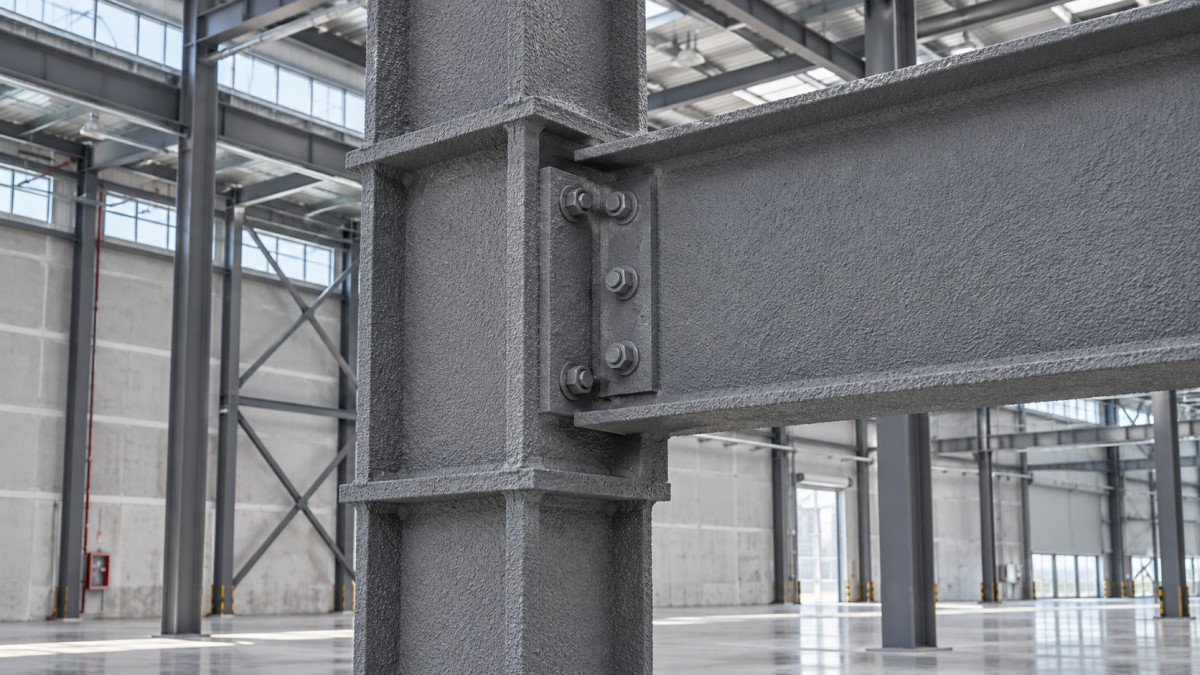
For protection manufacturers and fire engineers, the section factor is a central input when determining coating thickness or validating a tested system. It must be calculated using the correct exposure condition: three-sided exposure for a beam supporting a slab, four-sided exposure for a free-standing column, or a more specific configuration where adjacent construction shields part of the steel. A small error here can lead to a coating thickness that looks compliant on paper but is unsuitable for the actual installed condition.
Protection systems influence steel selection and detailing
Most fire-rated structural steel relies on passive fire protection. The chosen system affects not only the protection specification but also the type of member, connection layout, fabrication sequence, and inspection plan.
Intumescent coatings
Intumescent coatings expand under heat to form an insulating char layer. They are widely used where the architectural appearance of exposed steel is important, such as offices, atria, retail spaces, transport hubs, and visible industrial structures. They can offer a relatively slim profile, but their performance depends on specified dry-film thickness, approved primer and topcoat compatibility, surface preparation, section factor, environmental exposure, and application quality.
For QC managers, thickness measurement is only one part of acceptance. Edges, bolt heads, connection plates, welds, repaired areas, and concealed interfaces must also receive the required treatment. Coating systems should be matched to the tested or assessed configuration; substituting a primer, changing the steel profile, or applying an unapproved topcoat can affect the approval basis.
Spray-applied fire-resistive materials
Spray-applied materials are often used on concealed structural frames where appearance is less critical and large areas must be treated efficiently. They may be cementitious or fibrous, depending on the project requirements and local approvals. Their application calls for careful control of substrate condition, thickness, density where applicable, adhesion, curing, and protection from moisture or impact during subsequent trades.
Complex trusses and crowded service zones deserve early review. A system that is easy to spray in an open frame may be difficult to apply continuously around bracing, gusset plates, pipe supports, and mechanical penetrations.
Board encasement and concrete-based protection
Board systems and concrete encasement can provide durable fire protection, particularly where the structure is exposed to impact, weather, or demanding service conditions. They also require disciplined detailing. Board joints, fasteners, access openings, service penetrations, and interfaces with walls or floors can become weak points if not built according to the tested assembly. Concrete-filled hollow sections may offer enhanced fire performance in certain designs, but they still need engineering verification for the specific section, load, reinforcement arrangement, and exposure condition.
Connections are not secondary details
A protected beam with an inadequately protected connection is not a complete fire-resistance solution. Bolted end plates, fin plates, seated connections, column splices, bracing nodes, and base plates can experience different thermal conditions from the members they join. Their behaviour may be affected by reduced bolt strength, plate deformation, weld performance, thermal expansion, and force redistribution.
Connection design must be coordinated with the selected passive fire protection system. In some tested assemblies, protection is required to extend a prescribed distance from the connection. In others, particular connection geometries or exposed elements are addressed through engineering assessment. Safety managers should be cautious when field modifications are proposed after approval: adding a stiffener, relocating a service support, trimming protection around a bolt, or changing a beam connection can invalidate assumptions that were never visible in the general arrangement drawings.
A practical control path for quality and safety teams
Fire-rated steelwork becomes more reliable when verification follows the material from procurement through handover. The following control path is useful because it joins structural quality records with fire-protection records instead of treating them as separate packages.
- Confirm material traceability. Review mill test certificates, heat numbers, product dimensions, grade, and applicable delivery condition. Ensure the delivered structural steel matches approved drawings and fabrication documentation.
- Check fabrication changes. Record substitutions, member-size changes, added plates, revised holes, and connection alterations. Evaluate whether these changes affect the section factor, applied loading, or approved fire-protection detail.
- Verify surface preparation. Steel must be clean and suitably prepared for the selected coating or protection system. Oil, moisture, loose rust, incompatible primers, and excessive weld spatter can compromise adhesion.
- Inspect protection installation progressively. Do not wait until completion. Verify coating thickness, board fixing patterns, joint treatment, encasement continuity, and protection around connections while access remains available.
- Control interfaces. Coordinate fire protection with mechanical, electrical, cladding, ceiling, and façade teams. Penetrations and later-installed supports often create unprotected areas.
- Maintain a handover record. Keep approved product data, batch information, installation reports, thickness logs, nonconformance records, repair evidence, and photographs where required by the project quality plan.
Frequent misunderstandings that create avoidable risk
“The steel is non-combustible, so it meets the fire requirement.” Non-combustibility and fire resistance are different concepts. Steel does not contribute fuel in the same way as combustible materials, but it can lose structural capacity rapidly when heated.
“A 60-minute coating is suitable for every 60-minute member.” Ratings are linked to a particular system, section factor, exposure condition, member orientation, substrate, and sometimes load ratio. A product label cannot replace project-specific verification.
“More coating is always safer.” Excess thickness may create application, drying, cracking, or compatibility concerns, while insufficient thickness is plainly noncompliant. The goal is the specified, verified system—not an arbitrary amount of material.
“Fire protection can be repaired later without review.” Minor repairs are often possible using approved methods, but damaged or altered protection should be assessed before concealment. The repair material, substrate preparation, and reinstated thickness all matter.
Making selection decisions with the whole life cycle in view
The best structural steel solution is rarely the lightest member or the cheapest protection product in isolation. A sound decision considers procurement availability, fabrication complexity, erection sequence, architectural exposure, maintenance access, corrosion environment, anticipated alterations, and inspection practicality. The steel supply chain also matters: plate, sections, hollow structural sections, pipe, and long products may have different lead times, certification routes, and dimensional tolerances, all of which can affect delivery and downstream coordination.
For safety managers, early alignment is especially valuable in projects with exposed steelwork, high occupancy, critical operations, or limited future access. For quality teams, the central discipline is traceability: trace the structural steel to its approved grade, trace the fire-protection system to its tested or engineered basis, and trace field installation to documented inspection points.
Fire resistance should therefore be treated as a structural performance requirement, not a coating specification added at the end of construction. When steel grade, member geometry, loading, connections, passive protection, and verification records are considered together, the selected structural steel system is far more likely to perform as intended when conditions become severe.
Please give us a message
Tianjin Kaichuang Metal Material Co., Ltd
Add: No. 41, District 6, First Street, Huanghuadian Town, Wuqing District, Tianjin
Tel: + 86 137 9101 9833
E-mail: boss@kaichsteel.com