Steel Hub

On July 25, 2026, the U.S. Department of Commerce formally opened combined anti-dumping and countervailing investigations into cold-rolled stainless steel plate (CSP) from China. For exporters, importers, distributors, and supply-chain teams handling the covered HS codes, this is not only a trade case update but a compliance event that can affect export paperwork, customs documentation, origin review, and near-term sourcing decisions ahead of an expected preliminary determination before November 2026.
What has been formally initiated
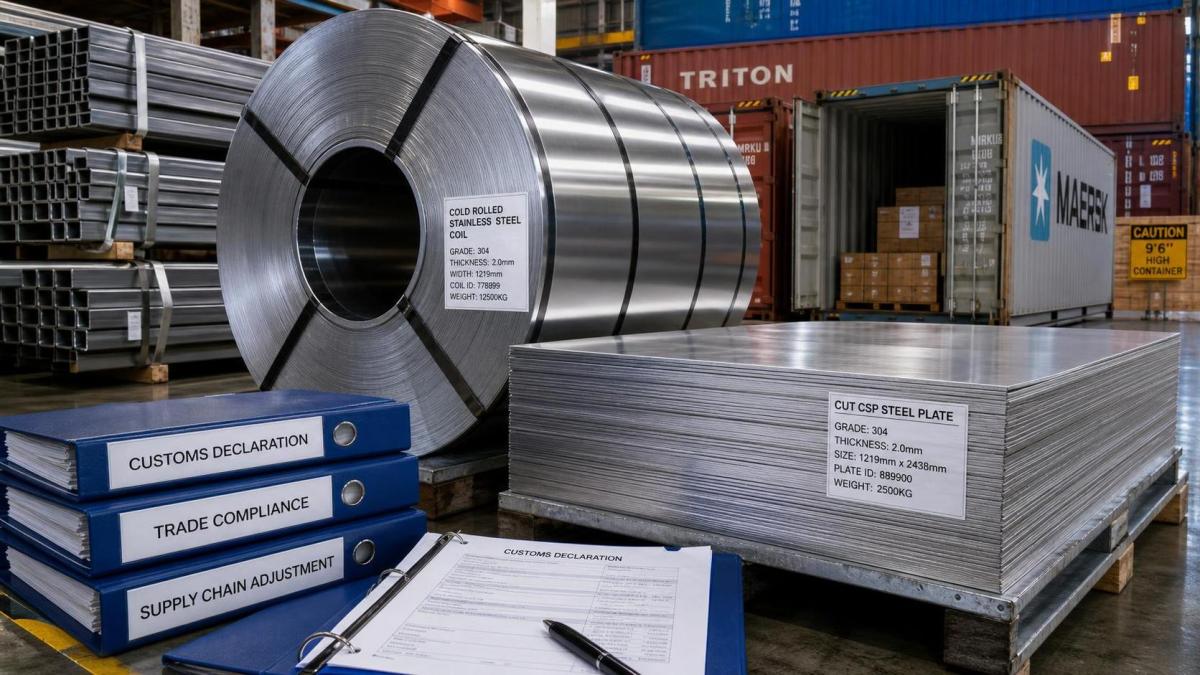
According to the information provided, the case was officially filed on July 25, 2026 and covers Chinese cold-rolled stainless steel plate under HS codes including 7219.32, 7219.33, and 7219.34. The action combines anti-dumping and countervailing investigations in one proceeding. The provided summary states that the case will directly affect export licensing, customs clearance documents, and importer compliance costs, and that a preliminary ruling is expected before November 2026. It also states that U.S. distributors and importers need to review current inventory, adjust sourcing channels, and prepare proof of origin compliance.
Where the pressure is likely to appear first
Export documentation moves closer to the center of risk
From an industry perspective, exporters dealing in the covered product categories may feel the impact first through documentation and shipment preparation. The reason is straightforward: once an investigation is opened, the accuracy and consistency of product classification, licensing materials, and customs files become more sensitive in practice. What deserves closer attention is whether internal product mapping, shipment records, and origin-related documents are aligned across sales, logistics, and customs-facing files.
Import-side costs and file readiness become immediate concerns
For U.S. importers and distributors, the provided summary already points to higher compliance costs as a direct effect. Analysis shows that this can shift attention from routine purchasing toward document defensibility, inventory review, and sourcing continuity. The business impact is likely to appear in landed-cost assessment, customs file preparation, and decisions about whether existing purchase plans remain workable under a more uncertain trade-control environment.
Procurement and channel planning may need faster adjustments
For procurement teams and channel operators, the issue is not limited to price. Observably, the opening of a dual investigation can push buyers to reassess supplier structure, inventory exposure, and delivery planning for the covered categories. What deserves closer attention is whether current purchasing arrangements depend too heavily on the investigated product scope and whether alternative sourcing needs to be evaluated before the preliminary ruling changes execution expectations further.
Service providers around trade execution may face tighter review cycles
Supply-chain service providers, customs support teams, and document-handling functions may also be affected because the case increases the importance of clean records and origin support. The practical pressure point is less about a new standalone requirement being confirmed today and more about a narrower margin for inconsistency in classification support, customs submissions, and transaction files linked to the covered goods.
What companies should track now
Recheck product scope against internal shipment records
Companies handling CSP should promptly verify whether their products fall within the HS codes identified in the provided summary, including 7219.32, 7219.33, and 7219.34. Analysis shows that this step matters because later compliance actions often depend on whether internal product descriptions, customs declarations, and commercial paperwork point to the same scope understanding.
Prepare origin and customs support files early
The provided information specifically highlights the need for proof of origin compliance. It is more appropriate to understand this as an immediate file-readiness issue rather than a distant legal matter. Businesses should therefore pay close attention to origin-related records, customs documents, and any supporting technical or trade paperwork already used in shipments or import clearance.
Review inventory exposure and purchase timing
For importers and distributors, the summary explicitly calls for an assessment of current inventory and sourcing adjustments. Observably, this means companies should examine stock already in channel, goods in transit, and near-term procurement commitments tied to the covered product range. This is not yet a confirmed market outcome, but it is a practical response to an active trade case with a defined preliminary timetable.
Follow the path to the preliminary ruling
Because a preliminary determination is expected before November 2026, companies should keep a close watch on official statements and any changes in execution language as the case progresses. Analysis shows that the main task at this stage is monitoring, not assuming a final result. Businesses should focus on whether filing expectations, customs treatment, or compliance interpretations become more specific over the coming months.
Why this matters beyond the filing date
Analysis shows that this development is best read as an execution signal with immediate operational relevance, even though the case has not yet reached its preliminary ruling. The importance lies in the fact that it already changes how affected market participants need to think about trade files, sourcing flexibility, and transaction compliance. It is more appropriate to understand this as a live regulatory and trade-control process that now requires active monitoring, rather than as a completed rule change with all consequences already settled.
How the market is likely to read this stage
At this point, the case should be viewed in a measured way. The confirmed facts are limited to the formal initiation, the covered product references, the expected preliminary timing, and the direct compliance and sourcing implications stated in the provided summary. From an industry perspective, the main takeaway is that companies connected to the covered CSP trade need to shift from passive observation to document review, sourcing reassessment, and process monitoring, while avoiding assumptions about outcomes that have not yet been officially determined.
Basis of this article and what still needs verification
This article is based on the user-provided news title, event date, and event summary. For events of this kind, companies would usually also monitor source types such as official notices, releases from regulatory or trade authorities, customs or trade administration information, industry association updates, standard-setting documents, and reporting from authoritative media. No specific official source link was provided in the input, so the exact official publication path still needs to be verified on an ongoing basis. Further observation is also needed on later official wording, implementation interpretation, origin-compliance expectations, changes in procurement or tender documents, industry feedback, and how affected companies execute their responses in practice.
Please give us a message
Tianjin Kaichuang Metal Material Co., Ltd
Add: No. 41, District 6, First Street, Huanghuadian Town, Wuqing District, Tianjin
Tel: + 86 137 9101 9833
E-mail: boss@kaichsteel.com