Steel Hub

When Steel Lead Time Starts Driving Cost, Supplier Comparison Has to Change
In steel purchasing, price is rarely the only number that matters. Once a project reaches the point where schedule pressure turns into liquidated damages, idle labor, disrupted fabrication, or missed installation windows, lead time becomes a cost driver in its own right. That changes how steel supply should be evaluated.
This is especially true in sectors that depend on steel as an upstream input rather than a standalone purchase decision. Construction, equipment manufacturing, shipbuilding, rail, energy, and industrial fabrication all feel the same pressure in different ways: one delayed shipment of plate, tube, section, or long products can block several downstream activities at once. A low quoted ton price may still become the expensive option if material arrives in the wrong sequence, without processing, or with insufficient quantity continuity.
So the real comparison is not just supplier A versus supplier B. It is total delivery fit versus project exposure.
Start with the cost of delay, not the cost of steel
Many evaluations go wrong because the team compares steel supply options before agreeing on what one week of delay actually costs. For some projects, delay mainly affects warehouse planning. For others, it stops welding lines, crane bookings, subcontractor mobilization, or civil sequencing. Those are very different risk profiles.
A practical evaluation usually starts with three questions:
- Which steel items are on the critical path?
- Which items can be substituted, split delivered, or bought from buffer stock?
- What is the financial impact if delivery slips by one production cycle or one site milestone?
That framing matters because not all steel categories behave the same in the market. Commodity hot-rolled plate in standard thickness may have more sourcing flexibility than a special section size, heavy-wall tube, or a grade that requires tighter documentation. If your project depends on harder-to-replace items, supplier comparison should place more weight on availability and schedule confidence than on nominal unit price.
Availability is not the same as capacity
One common mistake is assuming that a large mill or a well-known trader automatically offers the shortest lead time. In practice, there is a difference between production capacity and usable availability.
A supplier may have strong annual output, broad product coverage, and competitive pricing, but still be a poor fit if your requirement falls between rolling schedules, heat sizes, finishing slots, or export documentation queues. Another supplier with smaller overall scale may outperform on lead time because it holds matching stock, has faster cutting capacity, or is used to mixed-size orders.
When comparing steel supply, ask for clarity on the source of delivery promise:
- Is material already in stock, or does it depend on future rolling?
- Is the quoted lead time based on standard production windows or on a confirmed allocation?
- Does the supplier control processing in-house, or is it outsourced?
- Can the supplier deliver in batches aligned with fabrication or site sequence?
Those details often reveal more than the headline quote.
Why product range matters more when schedules are tight
Lead time risk grows when procurement is fragmented. If plate comes from one source, structural sections from another, pipe from a third, and cut-to-length or drilling from a fourth, the project team is not managing one schedule. It is managing several schedules with different failure points.
That does not mean a single-source model is always better. Sometimes splitting supply creates price leverage or reduces concentration risk. But when timing pressure is severe, supplier breadth becomes a meaningful selection criterion. A source that can cover multiple steel forms—plate, section, tube, and long products—and coordinate documentation and shipment windows may reduce hidden cost even if its line-item pricing is not the lowest.
This matters in the steel industry because the supply chain starts far upstream, from iron ore and scrap through steelmaking and rolling, then moves into stocking, slitting, cutting, blasting, machining, coating, packaging, and transport. Every handoff adds a scheduling variable. Evaluators should not only compare product lists; they should compare how many handoffs are needed before the steel can actually be used.
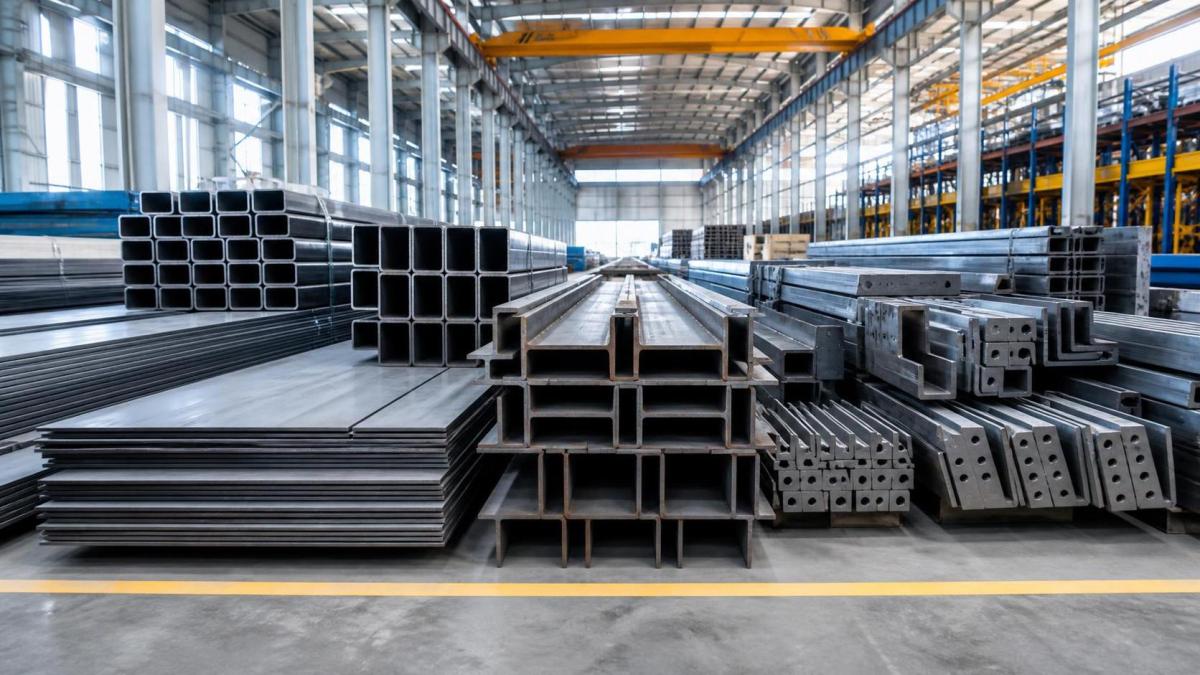
Processing capability can be the difference between “delivered” and “usable”
A surprisingly expensive delay is material that arrives on time but cannot go straight into fabrication or installation. For example, plate may need cutting, beveling, or shot blasting. Sections may require drilling or length control. Tubes may need end preparation, bundling standards, or traceability by heat number. If those services are outside the supplier’s workflow, the schedule risk does not disappear after purchase order issuance; it simply moves to another party.
That is why lead time comparison should include processing capability and queue position, not just raw material supply. Ask what portion of value-added work is performed internally, how change requests are handled once production starts, and whether the supplier can prioritize project-critical items without disrupting the whole order.
In time-sensitive projects, a supplier that offers fewer product types but stronger processing control may be a safer choice than a broad seller that still relies on multiple subcontracted steps.
Compare schedule reliability, not promised lead time
Quoted lead time is easy to collect and easy to misunderstand. Two suppliers can both offer “four to six weeks,” yet one may mean ex-stock dispatch after order confirmation and the other may mean target mill release subject to rolling plan. On paper, they look close. Operationally, they are not.
A better comparison looks at reliability indicators such as:
None of these points is exotic. They are basic execution questions. Yet they tend to separate suppliers that look similar in commercial meetings.
Price stability is part of lead-time risk
In steel markets, longer lead times usually increase price exposure. If the order depends on future rolling, future scrap or ore movements, energy costs, freight swings, or exchange-rate changes may affect the final economics even when the initial quote seems attractive. That exposure is not always avoidable, but it should be made visible during evaluation.
This is where commercial structure matters. Is the quote fixed for a defined validity period? Is it tied to mill confirmation? Are there surcharge mechanisms for alloy, freight, or processing changes? Can the order be phased without resetting all commercial terms? These are not legal fine points; they are part of the real cost comparison when projects cannot tolerate replanning.
A slightly higher offer with clearer allocation and pricing terms may end up less risky than a cheaper quote that remains open to production rescheduling or commercial revision.
The best option often depends on where uncertainty sits
Not every project should buy steel the same way. If the engineering is stable but logistics are uncertain, local stockholding and partial delivery flexibility may matter most. If transport is predictable but technical approval is still moving, then a supplier with broad grade and size substitution options might be more valuable. If quantities are large and repetitive, direct mill supply can make sense. If item variety is high and sequence matters, a stock-and-process model often deserves more weight.
Experienced buyers usually avoid one universal rule here. They compare the supply model against the project bottleneck. That is a better decision method than ranking suppliers only by scale, country of origin, or first-round price.
A practical way to compare steel supply options
For business evaluation, a simple weighted scorecard often works better than a long technical memo. The useful categories are usually straightforward: confirmed availability, realistic lead time, product coverage, processing capability, shipment sequencing, document control, commercial clarity, and escalation responsiveness.
The key is not the spreadsheet itself. The key is making sure each score is based on evidence. “Can supply” should not be scored the same as “has stock reserved.” “Can process” should not be treated the same as “processing slot confirmed.” And “competitive price” should not outweigh a high probability of downstream disruption if the project is time sensitive.
If internal teams disagree, it usually helps to compare three scenarios: lowest purchase price, lowest delay risk, and best blended value. That tends to expose where a cheap offer is actually shifting cost into operations.
What to watch before making the final call
Before awarding a steel supply package, confirm the parts that most often cause trouble later: actual stock status, production slot assumptions, processing route, quality documentation timing, Incoterms or delivery boundary, and whether the supplier can support quantity changes without restarting the schedule. If the project involves specific grades, dimensional tolerances, or end-use compliance requirements, those points usually need to be checked against the relevant standards and project documents rather than assumed from a general quotation.
When lead time drives project cost, the best steel supply decision is rarely the one with the cleanest unit price comparison. It is the option that keeps material flowing in the form, sequence, and condition the project can actually use. That sounds obvious, but in steel procurement, obvious things are often the ones skipped when deadlines get tight.
Please give us a message
Tianjin Kaichuang Metal Material Co., Ltd
Add: No. 41, District 6, First Street, Huanghuadian Town, Wuqing District, Tianjin
Tel: + 86 137 9101 9833
E-mail: boss@kaichsteel.com