Steel Hub

Stainless Steel Pipe Cost Drivers: Grade, Size, and Finish
When evaluating stainless steel pipe sourcing, buyers quickly find that price is shaped by more than market trends alone. Grade selection, pipe dimensions, wall thickness, and surface finish all influence total cost, procurement risk, and long-term value. For business evaluation teams, understanding these cost drivers is essential for comparing quotations accurately, controlling budgets, and choosing materials that balance performance, compliance, and supply reliability.
If you are reviewing quotes for stainless steel pipe, the fastest way to lose control of cost is to compare numbers without checking what is actually being offered. Two suppliers may both quote “304 pipe,” but one may be pricing to a different standard, a different wall tolerance, a different finish, or a different testing scope. On paper, the lower offer looks attractive. In practice, that gap often reappears later through rework, delayed approval, or replacement buying.
This is the checklist I would use before treating any stainless steel pipe quotation as commercially comparable.
Start with grade, because it changes everything
Grade is usually the first cost driver procurement teams look at, and for good reason. Austenitic grades such as 304 and 316 are common reference points, but the price difference between them is not just a supplier markup. Alloy content, especially nickel and molybdenum exposure, affects raw material cost and market volatility. If the application actually needs better corrosion resistance, switching down to a cheaper grade can be a false economy. If the service environment is mild, over-specifying the grade can quietly drain budget across a large volume purchase.
- Check whether the quote clearly states the material grade and the applicable standard, such as ASTM, ASME, EN, or JIS, where relevant.
- Confirm whether dual certification is required. In some projects, pipe offered as 304/304L or 316/316L may improve sourcing flexibility, but that should match the engineering requirement.
- Ask what problem the grade is solving: corrosion, temperature, fabrication, hygiene, pressure service, or customer specification.
- If the application team says “use 316 to be safe,” ask for the service condition basis. That answer often determines whether the extra spend is justified.
A common buying mistake is treating stainless steel pipe grade as a simple commodity label. It is not. The commercial decision should follow the operating environment, not habit. For coastal, chemical, chloride-bearing, or sanitary exposure, the grade discussion deserves more discipline. For general indoor structural or low-corrosion use, it may not.
Do not separate diameter from wall thickness
Buyers often focus on outside diameter because it is easy to visualize and easy to list in a bid sheet. Cost, however, is heavily driven by metal weight, and weight is a function of both diameter and wall thickness. A quote for the same nominal pipe size can move sharply depending on schedule or thickness tolerance.
This matters in two ways. First, thicker wall means more material and a higher base price. Second, thicker or less common combinations can reduce supplier availability, which affects lead time and minimum order quantity. A pipe that looks standard to the buyer may sit outside the supplier’s regular rolling range or stock program.
If the quotation does not define wall thickness clearly, it is not complete enough for cost review. That is usually where low headline prices hide.
Surface finish is not cosmetic in procurement terms
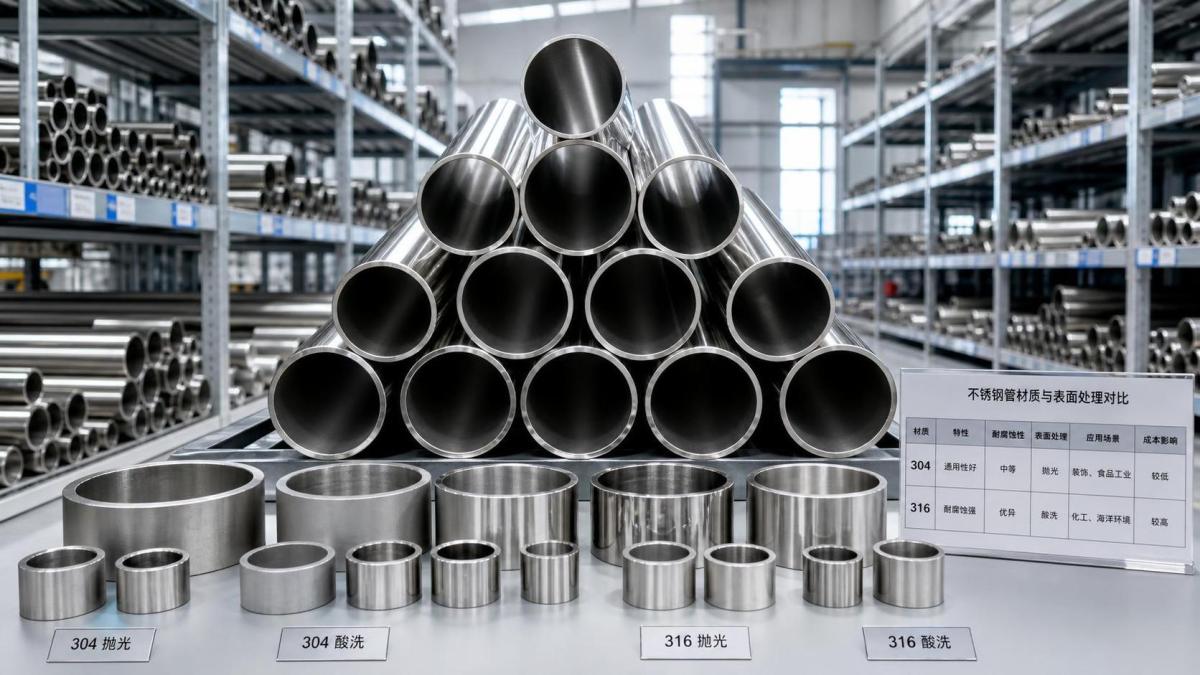
Finish is one of the most underestimated cost drivers in stainless steel pipe purchasing. People outside the category sometimes assume finish only affects appearance. In reality, it can change processing steps, inspection expectations, packaging requirements, and scrap sensitivity.
Mill finish, pickled finish, polished finish, and application-specific sanitary finishes are not interchangeable from a commercial standpoint. A brighter or smoother surface may require additional polishing, tighter handling control, and more careful transport. That raises cost even before the pipe reaches the customer.
It is worth asking a blunt question here: does the project need that finish, or is the finish being carried over from an old specification? In decorative, food-contact, pharmaceutical, or visible architectural applications, finish can be central. In concealed industrial service, paying for a higher surface specification than necessary is common and avoidable.
- Request the finish designation in writing, not just “polished” or “smooth.”
- Check whether internal and external finishes are both specified.
- For hygienic service, verify whether roughness limits or inspection requirements are defined by the project documents. If not, mark this as 【待核实】 before approving cost.
- Review packaging expectations. Premium finish with poor packaging often turns into claims and replacement cost.
Manufacturing route changes the commercial picture
Whether the stainless steel pipe is welded or seamless is one of the first commercial filters. It affects not only unit price but also availability, lead time, testing expectations, and acceptable use cases. Seamless pipe usually carries a higher cost because the production route is more material- and process-intensive. Welded pipe can be cost-effective and fully appropriate in many applications, but only if it matches the design code and service requirement.
This is where evaluation teams need to stay close to engineering. A purchasing-led substitution from seamless to welded can look smart in a spreadsheet and become expensive later if approvals fail or the end user rejects documentation. The opposite also happens: buyers accept seamless pricing where welded product would have been acceptable, simply because the requisition was copied from a previous job.
If the bid package does not make the manufacturing method explicit, ask before comparing offers.
Standards, testing, and certification can move cost more than expected
A quote that includes full documentation is not the same as one that only includes material supply. Mill test certificates, PMI requirements, hydrostatic testing, non-destructive examination, third-party inspection, and export documentation all add time and cost. None of that is padding if the project genuinely requires it. But it should be visible.
For business evaluation teams, the practical rule is simple: do not compare a documentation-heavy offer with a bare-material offer and call it a price gap. Call it a scope gap until proven otherwise.
- Ask whether the quoted price includes MTC/EN 10204 documentation if your project requires it. Specific document level requirements should be checked against the contract documents.
- Clarify whether third-party inspection is included or quoted separately.
- Check test frequency and acceptance standard. A vague “tested as per standard” line is not enough for serious evaluation.
- If destination market compliance matters, verify import, marking, and documentation needs with the local team. Requirements vary and should not be assumed.
Quantity and mix matter more than many buyers expect
Suppliers price stainless steel pipe differently when the order is concentrated in a few standard items versus spread across many small sizes, odd lengths, or mixed finishes. Fragmented demand increases setup changes, handling time, and inventory risk. That usually shows up through higher unit rates or stricter minimums.
If you are trying to improve the buy, look at the line-item mix before pushing for a discount. In some cases, consolidating sizes, relaxing cut-length precision, or separating urgent items from bulk items yields better savings than another round of price negotiation.
This is especially relevant when the project team wants “just in case” extras on every line. Those add safety from their point of view, but they also create dead stock risk, particularly for less common grades and finishes.
Lead time deserves a cost line of its own
Urgent stainless steel pipe orders often cost more even when the base specification stays unchanged. Mills and stockholders charge for schedule compression in different ways: premium pricing, split shipments, lower discount tolerance, or limited choice of origin. Buyers sometimes miss this because the quote does not label it as an expedite fee.
When reviewing procurement options, separate these questions:
- Is the requirement truly urgent, or is the schedule assumption unchallenged?
- Can standard sizes ship now while special items follow later?
- Would a stock-origin option reduce project risk even at a slightly higher unit price?
A cheaper mill offer with a long lead time is not automatically the better buy. If delay affects fabrication, installation windows, or customer penalties, total cost changes fast.
Watch the terms outside the pipe itself
Serious quote reviews do not stop at material specifications. Freight terms, packing method, insurance scope, damage claim handling, and payment terms can easily distort the real landed cost. Stainless steel pipe with polished or controlled finish is particularly exposed to transit damage and handling claims.
Check whether end protection, bundling, sleeving, wooden cases, or export packing are included. Also check whether weight basis, theoretical or actual, is defined if that affects billing. Different commercial practices exist, and they should be confirmed before award rather than argued after receipt.
A practical short list before approval
- Grade matches service condition, not habit.
- Diameter, wall thickness, and length are fully defined.
- Finish requirement is necessary and stated clearly.
- Welded versus seamless is explicit.
- Testing, certificates, and inspection scope are comparable across offers.
- Lead time assumptions are realistic.
- Packing and delivery terms support the actual use case.
- Any unresolved technical or compliance point is flagged as 【待核实】, not buried in commercial notes.
That is usually enough to expose whether a stainless steel pipe quote is genuinely competitive or just incomplete. Good procurement decisions in this category rarely come from chasing the lowest visible number. They come from getting the specification, commercial scope, and delivery reality aligned before the order is placed.
Please give us a message
Tianjin Kaichuang Metal Material Co., Ltd
Add: No. 41, District 6, First Street, Huanghuadian Town, Wuqing District, Tianjin
Tel: + 86 137 9101 9833
E-mail: boss@kaichsteel.com