Steel Hub

Protecting the edge of a steel coil starts before the first lift. A coil edge is exposed to concentrated contact forces, so a short impact, a dragging motion, or an incorrectly positioned lifting device can flatten, nick, telescope, or buckle material that otherwise appears undamaged. These defects often remain near the outer wraps at first, then become visible during slitting, stamping, roll forming, or uncoiling.
The handling method must match the coil's orientation, width, mass, surface condition, packaging, and intended downstream process. A small edge mark may be tolerable for one application but unacceptable where strip tracking, painted surfaces, tight blanks, or precise slit widths are involved. The practical goal is to keep all contact away from the exposed edge whenever possible and to prevent the coil from shifting after contact has been made.
Start with the condition of the coil
Before moving a coil, inspect the outer wraps, edge protectors, banding, bore condition, and pallet or skid support. This is not only a receiving inspection. It establishes whether a later defect was already present and whether the coil can be lifted safely in its current condition.
Pay particular attention to loose outer wraps. A loose wrap can catch on a saddle, fork tip, guide, floor irregularity, or adjacent coil. Once caught, the strip may crease at the edge or peel away from the coil body. Do not attempt to pull a loose wrap tight by hand while the coil is suspended or being moved. Secure the coil according to site procedures before transport, and avoid placing it where the loose section can be pinched.
Edge protectors deserve a closer look than a quick visual check. Bent, crushed, wet, or displaced protectors no longer distribute contact pressure as intended. A protector that has shifted toward one side may leave part of the edge exposed exactly where a sling, pusher, or restraint will bear against it. Replace damaged protection before moving the coil rather than treating it as a cosmetic issue.
For coated, galvanized, stainless, electrical, or pre-painted strip, apparent edge damage can include coating fracture, zinc flaking, staining, or film scuffing as well as deformation. A contact surface that is acceptable for hot rolled coil may be unsuitable for material with a sensitive finish. Cleanliness and dryness of saddles, lifting attachments, and protective pads matter more for these products.
Choose lifting equipment by contact path, not only lifting capacity
A lifting device can have sufficient rated capacity and still damage a coil if its contact points are wrong. The relevant question is where the load is supported and how the coil is prevented from rotating or sliding while it is suspended.
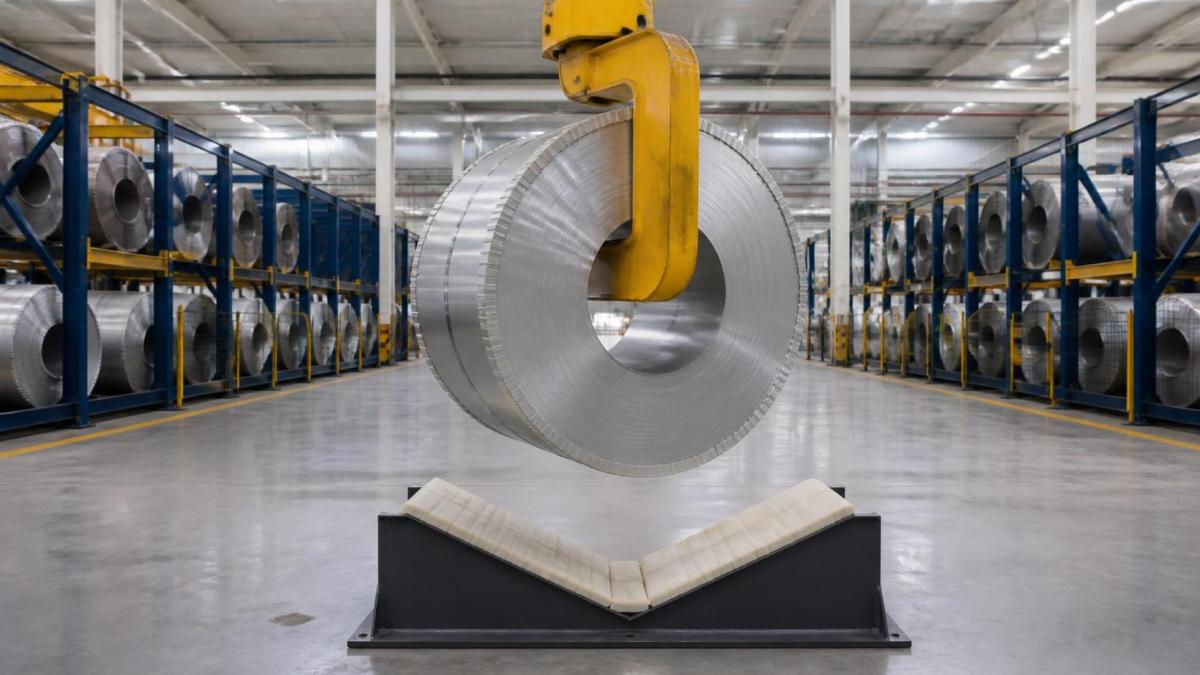
For eye-to-sky coils, a properly sized coil hook or C-hook supports the load through the bore and generally avoids direct contact with the strip edges. Clearance is important. The hook must enter and exit without scraping the bore edge, outer wraps, banding, or nearby coils. A hook that is too large can strike the inside edge; one that is too small may not seat correctly and can concentrate load against a narrow area.
For eye-to-wall coils, a lifting mandrel, expanding shaft, or approved mechanical attachment is often preferred where the process allows it. The device should support the coil through the inside diameter and keep the coil stable during lifting and rotation. If the coil must be turned from one orientation to another, plan the turning path first. Uncontrolled rotation is a common cause of edge contact with the floor, a rack upright, or the lifting fixture itself.
Slings require special care. A bare wire rope, chain, or narrow web sling placed over the outside diameter can imprint or crush the outer wraps, particularly at the coil shoulders. Where slings are permitted, use the specified protective sleeves, spreader arrangement, and bearing locations. Do not assume that a soft sling automatically protects the edge: a sling under tension can still pull into a sharp edge or force the coil against a hard corner.
- C-hooks and coil rams: effective when bore dimensions, hook throat, and counterweight geometry are suited to the coil. Keep the coil fully seated before travel.
- Mandrels and expanding devices: reduce outer-wrap contact, but expansion force must be appropriate for the bore and coil weight. Excessive expansion can mark or distort the inside diameter.
- Fork attachments: useful only when they provide broad, controlled support and adequate clearance. Standard fork tips placed through a coil eye can strike an inner edge or create a point load.
- Slings: demand approved edge protection and stable geometry. Avoid arrangements that allow the coil to roll, tilt, or settle onto one exposed edge.
Keep the coil from contacting hard surfaces during travel
Many edge defects occur after a successful lift. A suspended coil may sway, rotate slowly, or drift toward a column, rack, vehicle sidewall, or another coil. The movement does not need to be dramatic. A light scrape along a structural edge can damage multiple wraps in a continuous line.
Travel routes should be clear before the coil leaves its storage position. Remove loose dunnage, discarded banding, tools, and debris that could force a sudden stop or make a load handler change direction abruptly. Narrow aisle clearances deserve particular attention where wide coils are transported eye-to-wall. The coil diameter and lifting attachment both need clearance, not just the vehicle or crane path.
Low travel height reduces the consequence of a drop and makes the load easier to control, provided it remains clear of the floor and obstructions. Sudden acceleration, hard braking, and sharp turns increase swing and can shift a coil within a C-hook or sling arrangement. A controlled, level movement is especially important for narrow coils, which can be more prone to tilting, and for coils with damaged or uneven outer wraps.
Never use the exposed edge as a guide surface to steer, stop, or align the coil. Pushing a coil against a wall, rack leg, fixed stop, or neighboring coil transfers force into a narrow strip of material. If positioning needs correction, lower the coil onto the intended support, release the load, and use an approved method with protected contact surfaces.
Support the coil correctly when it is set down
The receiving surface determines whether the coil stays round and protected after the lift ends. Saddles, cradles, V-blocks, timber skids, and coil racks should support the coil over a broad area of the outside diameter. Their contact faces must be free of exposed fasteners, sharp weld spatter, burrs, broken timber, metal chips, and hardened residue.
A coil placed directly on a flat floor can roll or settle onto an edge. Even if it does not move immediately, local floor damage, grit, or moisture can mark the outer wrap. Use designated coil supports that prevent rolling without contacting the edge. The support spacing should suit the coil diameter so that the coil rests securely rather than balancing on a narrow high point.
Wooden dunnage is not automatically protective. Split timber, embedded steel staples, and crushed blocks can create hard points. If moisture is present, wood can also transfer contamination to some surfaces during extended storage. Use sound, dry dunnage of consistent height, and make sure both supports are fully bearing before the lifting device is released.
When coils are stored eye-to-wall, restraint systems should bear on protected outside-diameter areas or on purpose-designed fixtures. A stop that contacts the coil edge can deform the edge during placement or when the coil settles under its own weight. The same concern applies to transport chocks: their purpose is to prevent rolling, not to wedge into the strip edge.
Do not confuse edge wave, telescoping, and impact damage
Several coil conditions can look similar from a distance, but their causes are different. Treating all of them as simple handling damage can lead to the wrong corrective action.
A sharp dent at a single clock position often points to a contact event. Damage repeated at two opposite positions can indicate unsuitable saddles, inadequate packing, or a fixture that bears at fixed locations. A long, smooth abrasion may come from dragging against a surface during transport. Record the coil position, contact point, and condition of the equipment while the evidence is still available.
Control the transfer points between storage, transport, and processing
Transfer points create more risk than steady travel because the coil changes support. Receiving from a truck, moving from a storage saddle to a decoiler, or transferring to a slitting line introduces moments when the coil may be partly supported by two different devices. Misalignment at these moments can force an edge into a guide, mandrel shoulder, coil car, or strip thread-up equipment.
Before loading a decoiler, confirm that the mandrel height, coil car position, and centerline are compatible with the coil eye. Forcing a coil sideways onto a mandrel can damage the bore edge and shift outer wraps. A coil that is noticeably off-center should be lowered and realigned rather than pulled into place under load.
On coil cars and feeding equipment, side guides should control position without pressing into the strip edge. Clearance settings need to reflect actual coil width, including any edge protector or packaging that remains in place during transfer. Excessive guide force can create edge marks that resemble shipping damage. Too much clearance allows the coil to drift and strike a guide during acceleration.
Band removal should occur only when the coil is fully supported and the next stage is ready to control the strip. Removing bands too early can release stored tension in the outer wraps. The result may be a loose edge, a sprung outer lap, or a coil that shifts before it reaches the decoiler. Cut banding in a controlled sequence and keep cut ends from falling onto support surfaces where they can later gouge another coil.
Packaging protects the coil only when it remains functional
Outer wrap, edge board, metal or plastic protectors, and circumferential bands are designed to absorb normal handling contact. They do not make a coil suitable for rough treatment. Once packaging is torn, saturated, or displaced, the exposed area should be treated as vulnerable.
A common mistake is lifting through packaging openings that were intended only for inspection or ventilation. This can tear the wrap and pull an edge protector away from the coil. Avoid dragging packaged coils across truck decks, skids, or racks, because friction can wear through the wrap at the coil shoulder before the damage is visible.
During transport, coil orientation, saddles, chocks, and restraint positions need to match the shipment arrangement. Restraints should stop movement without crushing the coil body or bearing on exposed edges. Recheck restraints after any loading adjustment, since a coil that has settled into its saddle can change the tension distribution in straps or chains.
Use defect records to correct the handling point, not only reject the coil
When edge damage is found, document the coil identification, affected side, clock position, number of wraps involved, packaging condition, and whether the defect was present before internal movement. Photos taken from both the coil face and outside diameter help distinguish a localized impact from a longer abrasion pattern.
Link the observation to the last handling event: unloading, storage placement, transfer, loading, or line setup. Repeated defects at the same location often reveal a worn saddle liner, a protruding restraint, insufficient aisle clearance, or an attachment that does not fit a particular coil range. Correcting that contact point prevents recurrence more effectively than adding another inspection step.
Edge protection is maintained through controlled contact: suitable lifting geometry, clean supports, restrained movement, and careful handoff between each piece of equipment. When a coil remains supported on its intended surfaces from arrival through processing, edge condition is far more likely to match the quality of the material inside.
Please give us a message
Tianjin Kaichuang Metal Material Co., Ltd
Add: No. 41, District 6, First Street, Huanghuadian Town, Wuqing District, Tianjin
Tel: + 86 137 9101 9833
E-mail: boss@kaichsteel.com