Steel Hub

On July 1, 2026, the U.S. Department of Commerce opened an annual antidumping administrative review covering Chinese galvanized steel sheet exports under HS 7210.49 and 7212.40, among others, for shipments made from April 1, 2025 to March 31, 2026. For exporters, importers, North American distributors, and supply chain service providers, this matters because the review can affect applicable duty rates, customs document preparation timelines, and the compliance costs tied to cross-border steel trade.
What Has Been Confirmed So Far
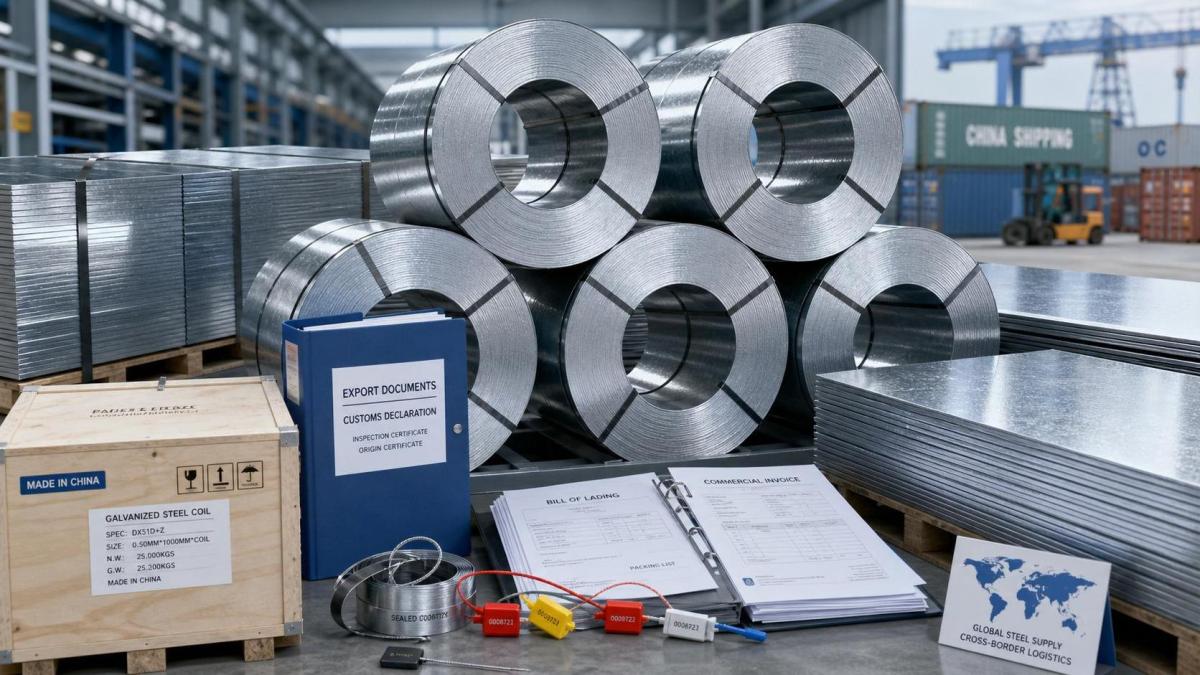
The confirmed information is limited but commercially significant. The U.S. Department of Commerce formally initiated an Administrative Review on July 1, 2026 concerning galvanized steel sheet exported from China. The review covers export batches shipped during the period from April 1, 2025 through March 31, 2026. The product scope cited in the input includes HS 7210.49 and 7212.40, among others.
It is also confirmed that this review has direct implications for the duty rate treatment applied to affected exporters, the preparation cycle for customs clearance documentation, and the compliance cost burden faced by importers. The summary further indicates that North American distributors may need to revisit inventory planning and procurement contract terms.
Where the Immediate Pressure May Appear
Export transactions may face a documentation and rate-management focus
From an industry perspective, Chinese exporters involved in the covered product categories may be most directly affected because the review speaks to duty-rate application. In practical terms, the areas to watch are shipment records, product classification consistency, and the timing and completeness of trade documentation connected to the covered review period.
Import-side compliance may become more operationally demanding
For U.S. importers and related compliance teams, the stated impact is not only about tariff exposure but also about process burden. Analysis shows that customs paperwork preparation, internal review cycles, and cost allocation discussions may receive more attention while the review remains active.
North American distributors may need to adjust stock assumptions
The input specifically highlights North American distributors. Observably, these businesses may feel the impact through inventory planning, especially where purchasing schedules and stock buffers depend on predictable landed costs and clearance timing. Contract clauses connected to pricing, delivery, and responsibility for compliance-related costs may also come under review.
Service providers in the trade chain may see tighter execution requirements
Logistics coordinators, customs service providers, and trade support teams may also be affected indirectly. What deserves closer attention is whether clients begin asking for faster documentation turnaround, clearer shipment records, and more detailed coordination across export, import, and distribution functions.
Operational Points Companies Should Watch Now
Track official wording and procedural updates carefully
Analysis shows that the immediate priority is not to assume a final outcome from the initiation itself. Companies involved with the covered products should closely track subsequent official wording, procedural notices, and any clarification related to product scope or review handling, because these details often matter in day-to-day execution.
Check which shipments fall within the stated review window
The review period is clearly defined as April 1, 2025 to March 31, 2026. Businesses should therefore confirm which export batches, purchase records, and customs files fall inside that window, and separate them from shipments outside the covered period for internal control purposes.
Revisit contract language tied to cost and delivery responsibility
The summary specifically points to procurement contract revisions. For that reason, importers, distributors, and exporters should pay attention to clauses related to duty responsibility, documentation obligations, delivery timing, and potential adjustments in compliance-related costs. This is a practical issue rather than a theoretical one.
Prepare customer and supplier communication in advance
Observably, this kind of review can affect expectations around lead time, paperwork readiness, and transaction certainty. Companies should be ready to explain what has happened, what remains under review, and what parts of the business process may require additional time or verification.
Why This Matters Beyond the Headline
Analysis shows that this development is better understood as an active trade procedure with real operating consequences, rather than as a final market outcome. The initiation itself does not settle every commercial question, but it does signal that affected participants in the galvanized steel trade need to pay closer attention to execution risk, documentation discipline, and contract clarity.
It is more appropriate to understand this as a development that requires continued observation. The most important issue at this stage is not broad market prediction, but how the review may shape duty-rate treatment, customs workflows, and commercial planning for the parties directly exposed to the covered product categories and shipment period.
How to Read the Current Signal
At this point, the review should be read as a concrete short-term compliance and transaction-planning issue, while also serving as a policy signal that merits ongoing monitoring. The confirmed facts already point to pressure on rate application, clearance preparation, importer costs, and distributor planning. However, the broader commercial effect still depends on how the review proceeds and how companies respond in their own operating chains.
A neutral reading is therefore the most useful one: this is neither a minor administrative note nor a concluded business result. It is a trade development with immediate relevance for affected participants and with implications that still need to be watched over time.
Basis of This Article and What Still Needs Verification
This article is based on the user-provided news title, event date, and event summary concerning the U.S. Department of Commerce's initiation of an antidumping administrative review on Chinese galvanized steel sheet exports. The content above distinguishes confirmed facts from analysis and observation.
For this type of industry update, source categories typically associated with verification include official government notices, company disclosures, industry association updates, authoritative media reporting, and relevant trade or standards documentation. A specific official source link was not provided in the input, so continued verification remains necessary. The next points worth tracking are any further official procedural statements, scope-related clarifications, and practical responses in customs, procurement, and distribution arrangements.
Please give us a message
Tianjin Kaichuang Metal Material Co., Ltd
Add: No. 41, District 6, First Street, Huanghuadian Town, Wuqing District, Tianjin
Tel: + 86 137 9101 9833
E-mail: boss@kaichsteel.com